Showing posts with label classical haiku poet. Show all posts

Sunday, May 13, 2018

Carpe Diem Crossroads #9 Ozaki Hosai's "on the field"


Dear Haijin, visitors and travelers,

What a joy to bring you a new episode of our "fusion" feature Crossroads. This week I have chosen two nice haiku created by one of the classic haiku poets. For this episode I have chosen two haiku created by Ozaki Hosai. He was one of the haiku poets that embraced the free-haiku movement, like for example Santako Taneda. Ozaki Hosai wrote his haiku only as one-line verses, as is one of the classic ways of writing haiku. The both haiku I have chosen I have "re-done" into the more Western way of three lines.

Ozaki Hōsai (1885 - 1926) was the haigo (haikai pen name) of Ozaki Hideo, a Japanese poet of the late Meiji and Taishō periods of Japan. An alcoholic, Ozaki witnessed the birth of the modern free verse haiku movement. His verses are permeated with loneliness, most likely a result of the isolation, poverty and poor health of his final years.

Ozaki Hosai
Ozaki Hosai has written nice haiku in my opinion, but I think you, my dear haijin, visitors and travelers, can create a wonderful "fusion" haiku with the following haiku by him:

on the field 
where evening has died out, 
my footsteps

the heart 
that seeks something 
I release to the sea

© Ozaki Hosai (revised by Chèvrefeuille)

footprints at the beach (image found on Shutterstock)
As you all (maybe) know the goal is to create a new haiku (only haiku) from the both given haiku or in other words ... to create a "fusion" haiku. I have given it a try too. 

footprints
left in the sand of time
sound of waves

© Chèvrefeuille

And now it is up to you ...

This episode of Carpe Diem Crossroads is NOW OPEN for your submissions and will remain open until May 20th at noon (CEST). Have fun ... !


Saturday, May 28, 2016

Carpe Diem Tan Renga Challenge Month May 29th: "a single frosty rose" by Mizuhara Shuoshi (1892-1981)


Dear Haijin, visitors and travelers,

Today I have a nice "hokku" of a "classical" haiku poet for you. I had never heard of him, but I ran accidentally to a haiku by him and I liked that haiku very much. Let me introduce to you Mizuhara Shuoshi.

Mizuhara Shuoshi (1892-1981) was a 20th century Japanese poet who was responsible for a trend towards greater emotional expression in haiku.
Shuoshi was the son of a doctor who ran a medical clinic, and as eldest son, he followed in his father’s footsteps and went into medicine. He studied serology, obstetrics, and gynecology at Tokyo University, graduating in 1926. He taught at Showa Medical College, practiced in his father’s clinic, and in 1932 was appointed to the prestigious post of medical advisor to the Ministry of the Imperial Household.
He began writing tanka and haiku as an undergraduate. In the 1920s, he was published in Hototogisu and his poetry was acclaimed. However, he felt restricted by the conservative principles of Takahama Kyoshi and his followers and declared his defection in a 1931 essay, "Truth in Nature and Truth in Literature". Unlike many poets, who rebelled against the rules like the 17 syllable count, Shuoshi instead felt that Kyoshi’s principles of emotional detachment limited his ability to emotionally express himself through poetry. Shuoshi and his followers started a magazine called Staggerbush and dedicated themselves to a more romantic, lyrical type of haiku.
Shuoshi retired from medicine in 1952 and began a series of visits to Buddhist temples. During his life, he published around 20 volumes of haiku.
 
Mizuhara Shuoshi (1892-1981)
Before I give you our "hokku" for todays Tan Renga Challenge I love to share a few other haiku written by Mizuhara Shuoshi:
 
woodpecker—
leaves quickly fall
in the meadow

Japanese rain
on the cherry blossoms
moistens his statue

singing skylark...
against the wind blowing through pines,
has descended
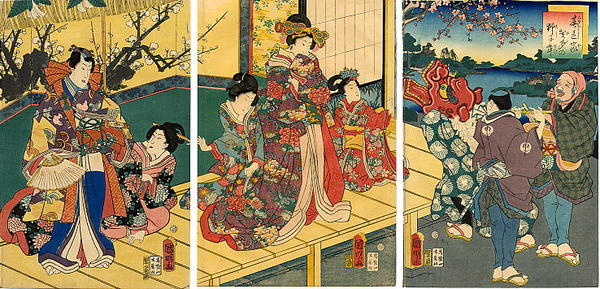
lion-dance dancer
shading his eyes with his hand to look
at Mt. Fuji in the sunset

Color of Spring, lion dance at the mansion (woodblock-print by Utagawa Kuniaki (1844-1868))
Mizuhara Shuoshi wrote a lot of haiku and tanka as you could read above. The haiku I shared here are really beautiful, but the one we are going to use is in my opinion a masterpiece, but that's just my humble opinion.

Here is our "hokku" by Mizuhara Shuoshi:

A new year begins
With the blooming
Of a single frosty rose


© Mizuhara Shuoshi

A nice "hokku" to start our Tan Renga with. Here is my attempt to make this Tan Renga complete:

A new year begins
With the blooming
Of a single frosty rose
                               (Mizuhara Shuoshi)

clouds of breath pointing the way
towards the old Shinto shrine
                      (Chèvrefeuille)
Not as strong as I had hoped. I also don't know for sure if the breath you can see when it is cold is called "clouds of breath".
This episode is open for your submissions tonight at 7.00 PM (CET) and will remain open until June 2nd at noon (CET). I will publish our new "hokku" on our Twitter account.