Monday, March 23, 2015

Carpe Diem #692, mud snail


Dear Haijin, visitors and travelers,

We are counting down o the end of March and today (24/3) we have another nice prompt to become inspired. Today it's mud snail to be our source of inspiration. I have sought for haiku with snail or mudsnail in it, and I found a lot of them, here are a few examples:

en hana ya jyôzu ni magaru katatsumuri

verandah flower--
making a skillful turn
a snail


© Kobayashi Issa
Or these haiku by Buson and Basho:

hiroinokosu tanishi ni tsuki no yûbe kana

 
mud-snails:
a few remain uncaught
under the evening moon
© Yosa Buson
sode yogosuran tanishi no ama no hima o nami
with dirty sleeves
farmers-turned-fishermen pick up mud snails
ever so busy
© Matsuo Basho (at the age of 39)
mud-snails
slowly, but slowly
the mud-snail finds its way
after the heavy rains
© Chèvrefeuille
I remember that we have had a CDHK "Little Creatures"-episode with mud-snails in the lead. And I wasn't aware of that when I created the prompt-list for March. So sorry if you read/see something familiar in this post.
This episode is open for your submissions tonight at 7.00 PM (CET) and will remain open until March 27th at noon (CET). I will (try to) publish our new episode, the last Haiku Writing Technique (for the time being), later on.

Carpe Diem Extra #12 - 2015, Our first Kukai "Wisteria"


Dear Haijin, visitors and travelers,

As you have read in one of the earlier posts ... I love to start our first Carpe Diem Haiku Kai Kukai, a haiku contest in which we are all the judges and by giving points we will decide with each other who is the winner. Let me tell you something more about Kukai ...

What is a Kukai?

A kukai is a peer reviewed poetry contest. A topic is assigned by your host(s), and all poets submit their poems on that topic to the following email address: carpediemhaikukai@gmail.com

An anonymous list is then distributed to all participating poets and they are invited to vote. Votes are returned to the host(s) who tally the votes and resend the poems to the participants, this time with names and points revealed.
How does OUR CDHK Kukai work?

I will give you a theme (or prompt/topic) to write/compose haiku about. Most times that will be a modern or classical kigo (unless otherwise stated). You don’t need to follow the classical haiku rules, but feel free to do so.
You can send your submissions for this first CDHK Kukai to the above email-address. Please write CDHK Kukai March 2015 in the subject box.
You may send a maximum of three, never published earlier, haiku including your name (or penname). !! Only haiku !!
Please send your submission for our first kukai before April 15th at noon (CET). I will make an anonymous list of the submitted haiku and will email it to you.
Then it’s your turn to be judge. You may give 3, 2 and 1 point (3 for the best in your opinion) to three of the haiku. Of course you may not give your own haiku points.
When you are ready with judging the haiku than please email the anonymous list back to our above email-address. (Please write scored or judged haiku in the subject box).

I will gather the points and after that I will publish the list (with names) here at our Haiku Kai.

I hope to see a lot of haiku for this first kukai and I hope it will bring us joy.

This first Carpe Diem Haiku Kai Kukai (March 2015) is NOW OPEN for your submissions and our theme for this first CDHK Kukai is
WISTERIA


Sunday, March 22, 2015

Carpe Diem Time Glass #26, First Blossoms


Dear Haijin, visitors and travelers,

I hope you all did like the posts by Jen and that they inspired you to create all new haiku. Jen thanks for stepping in and granting me some free off. It's Sunday again and than it's time challenging day. I have a new episode of our Time Glass feature for you all and I hope you will like it.

Today, March 22nd, spring has started here with a great sunny day and that gives hope for an all wonderful spring. Trees start to blossom, but my Sakura hasn't started to bloom yet ... it will take a few days of sunny weather I think, but the buds are almost bursting into joy and colors ... I think you already know what the prompt is for this Time Glass episode!

Yes ... you're right cherry blossoms ....

I have a gorgeous photo for you which I took several years ago from my Sakura ...


And the prompt for today is FIRST BLOSSOM ... you have just 24 hours to respond with a haiku, a tanka, a haibun or haiga. So have fun ...

This episode will be open for your submissions tonight at 7.00 PM (CET) and will remain open until March 23rd at 7.00 PM (CET). So you have just 24 hours to respond.

Carpe Diem #691, Witch Hazel


Dear Haijin, visitors and travelers,

What a great weekend I have had ... no worries about CDHK and that felt great. Thank you Jen for stepping in and keep CDHK on road this weekend. You have shared wonderful posts here and I am grateful for that. So thank you Jen ...

Thank You
We are on our way to a new month of Carpe Diem Haiku Kai ... we have just 8 days to go and than it will be April. I am really looking forward to our next month of Carpe Diem Haiku Kai and especially because of our featured haiku poetess that month Kala Ramesh (you can already read a few of her haiku in our last Sparkling Stars episode) and of course our adventure through the Bhagavad Gita that wonderful story about Arjuna speaking with Krishna before going into battle.
Another thing which I need to say here is the following: I will start this week with our first Carpe Diem Kukai, a kind of haiku-contest in which we all will be the judges and give each other's haiku points. Soon I will publish an episode of Carpe Diem Extra in which I will explain the Kukai.

Credits: Witch Hazel
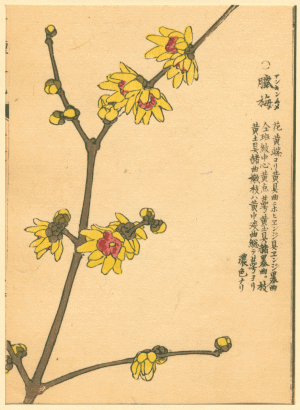
Ok back to our prompt for today. Today our prompt is Witch Hazel ... a unique bush with a lot of uses hidden in it e.g. health issues. I will try to tell you all first a little bit more about Witch Hazel
The Virginian witch hazel or the magic hazel contributes the botanical name Hamamelis virginian. It is either a shrub or a small tree that sufficiently thrives in damp forest areas. The tree is very delicate and flowers that unfold in November and December. The branches of the magic Hazel for a long time are used as a means of divination; bark and leaves are strongly astringent and have a soothing and toning effect.
In general spiritual idea/thought is that witch hazel stands for: a
part of yourself, who possesses ancient knowledge of healing; an aspect of your personality that can take either real or in a figurative sense of water.

I found a nice haiku written by Hata 3 about the witch hazel, Hata 3 is a Japanese haiku poet.

~ mansaku ya huruki koromo o nugi suteyo


Japanese witch hazel -
throw off cloak of
an old time

© Hata3
Credits: Woodblock "Witch Hazel" by Kono Bairei 1880
And I found a wonderful poem, Reluctance by Robert Frost (1874–1963) in which the Witch Hazel is part of the scene so to say.
Out through the fields and the woods
And over the walls I have wended;
I have climbed the hills of view
And looked at the world, and descended;
I have come by the highway home,
And lo, it is ended.
The leaves are all dead on the ground,
Save those that the oak is keeping
To ravel them one by one
And let them go scraping and creeping
Out over the crusted snow,
When others are sleeping.
And the dead leaves lie huddled and still,
No longer blown hither and thither;
The last lone aster is gone;
The flowers of the witch hazel wither;
The heart is still aching to seek,
But the feet question ‘Whither?’
Ah, when to the heart of man
Was it ever less than a treason
To go with the drift of things,
To yield with a grace to reason,
And bow and accept the end
Of a love or a season?
Credits: Witch Hazel
I love this bush ... it's just made for being praised in haiku I think ... but how to catch that idea, that feeling in a haiku? I have tried the "Baransu" technique, but I had some difficulties to find the first line ...

magic is in the air
the sun climbs to his throne
witch hazel buds burst


© Chèvrefeuille

Than I thought of our Haiga Festival and sought for a photo of the Witch Hazel in my personal archive, but couldn't find one ... so I sought the Internet and found a wonderful photo which perfectly fits the haiku.

Credits: Witch Hazel photo (not the haiku)
Well ... I liked creating this episode and I hope it will inspire you all to write/compose an all new haiku and share it with us all here at our Haiku Kai.

This episode is open for your submissions tonight at 7.00 PM (CET) and will remain open until March 26th at noon (CET). I will (try to) publish our next episode, mud snail, later on. For now ... have fun, be inspired and share your haiku with us all.

Saturday, March 21, 2015

Carpe Diem Special #138: Santoka Taneda’s “Soaking Wet”


Hello once again, Haijin.  This is Paloma from Blog It or Lose It, helping Chèvrefeuille for the weekend.  It’s been an honor – and quite an experience!  Thank you, once again, Chèvrefeuille for making Carpe Diem such a joy!


Source


For today we return to the haiku of Santoka Taneda.  As Chèvrefeuille shared in this month’sprompt list page, the poet spent much of his life wandering as a mendicant priest.  And while he made many observations on the natural world – the loneliness and isolation of his wandering is a constant theme in his work.  Consider this haiku, for example:

shigurete sono ji ga yomenai michishirube

soaking wet
I can’t read the letters
on the signpost


I love that this haiku is ambiguous – “soaking wet” refers to what?  the poet? the signpost? both?  Do you hear the hissing of the rain in how he’s repeating sh / s / ch sounds?   And – what wonderful layers of meaning in the haiku!

Here is another example from Santoka Taneda’s Grass and Tree Cairn:

In April 1926, burdened with unsolvable illusions, I set out on a journey of alms-begging and drifting.

     Wakeitte mo wakeitte mo aoi yama
     I go in      I go in      still the blue mountains

     Shitodo ni nurete kore wa michishirube no ishi
     Soaking wet      this a road-marker stone

     Enten o itadaite koi aruku
     Burning heaven on my head      I beg      I walk

                 © SantokaTaneda

Did you notice that his line length is very irregular – and that he loves repetition?  


Source


Here is another example:

kyō mo nurete shiranai michi o yuku
Today again     soaking wet     I walk on an unknown road.    
(Tr. by John Stevens)

And – here is an unusual haiku from the journey – which I will leave without comment:

nombiri shito suru kusa no me darake
Nonchalantly urinating    By the road     Soaking the young weeds
(Tr. by John Stevens)

Here is my haiga – attempting to stay in the spirit of Santoka Taneda:


     If you are interested in reading more of Santoka Taneda’s work, visit these sites:

     Santoka: Grass and Tree Cairn (Haiku Foundation)
     Fire on the Mountain (Internet Archive: Wayback Machine)
     The Poetry of Santoka Taneda (Greenleaf)
     Taneda (Terebess Asia Online)

**


This prompt will be open for entries from March 21st at 7 PM through March 25th at noon (CET). 


Friday, March 20, 2015

Carpe Diem Time Machine #6: Skylark


Greetings once again, Haijin!  This is Paloma from Blog It or Lose it, helping Chèvrefeuille during his weekend break. 

Today’s prompt is “skylark” – and at first I had no idea what to do for this prompt.  The skylark has figured prominently at Carpe Diem Haiku Kai – featured many, many times.   Then I read the following haiku from Chèvrefeuille:

mezzo-soprano sings
a love song by Chopin -
cry of a Skylark   

in touch with the gods
pine trees reaching for heaven -
skylarks sing their song


These haiku reminded me that the skylark is a staple of Western poetic tradition as well as Eastern tradition.  Percy Bysshe Shelly wrote "To a Skylark"; Gerard Manley Hopkins wrote to "The Caged Skylark", and – William Wordsworth wrote his own version of  "To a Skylark". 

So – I hope Chèvrefeuille will be okay with this – why don’t we look at the Wordsworth version for inspiration today?


Ethereal minstrel! pilgrim of the sky!
Dost thou despise the earth where cares abound?
Or, while the wings aspire, are heart and eye
Both with thy nest upon the dewy ground?
Thy nest which thou canst drop into at will,
Those quivering wings composed, that music still!

Leave to the nightingale her shady wood;
A privacy of glorious light is thine;
Whence thou dost pour upon the world a flood
Of harmony, with instinct more divine;
Type of the wise who soar, but never roam;
True to the kindred points of Heaven and Home!

And for more inspiration – here is a recording of a skylark’s song!


What images in the Wordsworth poem strike your fancy?  You’ll find joy, sensuality, freedom, and centeredness.  

Or – would you like to try a senryu or a kyoka – and be an “anti-Wordsworth”?

I have no skylark photos, sadly, so please forgive my use of a Wikimedia image.  Here's my attempt:


This challenge is open to your entries from March 20th at 7 PM through March 24th at noon (CET).


Thursday, March 19, 2015

Carpe Diem #690: Higan (Equinox)


Hello everyone!   This is Paloma from Blog It or Lose It, and I am helping Chèvrefeuille for the weekend while he enjoys some time with his family and friends.  It’s an honor to be able to help out – and once again – I’m sending a big **thank you** to Chèvrefeuille.  He is enormously busy with Carpe Diem Haiku Kai, Tanka Shrine, Family, and Shuukan – and recently – with the Fairy Tale prompt!  Thank you for sharing your love of haiku with so many people!


Source


For today we’re looking at the Higan festival.  This is a theme Carpe Diem first visited in March of 2013.  Those of you who live in the Southern Hemisphere will be happy to learn that Higan is celebrated for one week in March (Haru Higan) and for one week in September (Aki Higan) – it is a celebration of the Equinox – in which there are equal periods of day and night.   

The term “Ohigan” means “the other shore” or “the shore of Sanzu River”.  In Buddhist literature, this refers to leaving the shore of ignorance and suffering and crossing to the shore of Enlightenment.

Haran no Higan lasts for seven days in March, but “Shunbun no hi” is celebrated on the actual day of the equinox.  On this day, people visit their hometown and tend the graves of their ancestors:

“To help their ancestors make the crossing, family members visit the cemetery to pray, weed graves, wash tombstones, light incense and leave flowers.  According to tradition, food, in the form of ohagi or botamochi (sweet rice balls covered with red bean paste), is left to help nourish their ancestors journey to the next world.” 
Source
Farmers may use this day to pray for an abundant crop, and there is a folk saying related to higan:

Atsusa samusa mo Higan ma de
[“Heat and cold last until Higan”]

But – as you know – Mother Nature doesn’t care much for folk sayings – as Issa points out in this haiku:

"fair weather by Spring's Equinox"
so they say …
liars!

© Issa

Here are some haiku about Higan to inspire you:

walking on and on
among the endless
blooming higan flowers  


a lone crow
pensive on its perch
spring equinox


Here is an Aki Higan haiku for the folks in the Southern Hemisphere:

autumn equinox -
the dead old relatives
visit my dream

© 2006 – Gabi Greve

And of course here is a spring haiku that is part of a series by Chèvrefeuille:

                celebrating the sun
                with narcissus flowers in my hair -
                Spring Equinox

                © Chèvrefeuille

What can I write about higan and the equinox?


There's also this slightly more cheerful haiku - but I didn't have a photo to turn this into haiga:

toddler’s joy:
Daddy’s home before dark
on the equinox 


Probably not my best, but hopefully they will trigger some thoughts about Higan.  :)

This episode is open for your submissions from March 19th, 7 PM (CET) and will remain open until March 23rd, at noon (CET).