Thursday, February 2, 2017

Carpe Diem #1142 Honshu, the "main island"


Dear Haijin, visitors and travelers,

Well our journey has started and today we will go on with our journey through the land of the rising sun. We have arrived on the airport of Tokyo on the so called "main Island" Honshu. It's the biggest Island of Japan and on this part the most Japanese people live. It is here were we will encounter the ancient and the modern times of Japan.
Tokyo is the technology capital of the world, here the magic happens according to all technology we know nowadays. Tokyo is one big advertorial ... look at the following image:

Tokyo scene
lights screaming
buy me buy me buy me -
a Nightingale sings

© Chèvrefeuille

Tokyo is really a town of the world. If we look back in time than we see a very different country. Japan was a very closed country several centuries ago. It was inhabited far back in time. First signs of life in Japan are known from the Paleolithic or Old Stone Age (50.000-10.000 years ago).
The first written mention of Japan is in Chinese history texts from the 1st century AD. Influence from other regions, mainly China, followed by periods of isolation, particularly from Western Europe, has characterized Japan's history. From the 12th century until 1868, Japan was ruled by successive feudal military shoguns who ruled in the name of the Emperor.

In Basho's time, the 17th century there were in a way warm relations between my country (The Netherlands) and Japan, so we have already a relationship with Japan over more than 350 years. Maybe that's why in my country there are so many lovers of Japanese culture, not only haiku or tanka, but also sume-i, ikebana and origami.

Maybe you can remember these haiku by Basho:

even the captain
bows down before
the lord of spring


© Basho (Tr. Jane Reichhold)
the captain and
the flowers have come
on a saddled horse


© Basho (Tr. Jane Reichhold)
(The post on CDHK were these haiku were used you can find here.)
 Japan a modern country with a rich history, a history they cherish, because Japan is not only the present, but also the past and the future.

For this (belated) episode I love to challenge you to create haiku or tanka in which you bring ancient and modern together as for example Shiki did:

first steam train
smoke whirls
after the passage of a train -
young foliage

© Masaoka Shiki

From my archives:

under the full moon
the screech of a steam engine -
cherry blossoms shiver

© Chèvrefeuille

This episode is NOW OPEN for your submissions and will remain open until February 7th at noon (CET). I will (try to) publish our new episode later on.


Tuesday, January 31, 2017

Carpe Diem #1141 Japan, the journey begins


Dear Haijin, visitors and travelers,

First I have to apologize, because I haven't the prompt-list ready for February 2017, but I hope to bring the "list" later this week. As you all know we are starting with the discovery of the land of the rising sun, Japan, mother of haiku.

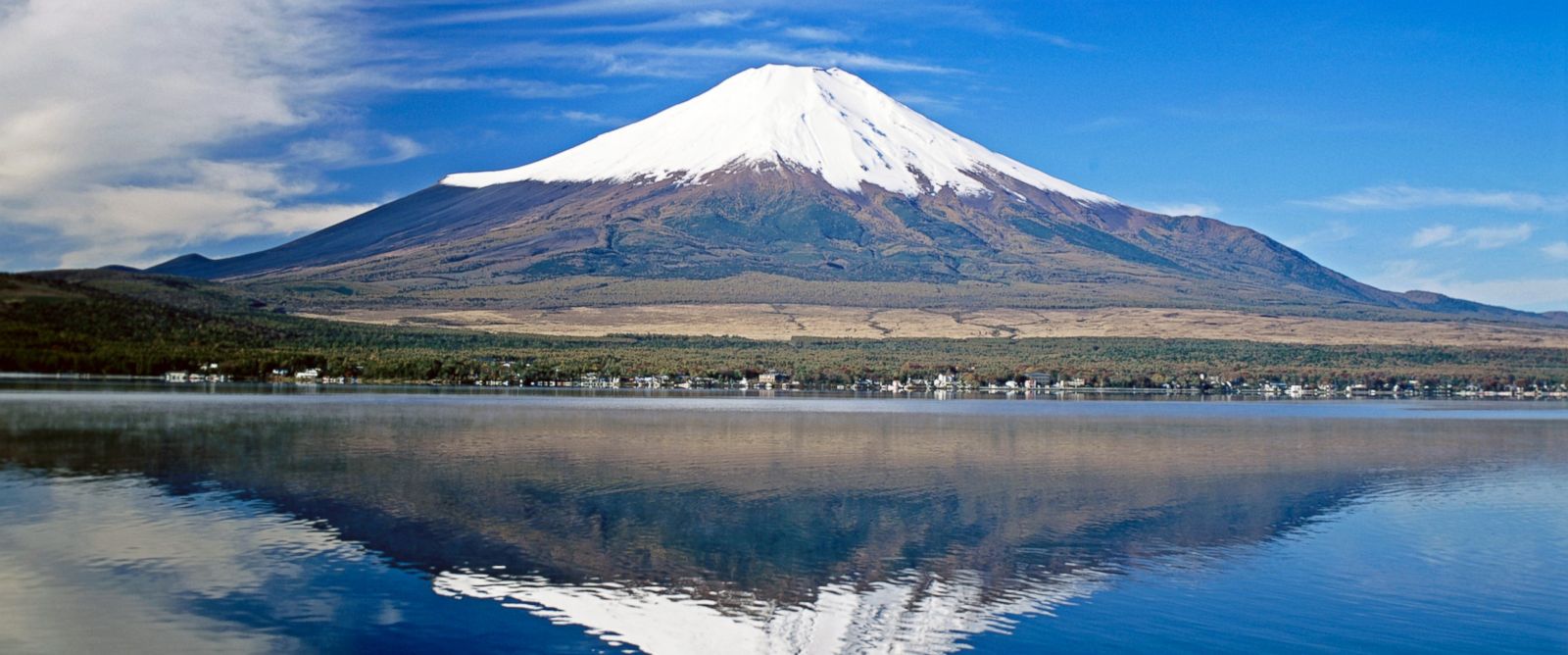
Haiku ... the tiniest poem around the world, a poem we all love dearly and maybe are addicted to. Japan ... the "motherland" of haiku is our adventure place this month. On the above logo you see the holy mountain of Japan in Spring, Fuji no Yama with its snow decked top behind that other wonderful piece of Japan ... the Sakura, the cherry blossom.

I hope to be your guide on a beautiful trip through this country ... a country I hope to visit for real once in my life, but until than I will visit this country together with you, my dear haijin, in the virtual world.

Mount Fuji no Yama
Let us take a look at a haiku created by Basho (1644-1694) in which he describes Mount Fuji:

Fuji no yama nomi ga chausu no ooi kana cha-usu

Mount Fuji
like the tea-grinding mill 
carried by the lice . . . 

© Basho (age 33)

To compare Mount Fuji to a cha-usu, a mill for grinding tea leaves, has been done since olden times.

This is complete fiction to show the greatness of Mount Fuji.

There was a popular song in Edo to which Basho is referring

蚤が茶臼を背たら負うて、背たら負うて、
富士のお山をちょいと越えた

The lice are carrying a tea-grinding mill
carrying it on their back
just trying to climb over Mount Fuji. 

It was also a popular game to cover a tea-grinding mill with strong washi paper to make it look like Mount Fuji.

Matsuo Basho (1644-1694)

An other nicely written haiku by Basho ... in praise of Fuji no Yama:

hito one wa shigururu kumo ka Fuji no yuki

over one ridge
do I see winter rain clouds?
snow for Mt. Fuji 

© Basho (age 44)

The above haiku is a beautiful 'winter landscape painting' on a large scale, in which you are viewing Mt. Fuji in relation to its surrounding mountain families. In the centre, you see Mt. Fuji covered with snow in all its glories. And you also see other mountain-families were probably snow does not reach, as they are not high enough. Your eyes travel from right to left and from left to right, surveying many different things happening. Over one ridge (o-ne) are winter clouds unloading their cargo. However, of all the mountains how tall, superb and magnificent the snow-covered Mt. Fuji is! 
This haiku is famous for depicting the superiority of Mt. Fuji in relation to other mountain families.

A last one also about the Holy Mountain of Japan:

a day of quiet gladness,
Mount Fuji is veiled
In misty rain.

© Basho

I wonder will we see Japan through the eyes of Basho this month, because of the fact that I see him as my haiku master? I think that will be happening, but I hope to be aware of it, because Japan is not only Basho and his haiku. Japan is far more ...

Ancient mountain and the modern time ... there is no time ...

To end this episode I love to share a haiku by our unknown haiku poet, Yozakura. I hope to go on with his story this month, so her it is a haiku, a beauty, by Yozakura:

fujisan no yuki no hi no owari ni ha sakura

through cherry blossoms
at the end of the day -
snow on Mount Fuji

© Yozakura

I hope I have inspired you and I hope this first episode of our new CDHK month will give you the feeling, the idea ... that this month will be awesome.

This episode is NOW OPEN for your submissions and will remain open until February 5th at noon (CET). I will post our next episode, history of Japan, later on.

PS. I haven't time to create a new episode of Universal Jane ... I hope you will forgive me.
PPS. I am hopelessly behind with commenting I hope to catch up a.s.a.p.

Monday, January 30, 2017

Carpe Diem #1140 arriving at the right moment


Dear Haijin, visitors and travelers,

Well ... here it is finally we have reached Santiago De Compostela. We have succeeded the Road, an equivalent of the Road Jesus had to take on His final days, but here it is not going to stop. Here at Santiago De Compostela it starts ... the final piece of life as we know it ... here at Santiago de Compostela we have seen the Lamb and we have seen our future ... Here at the end of the Road we finally can see the connection with the divine Tarot, which I mentioned in one of my earlier posts this month ... We have conquered life and we may enter into the Love our Creator, Higher Spirit or what ever name you choose for that Power.

Finally Paulo recovers his sword what was taken from him at the start of his Road to Santiago ... he finally gets it back from his Master.

I love to share a short piece of text from "The Pilgrimage" to celebrate that we have, together with Paulo, done it.

[...] "As the lamb looked at me, I could read all of this in his eyes; now he had become my guide along the Road to Santiago. For a moment everything went dark, and I began to see scenes that were reminiscent of those I had read about in the Apocalypse: the Great Lamb on his throne and people washing his vestments, cleansing them with his blood. This was the moment when the God was awakened in each of them. I also saw the wars and hard times and catastrophes that were going to shake the earth over the next few years. But everything ended with the victory of the Lamb and with every human being on earth awakening the sleeping God and all of God’s power.
I was worthy of my sword because I knew what to do with it." [...] (Source: The Pilgrimage by Paulo Coelho)

The Lamb (part of a painting by Grunewald)
[...] "The Master held out the sword to me, and I grasped it. I looked about for the lamb, but he had disappeared. But that did not matter: the Water of Life fell from the sky and caused the blade of my sword to glisten.' [...] (Source: The Pilgrimage by Paulo Coelho)

the sound of rain
on young leaves of Ivy
I bow my head

© Chèvrefeuille

[...] "I have so much to do now that I have recovered my sword. The secret of my sword is mine, and I will never reveal it to anyone. I wrote it down and left it under a stone, but with the rain, the paper has probably been destroyed. It’s better that way. Petrus didn't need to know.
I asked my Master whether he had known what day I was going to arrive or whether he had been waiting there for some time. He laughed and said that he had arrived there the morning before and was going to leave the next day, whether I appeared or not.
I asked how that was possible, and he did not answer me. But when we were saying good-bye and he was getting into the rental car that would take him back to Madrid, he gave me a small medal of the Order of San Tiago of the Sword. And he told me that I had already had a great revelation when I had looked into the eyes of the lamb.
And when I think about it, I guess it is true that people always arrive at the right moment at the place where someone awaits them." [...] (Source: The Pilgrimage by Paulo Coelho)

How often we can say "I was on the right place at the right time"? I think we all will have such experiences. You walk somewhere and you see the most wonderful garden in full bloom. You were there at the right moment. You listen to the radio and than there it is that song that brought you and your loved one together. You were there at the right moment.

Isn't it wonderful? We can say this also for our haiku or tanka. We were on time at the right place to celebrate that beautiful moment, that spiritual moment as short as the sound of a pebble thrown into water. This is what the Road has taught us ...

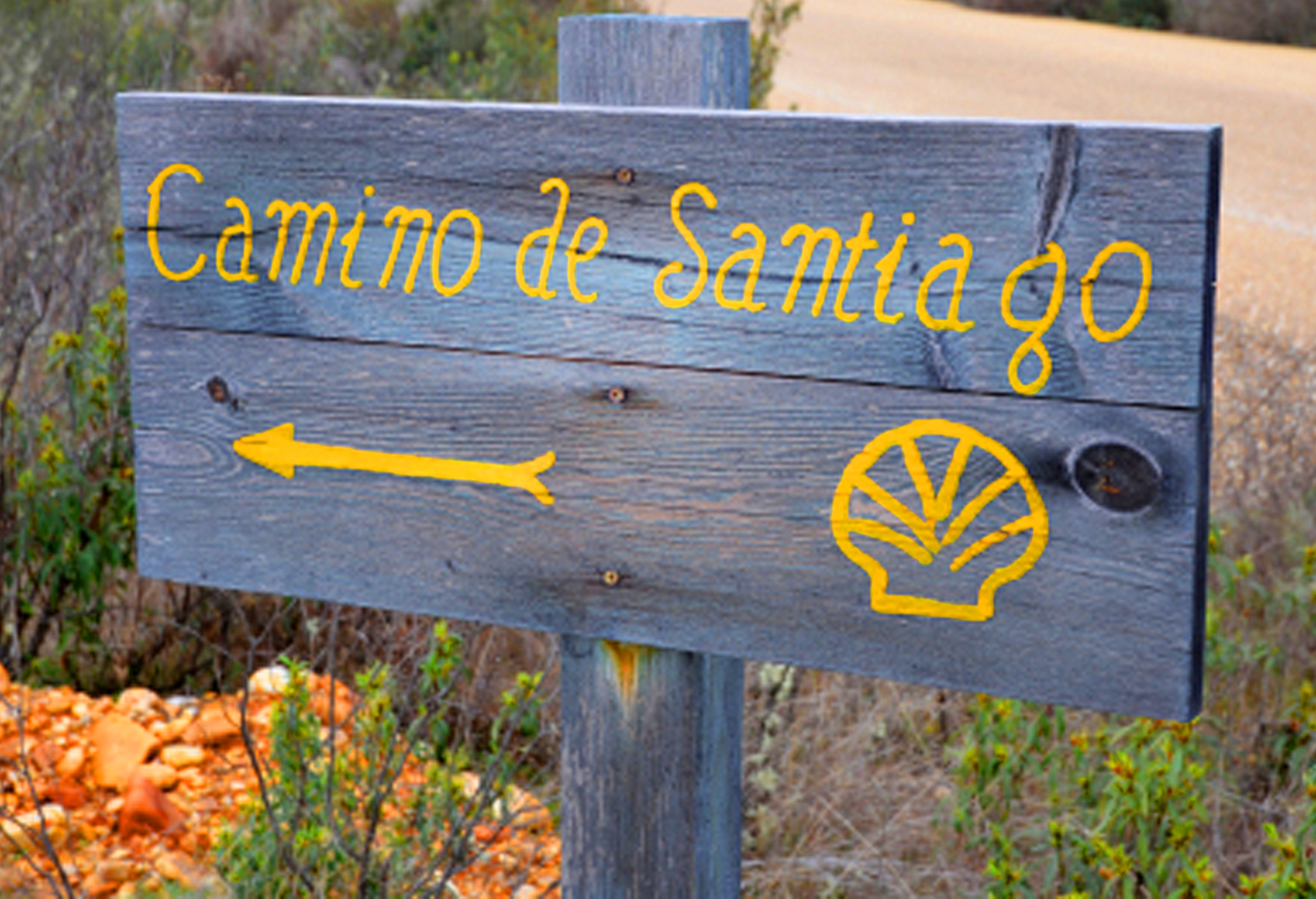
Camino sign
** I couldn't retrieve the owner of this photo, so please let me know, if it's okay to use your photo. I have credited this photo to the website were I found it. **

This episode is NOW OPEN for your submissions and will remain open until February 4th at noon (CET). I hope to publish our first episode, the first stage of our new journey through the land of the Rising Sun, later on.


Sunday, January 29, 2017

Carpe Diem #1139 listening

Dear Haijin, visitors and travelers,

Yesterday I promised you to publish the first prompts of February, but I have to say I am sorry I hadn't time to start creating the new prompt-list, but I have created our new logo for February already. I will share that new logo at the end of this episode.

We are on our way to Santiago De Compostela and we reached the end of this pilgrimage almost, but before we enter Santiago De Compostela there was another thing Paulo had to learn. About that is this new episode. First I thought to title this episode "silence", which also had fit the entire episode, but finally, just seconds ago, I decided to title this episode "listening".

Listening is a gift not everyone can listen, not everyone can be that listener that can and will help you to solve your problems or give answers on your questions. It is something like ... "sorry I didn't understand your problem". To help an other being in need you have to understand what the other asks you or from you, without understanding you cannot respond in the correct way. Let me try to re-form that response that used above. "I see what you mean, what can I do for you?" Isn't that incredible? Just rephrasing the response shows that you have listened, really listened, to what the other said.

Radiotelescope Dwingeloo (The Netherlands) (Dutch website)
The above picture shows you the Radiotelescope of Dwingeloo, a small village in my country. A radiotelescope is ... a big ear ... that listens to the sounds from the Cosmos, the stars, it's always on it always listens to the sounds of the stars and the cosmos ... that's what listening is. You have to be prepared to listen always to the sounds, the feelings, the emotions, the words and more from those around you. If you are a good listener than you are a blessed being, because it's not meant for every one to be a good listener.

I love to share a quote from "The Pilgrimage" about listening:

[...] ‘We are not smart enough to be able to listen to the silence! We are just human beings, and we don’t even know how to listen to our own ramblings. You have never asked me how I knew that Legion was about to arrive. Now I will tell you how: by listening. The sound began many days before, when we were still in Astorga. Starting then, I began to move along more quickly, because all the indications were that we were going to meet up with him in Foncebadon. You heard the same sound as I, but you were not listening.
‘Everything is contained in sounds – the past, the present, and the future. The person who does not know how to listen will never hear the advice that life offers us all the time. And only the person who listens to the sounds of the moment is able to make the right decisions.’ [...] (Source: The Pilgrimage by Paulo Coelho)

Listen to the sound of the wind it will reveal you the sacred wisdom of the Road to Santiago
Petrus, Paulo's guide, asks him to sat down and than told him about the "Listening Exercise":

[...] 'Relax. Close your eyes. Try for several minutes to concentrate on all of the sounds you hear in your surroundings, as if you were hearing an orchestra playing its instruments. Little by little, try to separate each sound from the others. Concentrate on each one, as if it were the only instrument playing. Try to eliminate the other sounds from your awareness.
When you do this exercise every day, you will begin to hear voices. First, you will think that they
are imaginary. Later, you will discover that they are voices of people from your past, present, and future, all of them participating with you in the remembrance of time.
This exercise should be performed only when you already know the voice of your messenger.
Do this exercise for ten minutes at a time. " [...] (Source: The Pilgrimage by Paulo Coelho)

You just have to try it to experience it, and I think it's not really necessary to know the voice of your messenger, your guardian angel. It's like listening to the wind, close your eyes, experience the spring breeze, you can feel it on your face, you can feel it playing with your hair ... the spring breeze (by the way all kind of wind) whispers his/her message in your ear. You can listen what the wind does tell you, it is the word of the Creator, Higher Self or what ever name you will give it.

Listening ... well I don't know if I am a good listener, but for sure I will try to be a good listener worth to have given that gift ... the gift of listening.

alone
only the spring breeze
listen

© Chèvrefeuille

Another one:


along the Road only the sound of nature to enjoy listen just listen
© Chèvrefeuille

Our new logo for February 2017
And a last one from my archives which I published in response on our Winter Retreat last winter:

rustling leaves telling stories from all over the world the silence deepens © Chèvrefeuille

Well ... I hope I have inspired you again with this post. This post is NOW OPEN for your submissions and will remain open until February 3rd at noon (CET). Have fun!


Saturday, January 28, 2017

Carpe Diem #1138 hospitality

Dear Haijin, visitors and travelers,

We have only three days left this month so I hope we will succeed to enter Santiago De Compostela, but we will see. After these three days we will start with a new month full of beautiful prompts ... and as I told you in one of my earlier posts ... that will be another wonderful pilgrimage like month. Why? Well let me tell you ...

We are all haiku poets, and tanka poets and poets of all those beautiful Japanese poetry forms we know, but what do we know about that land in which the roots are to find of our poetry? Next month we will go on a kind of pilgrimage through the land of the Rising Sun, the land of haiku ... Japan. It is one of my dreams to visit Japan for real, but ... well I think it will stay a dream for a long time.
I hope to have the journey ready next Sunday, maybe it will not be complete, but fo sure I will publish our first seven (7) prompts next Sunday if of course nothing comes in my way ...

Paulo Coelho the author of The Pilgrimage
As you know we are walking the Road to Santiago together with Paulo Coelho the world famous author from Brasil. His "The Pilgrimage" is our guide along the Road. In 2006 Paulo invited the Norwegian TV to join him on the Road to Santiago.

To make this pilgrimage more real I have searched all over the Internet and found a wonderful movie about The Road to Santiago De Compostela, its for sure worth to watch, but I couldn't copy it to here, so I will give you the URL to watch this movie titled The Way (find the movie HERE)

Along The Road to Santiago you can always find shelter at old barns, small villages, hotels, homes and more that is one of the "laws" of the Road to Santiago, while you are on your Road to Santiago as a pilgrim, wearing the St. James Scallop, you always will find a place to stay, to rest, to eat and drink, but also to sleep. This is also the deeper meaning of walking the Road ... be grateful for everything you got. The people living along the Road will give you shelter because they know that giving you a place to rest will give them a good feeling and it gives them the love, the unconditional love of our Creator.

This episode is about "hospitality". What is it? What does it mean to be friendly and loving to another being? We see this already in the shortness of our poems ... haiku shows us in just a few lines how to be friendly for your surroundings, for nature and the people around you. Nature gives us its hospitality to be in the beauty of nature. We may walk through nature, we can make use of all that nature gives us ... but in return for her hospitality we have to respect her and that's what haiku means. That's what the Road means and that's what the Road teaches us.

Beautiful Nature Along The Road To Santiago
Look at the beauty of nature along the Road. She cherishes us, she gives us comfort, she gives us love, she gives us hospitality ... so let us respect her ... she is all we need.

silence
a babbling brook
cherishes me


© Chèvrefeuille

This episode is NOW OPEN for your submissions and will remain open until Fevruary 2nd at noon (CET).


Friday, January 27, 2017

Carpe Diem #1137 The Bridge

Dear Haijin, visitors and travelers,

Thank you all for your support according to my exam of today. By the way I passed the exam, so I may now prescribe medicines for my oncology patients. It was a though exam, and at first I was very nervous, but finally I became more calm and could do the exam with a good result.

January is almost over and we are entering the last stages of our Road to Santiago. It was (and still is) an adventure to make this pilgrimage in the virtual world together with Paulo and his guide Petrus. We have learned a lot I think and maybe there will be a time to walk this Road for real ...

This episode I have titled "The Bridge" and it refers to the following passage in "The Pilgrimage":

[...] One morning we arrived  at an immense bridge, totally out of proportion to the modest stream that coursed below it. It was early on a Sunday morning, and, since the bars and taverns nearby were all closed, we sat down there to eat our breakfast.
‘People and nature are equally capricious,’ I said, trying to start a conversation. ‘We build beautiful bridges, and then Mother Nature changes the course of the rivers they cross.’
‘It’s the drought,’ he said.

‘What do you know about this bridge?’ he asked me.
‘Nothing,’ I answered. ‘But even with the drought, it’s too big. I think the river must have changed its course.’
‘As far as that goes, I have no idea,’ he said. ‘But it is known along the Road to Santiago as the “honorable passage.” These fields around us were the site of some bloody battles between the Suevians and the Visigoths, and later between Alphonse III’s soldiers and the Moors.

Maybe the bridge is oversize to allow all that blood to run past without flooding the city.’
‘However, it wasn’t the Visigoth hordes or the triumphant cries of Alphonse III that gave this
bridge its name. It was another story of love and death.'

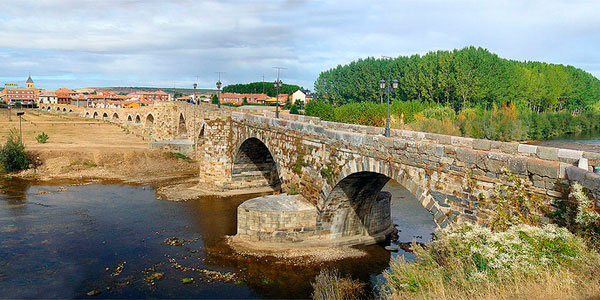
"The Honorable Passage", or Orbigo Bridge

‘During the first centuries of the Road to Santiago, pilgrims, priests, nobles, and even kings came from all over Europe to pay homage to the saint. Because of this, there was also an influx of assailants and robbers. History has recorded innumerable cases of robbery of entire caravans of pilgrims and of horrible crimes committed against lone travelers.’
‘Because of the crimes, some of the nobility decided to provide protection for the pilgrims, and each of the nobles involved took responsibility for protecting one segment of the Road. But just as rivers change their course, people’s ideals are subject to alteration. In addition to frightening the malefactors, the knights began to compete with each other to determine who was the strongest and most courageous on the Road. It wasn’t long before they began to do battle with each other, and the bandits returned to the Road with impunity.' [...] (Source: The Pilgrimage by Paulo Coelho)

Bridges ... bring people from different sides together, in a way our Haiku Kai can be compared with a bridge. Here we come together, haiku poets from all over the globe ... we have build virtual bridges from a lot of countries to here ... and I am proud of it.

from all directions
bridges lead people together
to be together
creating and celebrating poetry
from the land of the Rising Sun

© Chèvrefeuille

Let us protect all those bridges that brought us together ... a warmhearted family of haiku poets. Thank you all for crossing that bridge in harmony with each other out of unconditional love.

This episode is NOW OPEN for your submissions and will remain open until February 1st at noon (CET).


Thursday, January 26, 2017

Carpe Diem #1136 Imagine this ...


Dear Haijin, visitors and travelers,

As I told you all yesterday I am busy with preparing an exam I have to do tomorrow (January 27th) and it takes more time than I had thought so today I love to trigger your inspiration, your muses with another beautiful image along the Road to Santiago. So I have taken the easy way (again) to save time for my exam.

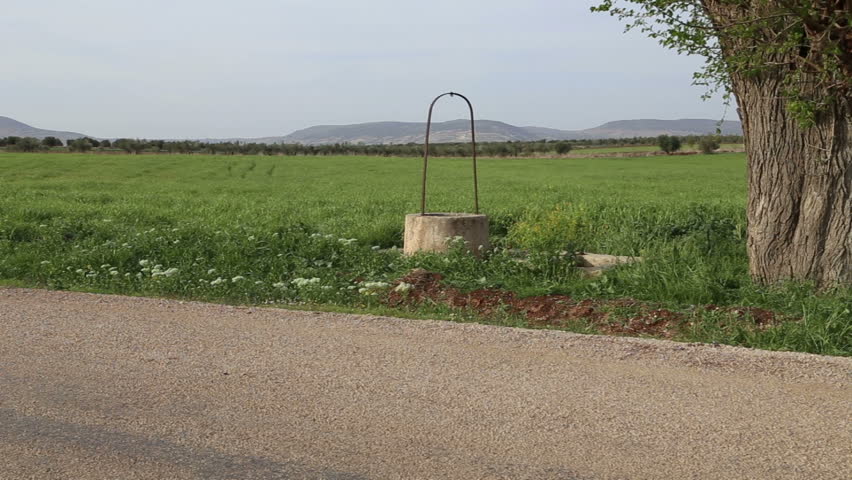
Along The Road to Santiago (© photo I don't know whom is the owner of the photo I found it at the website hidden in the link under the image)
This is a very beautiful overview somewhere along the Road. The "milestone" in the front is the usual marker for the Road, the scallop.

This episode, imagine this ..., is a kind of Carpe Diem Imagination. So let the image be your source of inspiration.

This episode is NOW OPEN for your submissions and will remain open until January 31st at noon (CET). Have fun!