Sunday, July 30, 2017

Carpe Diem #1228 sunset (CD Imagination)


Dear Haijin, visitors and travelers,

This is the last prompt for July 2017. this month we have explored several kigo for summer, classical and non-classical and I hope you did like this month.

Our last prompt for this month is sunset and I have made it myself easy, because I had a busy day. I will share an image of a summer sunset to inspire you.

sunset
This episode is open for your submissions tonight at 7:00 PM (CET) and will remain open until August 4th at noon (CET). I will try to publish our new episode, the first of our "modern art"-month, later on. For now .... have fun!


Saturday, July 29, 2017

Carpe Diem Extra July 29th 2017 new prompt-list


Dear Haijin, visitors and travelers,

I am glad to present you our new CDHK prompt-list for August. In this upcoming month I will challenge you with modern art ...

The new prompt-list you can find above in the menu, but it isn't complete yet. The open dates I will fill later with prompts.

Namasté,

Chèvrefeuille


Thursday, July 27, 2017

Carpe Diem Time Travel #5


!! Open for your submissions next Sunday July 30th at 7:00 pm (CET) !!

Dear Haijin, visitors and travelers,

Welcome at a new "weekend-meditation" here at CDHK. This week our "weekend-meditation" is an episode of Carpe Diem's Time Travel, Ancient Japanese poetry to inspire you. And this week I love to inspire you through a few poems from the Man'yoshu, an anthology of myriad poems. For this episode I have chosen a few poems from the 20th book of the Man'yoshu, here is the first by Wakayamatobe no Mimaro of Aratama District, a man of serviceable age in the service of the Registrar’s Office. :

wa ga tuma pa
itaku kopirasi
nomu midu ni
kagö sapë miete
yö ni wasurarezu

My wife
Loves me dearly, it seems
For in my drinking water
Her form appears
In life, I never can forget her.

It's a sad poem in which you can feel the loss of the poet. His wife died, but in everything, even the most simple things like water, he sees and senses his wife. A strong poem full of love, unconditional love.

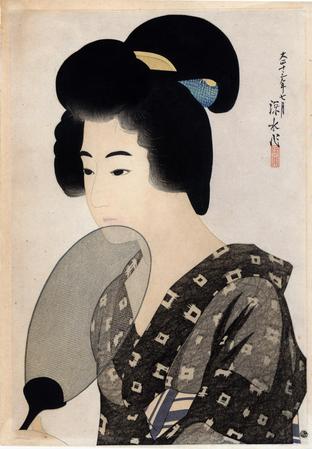
Japanese woman

Here is another poem with the seem tone and feeling. This poem is by Mononobe no Komaro of Lower Naga District:

wa ga tuma mo
e ni kaki toramu
iduma mo ga,
tabi yuku are pa
mitutu sinöbamu

My wife
In a picture I’d draw,
Had I but the time,
Then on my journey
Would I gaze at it, remembering her.

It seems like this 20th book of the Man'yoshu is filled with this kind of sad poems, so here is another one to inspire you:

sasa ga pa nö
sayagu simo yo ni
nana pe karu
körömo ni maseru
körö ga pada pa mo

The leaves of bamboo grass
Rustle on this frosty night;
Wearing sevenfold
Garments cannot compare
To my darling’s skin.

© poet's name unknown

And with this third poem I return back to the goal of the "waka", "uta" or "tanka" ... these poetry forms are meant for love and all that has to do with it. In this last poem I sense the deep love of the poet for his / her darling and in this poem he / she describes that in a wonderful way ... longing for the one you love ... that's unconditional love.


And for closure a tanka I created last year, but this one fits the idea of the above poems, so I share itr here again:

deep dark forest
seeking for nature’s mysteries –
a new day rises
after a hot and steamy night
she departs … without a kiss

© Chèvrefeuille

I hope you all will have a wonderful weekend and I am looking forward to all of your responses on this Time Travel episode in which we explored a few poems from the 20th book of the Man'yoshu.

This episode is open for your submissions next Sunday July 30th at 7:00 PM (CET) and will remain open until August 3rd at noon (CET). Have a great weekend ...


Wednesday, July 26, 2017

Carpe Diem #1227 waiting for autumn (Aki tikashi, Aki wo matsu)


Dear Haijin, visitors and travelers,

I had an amazing day today ... we had a wonderful nice, not to hot, summer day here in The Netherlands and my wife and i could be almost the whole day outside in the garden. I love my garden in every season, but especially in the tiny line between summer and autumn I love being in my garden. The leaves start coloring and the rains fall more often. Than I smell that nice perfume of wet earth and the starting of decay ... yes maybe this is my time of year.

Our classical prompt for today, waiting for autumn (Aki tikashi, Aki wo matsu), is extracted from the Kiyose, a collection of classical Japanese kigo (seasonwords). And it gives me the same feeling as described above. I am waiting, no longing, for autumn (Aki) and I can already smell it in the thin air of this summer day ... awesome.

autumn dreams
While I was doing my research for this episode I ran into several beautiful haiku with this theme, waiting for autumn, here is an example by Aioi Gakikajin:

Autumnal voices
in which of the windows
are there more?

© Aioi Gakikajin

And here is an other nicely crafted haiku. Deer start dating in autumn, and the lonely ones make a forlorn mating call that has become associated in Japan with lust and yearning:

Still with antlers, still
with love, the male deer —
— dashes!

© Kaneko Mukanshi

This second example makes me smile, because of the scene, but also of the true longing, waiting for autumn feeling in it. really an awesome haiku.

Longing for Autumn
Of course there are also beautiful tanka (waka or uta) about this waiting, longing for autumn. I found a nice one in the Man'yoshu written by Princess Nukata (ca. 630–690):

While, waiting for you,
My heart is filled with longing,
The autumn wind blows— 
As if it were you— 
Swaying the bamboo blinds of my door.

© Princess Nukata

And to conclude this episode ... I love to share the following tanka:

the scent of autumn
that sweet smell of decaying leaves -
after the rain - stronger
makes me think of days past
and my first real love ... 

© Chèvrefeuille

Well ... I hope you did like this episode. I enjoyed creating it. This episode is NOW OPEN for your submissions and will remain open until July 31st at noon (CET). I will try to publish our new "weekend-meditation" later on. For now ... have fun!


Tuesday, July 25, 2017

Carpe Diem #1226 swamp


Dear Haijin, visitors and travelers,

Welcome at a new day in our wonderful summer kigo month, July 2017. Here in The Netherlands it's raining almost all day, but temperatures are okay, around 22 degrees Celsius. So not really a summer feeling, but this sultry day is perfect for our prompt for today. A modern kigo extracted from "A Dictionary of Haiku" by Jane Reichhold.

Our prompt for today I didn't associate with summer, but than I remembered a hot summer day several years ago, I was a young adult, around 22 yrs of age. I wandered around my home town and ran into a swamp-like environment just outside of my home town. Not really a swamp, but it almost looked the same. Here in my home town we call that place "the willow storage". It's a part of the polder that looks like how earth looked in the prehistory ... and it is a marvelous piece of nature to be in.
As that young adult I was exploring who I am and who I wanted to be. I had a free mind and on that hot summer day I decided to "dive" into "the willow storage", but it was really hot and very sweaty, because of the high moistured air. Well ... as a free minder I decided to took of my clothes, put them in a bag, hide it, and walk into the willow storage completely naked. It felt great, it felt like being 100% in tune with nature. I heard the buzzing of mosquitoes and bees. I bathed in the warm waters of the willow storage and laid down on a nice spot of grass somewhere in the middle of it. It was a real nice day ... I even tried to create a haibun about this beautiful day several years later.

The Willow Storage

The willow storage is a wonderful place and as I was preparing this episode I thought back to that wonderful day.

Today our prompt is swamp and I don't hink it needs further explanation, so here is a haiku Jane wrote as an example for this modern kigo:

black cypress
draining into the swamp
strands of color

© Jane Reichhold (1937-2016)

Awesome haiku I would say. Here is another haiku this time written by myself:

hot summer day
wandering through the swamp
mosquitoes buzzing

© Chèvrefeuille

Well ... I hope I have inspired you.

This episode is NOW OPEN for your submissions and will remain open until July 30th at noon (CET). I will try to publish our new episode, waiting for autumn (Aki tikashi, Aki wo matsu), later on. For now ... be inspired and share your haiku, tanka or other Japanese poetry form with us all.


Monday, July 24, 2017

Carpe Diem #1225 cool, cool evening, cool wind (Suzushi,Ryofu)


Dear Haijin, visitors and travelers,

I am a bit late with this new episode, because I had a very busy day-shift at work. So my apologies for this small delay. Yesterday we had "dunes" for prompt and today I love to inspire you with a classical kigo for summer, cool, cool evening, cool wind (Suzushi,Ryofu), and the first thing that came in mind was a haiku by my master Matsuo Basho (1644-1694):

Matsuo Basho
You remember for sure Basho's haiku 'Old Pond', this famous haiku we have seen here often, we even have created an e-book around this famous haiku (see for the link to this e-book, the right side of our Kai):

an old pond
a frog jumps in
the sound of water

The following haiku by Basho has the same third sentence but fails to achieve the importance that it does have in the above verse.

Basho wrote the following haiku in the Summer of 1688.

taneshisa ya   aota ni suzuma   mizu no ato

delightfulness
cooling one self in a rice paddy
the sound of water

As we look closer at both verses we can see the picture, but in 'Old Pond' the main figure is the frog and in 'delightfulness' it's a human. Basho uses the same third sentence but, there is a difference in 'the sound of water'. In 'Old Pond' the sound of water is very short. It's just the frog who breaks the water. That sound is the essence of haiku, short as an eye-blink, just an 'aha-erlebnis'.
In 'delightfulness' the sound of water is made by a human who is cooling his feet in the water of the rice paddy. That 'sound of water' is a longer sound, the sound of splashing. In 'delightfulness' the cool water of the rice paddy is the 'aha-erlebnis'. How refreshing the cool water of the rice paddy on a hot summer day.

In my opinion 'the sound of water' in 'Old Pond' is stronger and important for the picture. In 'delightfulness' 'the sound of water' is less important for the picture. It's the coolness of the water of the rice paddy that's important.
Well it's just a thought, a reverie ....

dew drops on grass
The above image I used several years ago as the cover for a haiku-book in Dutch, but it also was used to illustrate the haiku I wrote in response on the above delightful haiku by Basho:

with my bare feet
in the cool grass of dawn
Ah! what a feeling

© Chèvrefeuille

Another haiku by Basho with the same theme, coolness, is the following:

essential to life
the little space under my hat
enjoying the coolness

This is a not so well known haiku of Basho. The Japanese hat in this haiku is the so called "kasa".

kasa
The "kasa" was an umbrella like hat. In some way through wearing this 'kasa' Basho always had his own shady place at hand.

such a hot day
my shadow needs to cool down
under the willow

© Chèvrefeuille

Another one with the same theme:

hot summer day
the shadow of the willows
Ah! that coolness

© Chèvrefeuille

the shadow of the willos

In some of Basho's haiku he refers to himself as part of the scene or looks to the scene from a distance. Not very common for haiku poets. It isn't done to be part of your own haiku as haiku poet, but rules are there to be once read and than to forget them immediately.
In the following haiku he does both. He is part of the scene, but is also watching it from a distance. I think it's a great way to write haiku (unless it wasn't common).
This "not being part of your own haiku" is still in our times one of the rules. Rules? Basho once said: "Know the rules of writing haiku and forget them immediately". Well ... that's my way to write haiku. So I 'forgot' the rules of the classical haiku and embraced the rules of the Kanshicho style in which Basho wrote his haiku between 1683 and 1685. In that style the syllable count is different and less important. But as Basho said: "Forget the rules immediately". Well I can say "forgetting the rules feels good and makes my mind free". With that thought I have written a lot of haiku.

kawa kaze ya   usu gaki ki taru   yu suzumi

a river breeze
the one wearing a light persimmon robe
enjoying the coolness

© Basho

Basho wrote a preface to this haiku.

"Enjoying the cool breeze on the bank of Shijo, an observance is practiced from the beginning to the middle of June. A special floor is set up right on the river, and people enjoy drinking and eating all night. Women tie their sashes correctly tight, and men wear their formal long coats. I see even the apprentices of a cooper and the blacksmith. They seem to have too much leisure time, singing and making noise. This is probably a scene which can only be seen in the capital (Edo, now called Tokyo)".
summer coolness

observing the crowd
having fun on the seashore
almost naked

© Chèvrefeuille

I love the full beaches in summer. Everyone has fun enjoying the warm summer and the coolness of the sea.
Children laugh making sandcastles, grown ups reading, playing, drinking, eating and laughing. Summer is a wonderful season and I think ... everyone enjoys it.

Sorry ... maybe a long (to long) read this episode, but I was on a roll. I hope I have inspired you to create haiku, tanka or other Japanese poetry form.

This episode is NOW OPEN for your submissions and will remain open until July 29th at noon (CET). I will try to publish our next episode, swamp, later on. For now ... have fun!


Sunday, July 23, 2017

Carpe Diem #1224 dunes


Dear Haijin, visitors and travelers,

I hope you all have had a wonderful weekend and I hope I have inspired you with our "weekend-meditation". Today we will go on with our Summertime month full of classical and non-classical kigo (seasonwords).
There are a lot of classical and non-classical kigo for summer and today I love to share another nice one, a modern one this time extracted from Jane's "A Dictionary of Haiku". Today I love to challenge you with dunes.

the cry of a seagull
resonates through the dunes
waves pounding the beach
© Chèvrefeuille
As I was preparing this episode the first thing which came in mind had nothing to do with summer. I thought of the novel series by Frank Herbert, Dune. I remember that I read this complete series (6 volumes) as a teenager and I loved it, loved it dearly. It inspired me to write my own novel several years later.

Dune (part 1) Frank Herbert cover

Let me tell you a little bit more about this beautiful series of novels by Frank Herbert:

Dune is a 1965 epic science fiction novel by American author Frank Herbert, originally published as two separate serials in Analog magazine. It tied with Roger Zelazny's This Immortal for the Hugo Award in 1966, and it won the inaugural Nebula Award for Best Novel. It is the first installment of the Dune saga, and in 2003 was cited as the world's best-selling science fiction novel.
Set in the distant future amidst a feudal interstellar society in which noble houses, in control of individual planets, owe allegiance to the Padishah Emperor, Dune tells the story of young Paul Atreides, whose noble family accepts the stewardship of the desert planet Arrakis. As this planet is the only source of the "spice" melange, the most important and valuable substance in the universe, control of Arrakis is a coveted—and dangerous—undertaking. The story explores the multi-layered interactions of politics, religion, ecology, technology, and human emotion, as the forces of the empire confront each other in a struggle for the control of Arrakis and its "spice".
Herbert wrote five sequels: Dune Messiah, Children of Dune, God Emperor of Dune, Heretics of Dune, and Chapterhouse: Dune. In 1984 Dune The Movie was created. A great movie which followed (in my opinion) the novels in an awesome way.

Virginia Beach Dune
Okay ... back to our prompt for today, dunes, a modern summer kigo. Here are a few haiku by Jane Reichhold (1937-2016) to inspire you.
rain-wet dunes
scraped with yellow light
of sunset showers
noon shadows
following the contours
of desert dunes
living in desert dunes
the ups and downs
of curved sand
© Jane Reichhold

Three beauties ... Jane was really a great haiku poetess. Here is another one by her. I think this one is one of her best on dunes:

the shape of wind
writing in dunes
loneliness
© Jane Reichhold

It will not be an easy task to create haiku or tanka in the same brightness and beauty as the ones shared here by Jane, but  ... I had to try.

hot summer day
seeking for relief and shadow
between the dunes
exchanging body fluids with the one I love
while seagulls cry


© Chèvrefeuille

Hmm ... nice tanka I think. What is your opinion on this tanka?

This episode is open for your submissions tonight at 7:00 PM (CET) and will remain open until July 28th at noon (CET). I will try to publish our new episode, cool, cool evening, cool wind (Suzushi,Ryofu), later on. For now .... have fun!