Showing posts with label ancient Japanese poetry to inspire you. Show all posts

Wednesday, October 20, 2021

Carpe Diem Haiku Kai Celebrates Its 9th Anniversary: #1852 Out In The Fields


Dear Haijin, visitors and travelers,

Welcome at a new episode of our Haiku Kai's celebration month, October 2021. We are celebrating our 9th anniversary with a "trip along memory lane" and today I have (another) nice episode in which we look back into our rich history.

As you all know there are several features here on CDHK and today I have a nice one. I don't know if you remember this special feature, but back in time it was one of my better creations "Carpe Diem's Time Travel, Ancient Japanese Poetry To Inspire You".

Let me give you a piece of one of the episodes of "Time Travel":

[...] In the Hyakunin-isshu are themes such as nature, the round of the seasons, the impermanence of life, and the vicissitudes of love. There are obvious Buddhist and Shinto influences throughout.

An example of the Tanka in Hyakunin-isshu created by Emperor Tenchi (7th century):

Aki no ta no
Kari ho no iho no
Toma wo arami
Waga koromode wa
Tsuyu ni nure-tsutsu.

OUT in the fields this autumn day
They're busy reaping grain ;
I sought for shelter ’neath this roof,
But fear I sought in vain,—
My sleeve is wet with rain.

A very nice Tanka I would say. It's written in a very sophisticated style that fits the Emperor. I especially like the rhyme in the last two lines. As you all know (maybe), it is "not done" to use rhyme in Tanka, but in this one it seems that it had to be that way. It gives the Tanka "style". [...]

Mount Yudano

The above tanka brought a (not so well known) haiku by Basho in mind.

katara re nu   yudano ni nurasu   tometo kana

forbidden to say
how sleeves are wetted
in the bathroom

© Basho

Mount Yudano was a sacred and secrative place for the Shinto sect. More about this haiku by Basho you can find at Basho Revisited, one of my other personal weblogs.

There are a lot of haiku (and tanka) in which several myths and secrets are hidden. For example in a lot of haiku and tanka the poets hide sexuality and the beauty of human body.

So for this episode I love to challenge you to create a haiku or tanka in which you hide sexuality and the beauty of the human body. I will give you an example, which you maybe remember:

what has happened?
petals of red roses around
the morning glory

© Chèvrefeuille (2012)

"Morning glory" points to a certain male part. So in this haiku you find hidden sexuality and the beauty of the human body.

This episode is NOW OPEN for your submissions and will remain open until October 24th at 10:00 PM (CEST). You can add your submission to the linking widget hidden in our logo below.


Thursday, July 27, 2017

Carpe Diem Time Travel #5


!! Open for your submissions next Sunday July 30th at 7:00 pm (CET) !!

Dear Haijin, visitors and travelers,

Welcome at a new "weekend-meditation" here at CDHK. This week our "weekend-meditation" is an episode of Carpe Diem's Time Travel, Ancient Japanese poetry to inspire you. And this week I love to inspire you through a few poems from the Man'yoshu, an anthology of myriad poems. For this episode I have chosen a few poems from the 20th book of the Man'yoshu, here is the first by Wakayamatobe no Mimaro of Aratama District, a man of serviceable age in the service of the Registrar’s Office. :

wa ga tuma pa
itaku kopirasi
nomu midu ni
kagö sapë miete
yö ni wasurarezu

My wife
Loves me dearly, it seems
For in my drinking water
Her form appears
In life, I never can forget her.

It's a sad poem in which you can feel the loss of the poet. His wife died, but in everything, even the most simple things like water, he sees and senses his wife. A strong poem full of love, unconditional love.

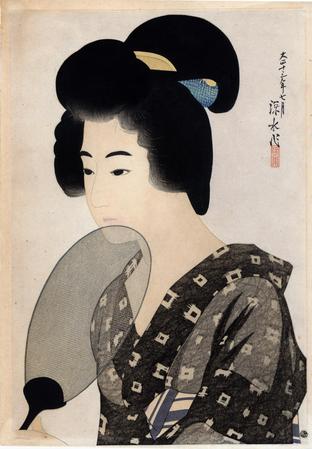
Japanese woman

Here is another poem with the seem tone and feeling. This poem is by Mononobe no Komaro of Lower Naga District:

wa ga tuma mo
e ni kaki toramu
iduma mo ga,
tabi yuku are pa
mitutu sinöbamu

My wife
In a picture I’d draw,
Had I but the time,
Then on my journey
Would I gaze at it, remembering her.

It seems like this 20th book of the Man'yoshu is filled with this kind of sad poems, so here is another one to inspire you:

sasa ga pa nö
sayagu simo yo ni
nana pe karu
körömo ni maseru
körö ga pada pa mo

The leaves of bamboo grass
Rustle on this frosty night;
Wearing sevenfold
Garments cannot compare
To my darling’s skin.

© poet's name unknown

And with this third poem I return back to the goal of the "waka", "uta" or "tanka" ... these poetry forms are meant for love and all that has to do with it. In this last poem I sense the deep love of the poet for his / her darling and in this poem he / she describes that in a wonderful way ... longing for the one you love ... that's unconditional love.


And for closure a tanka I created last year, but this one fits the idea of the above poems, so I share itr here again:

deep dark forest
seeking for nature’s mysteries –
a new day rises
after a hot and steamy night
she departs … without a kiss

© Chèvrefeuille

I hope you all will have a wonderful weekend and I am looking forward to all of your responses on this Time Travel episode in which we explored a few poems from the 20th book of the Man'yoshu.

This episode is open for your submissions next Sunday July 30th at 7:00 PM (CET) and will remain open until August 3rd at noon (CET). Have a great weekend ...


Thursday, June 29, 2017

Carpe Diem's Time Travel, Ancient Japanese Poetry To Inspire You #3 Hyakunin-isshu, A Hundred Verses From Old Japan


!! Open for your submissions next Sunday July 2nd at 7:00 PM (CET) !!

Dear Haijin, visitors and travelers,

Welcome at a new "weekend-meditation". This time I love to inspire you through the ancient Japanese poetry. Haiku is a very classical (and ancient) Japanese poetry form, but before haiku became renown in ancient Japan it was mostly the "waka" that was used as The poetry form. The "waka" is the pre-ancestor of what we now know as Tanka, a 5 lined Japanese poetry form following the syllables count 5-7-5-7-7. What we call syllabes however are "on" or "onji". These are the "sounds" of the Japanese language.

For this "Time Travel" episode I have chosen an anthology which was translated by William N. Porter back in 1909, the Hyakunin-isshu, A Hundred Verses From Old Japan. The Hyakunin-isshu is a collection of 100 specimens of Japanese Tanka poetry collected in the 13th Century C.E., with some of the poems dating back to the 7th Century. This edition was illustrated with Japanese woodblock prints of an unknown artist. I hope to share a few of these woodblock prints here too.


This woodblock print is titled "seashore" and was used as a kind of cover for this anthology. All the Tanka in the Hyakunin-isshu are on themes such as nature, the round of the seasons, the impermanence of life, and the vicissitudes of love. There are obvious Buddhist and Shinto influences throughout.

An example of the Tanka in Hyakunin-isshu created by Emperor Tenchi (7th century):

Aki no ta no
Kari ho no iho no
Toma wo arami
Waga koromode wa
Tsuyu ni nure-tsutsu.

OUT in the fields this autumn day
They're busy reaping grain ;
I sought for shelter ’neath this roof,
But fear I sought in vain,—
My sleeve is wet with rain.

A very nice Tanka I would say. It's written in a very sophisticated style that fits the Emperor. I especially like the rhyme in the last two lines. As you all know (maybe), it is "not done" to use rhyme in Tanka, but in this one it seems that it had to be that way. It gives the Tanka "style".

Pheasant woodblock print (found on Pinterest)
I found an other nice Tanka, this time created by the Nobleman Kaki-no-Moto (7th century):

Ashibiki no
Yamadori no o no
Shidario no
Naga-nagashi yo wo
Hitori ka mo nemu.

LONG is the mountain pheasant's tail
That curves down in its flight;
But longer still, it seems to me,
Left in my lonely plight,
Is this unending night.

As I read this Tanka another nice poem came in mind, the following haiku by Buson:

osokihi ya kiji no oriiru hashi no ue 

In these lengthening days
Pheasants settle
Upon the bridge.


In the Tanka the theme is the longest night (the winter solstice) and in the haiku, Buson refers to the longest day (the summer solstice). Both poems are beauties.

Yamato Province is renown for its cherry blossoms
Why this image of cherry blossoms in Yamato province? Well it has to do with the verse (tanka) I extracted from Hyakunin-isshu to inspire you, maybe the image will help you to imagine the Tanka written by Korenori Saka-no-Uye a not so well known poet from the 10th century.

Asaborake
Ariake no tsuki to
Miru made ni
Yoshino no sato ni
Fureru shira yuki.

SURELY the morning moon, I thought,
Has bathed the hill in light
But, no; I see it is the snow
That, falling in the night,
Has made Yoshino white.

And here is my response, maybe also to help you a little bit to imagine the scene:

on the mountain slopes
fragile cherry blossom petals fall
it seems to snow

© Chèvrefeuille

To conclude this episode "in style" here is another woodblock print from this classical anthology full of beautiful Tanka.

Moon Viewing 
Well ... I hope you did like this new episode of "Time Travel" and I hope to have inspired you to create haiku, tanka or other Japanese poetry form.

More from The Hyakunin-isshu? HERE

This episode is open for your submissions next Sunday July 2nd at 7:00 PM (CET) and will remain open until July 7th at noon (CET). Have a great weekend!


Thursday, June 15, 2017

Carpe Diem Time Travel #2 The Tale of Genji


!! Open for your submissions next Sunday June 18th at 7:00 PM (CET) !!

Dear Haijin, visitors and travelers,

Welcome at a new episode of our "Time Travel" feature. This feature I have created especially for our "weekend-meditation" and its goal is to create new haiku, tanka or other Japanese poetry form inspired on poems from ancient times. For example: waka taken from the Man'yoshu, as we did in the first episode of this new feature.

This episode I love to introduce to you a well known Japanese novel from the 11th century, The Tale of Genji. And I will share a few poems from this Tale with you to inspire you. Let me (with help from Mark Cartwright) tell you a little bit more about this ancient Japanese novel.

Tale of Genji (by Mark Cartwright); published on 10 April 2017 at www.ancient.eu 

The 'Tale of the Genji' or Genji Monogatari, written in the 11th century CE by Murasaki Shikibu, a court lady, is Japan's oldest novel and possibly the first novel in world literature. The classic of Japanese literature, the work describes the life and loves of Prince Genji and is noted for its rich characterization and vivid descriptions of life in the Japanese imperial court. The work famously reproduces the line 'the sadness of things' over 1,000 times and has been tremendously influential on Japanese literature and thinking ever since it was written. The 'Tale of Genji' continues to be retranslated into modern Japanese on a regular basis so that its grip on the nation's imagination shows no sign of loosening.

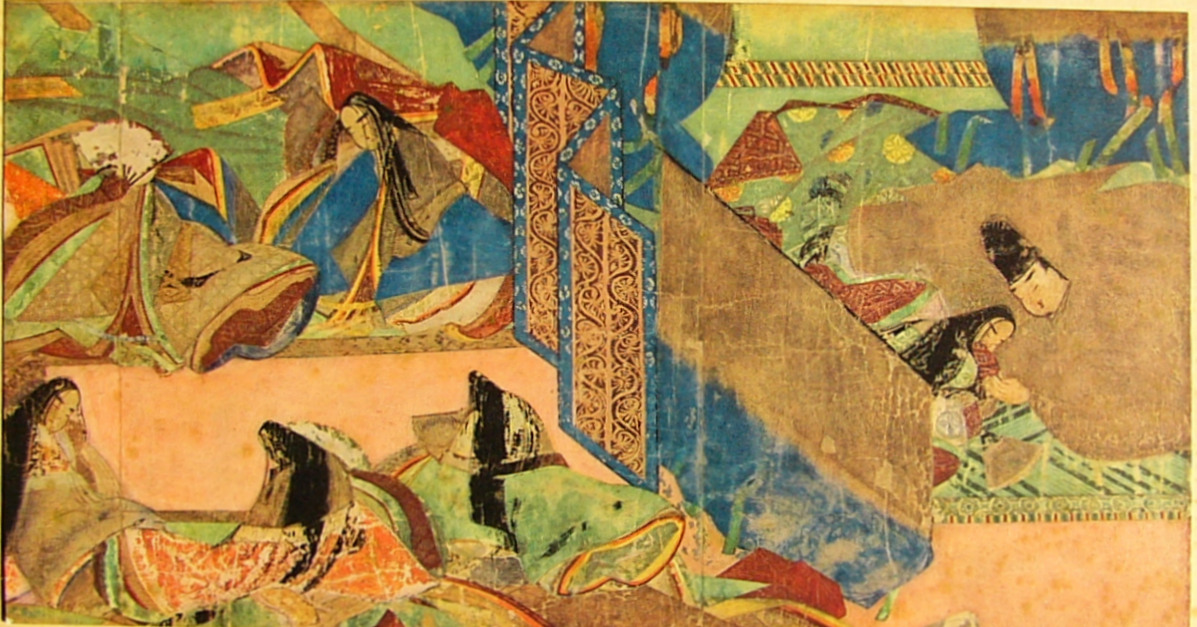
Hand painted illustration from the Tale of Genji

Murasaki Shikibu

The work's author is considered to be a lady of the imperial court by the name of Murasaki Shikibu who wrote it over several years and completed it around 1020 CE during the Heian period (794-1185 CE). Murasaki is also known as To no Shikibu. Murasaki was a nickname and shikibu means 'secretariat,' which was the role of her father as in ancient Japan it was common to call a daughter by her father's position. She was a member of the Fujiwara clan. Her birth is accepted as around 973 CE and her death after 1013 CE, the date of the last mention of her in court documents. Details of her life are sketchy except that her father was Fujiwara no Tametoki, a provincial governor, and that she married a fellow Fujiwara clan member, one Fujiwara no Nobutaka, with whom she had one daughter, Daini no Sammi. Murasaki's husband died in 1001 CE, and she then became a lady-in-waiting (nyobo) to Empress Akiko (aka Shoshi) where she displayed great talent in the arts, particularly calligraphy, the harp (koto), painting, and poetry. Besides the novel, other surviving works by Murasaki include poems and her diary.

The novel describes life in the Japanese Imperial Court. Its etiquette & intrigues & above all the central character of Prince Genji. (Genji Monogatari)

The Japanese title Genji Monogatari may be translated as 'The Tale of Prince Genji.' It consists of 54 chapters and 750,000 words, although the final 13 chapters are regarded as a later addition by a minority of scholars principally because the story then no longer concerns Genji but his son Kaoru and takes on a darker tone. Neither do scholars entirely agree on the order of the chapters as many seem like later insertions by the author and several are parallel chapters or narabi where events occur not after but contemporary with the events described in earlier 'ordinary' chapters (hon no maki).

The novel describes life in the Japanese imperial court, its etiquette and intrigues, and, above all, the central character of Prince Genji who is the perfect gentleman in looks and deed. Genji's relations, love affairs, and transition from youth to middle age are all captured by Murasaki's astute writing which combines romanticism and realism in equal measure to capture a timeless treatment of human relations and the general impermanence of all things.

Scene from The Tale of Genji (Brooklyn Museum)

In her own words Murasaki describes this discovery:

"But I have a theory of my own about what this art of the novel is...it happens because the storyteller's own experience of men and things, whether for good or ill - not only what he has passed through himself, but even events which he has only witnessed or been told of - has moved him to an emotion so passionate that he can no longer keep it shut up in his heart. Again and again something in his own life or that around him will seem to the writer so important that he cannot bear to let it pass into oblivion". (Mason, 96)

Murasaki Shikibu (978-1014) is seen as the inventor of the "Psychological Novel", as she shows in her Tale of Genji.

Murasaki Shikibu (978-1014)
Now we know a little bit about the background of The Tale of Genji and now we are looking to a few poems from this wonderful ancient Japanese novel.

In The Tale of Genji we see very often two characters speaking with each other through poems, so maybe we can say that The Tale of Genji was the first kind of Tan Renga. In the examples I will show you that.

This first poem is a stand alone poem:

since my departure for this dark journey,
makes you so sad and lonely,
fain would I stay though weak and weary,
and live for your sake only!


And here is a beautiful example of a "poem-conversation":

fain would one weep the whole night long,
as weeps the Sudu-Mushi's* song,
who chants her melancholy lay,
till night and darkness pass away


(the "answer"):

to the heath where the Sudu-Mushi sings,
from beyond the clouds one comes from on high
and more dews on the grass around she flings,
and adds her own, to the night wind's sigh.


* Sudu-Mushi are a kind of insects which sing in herbage grass especially in autumn evenings

Scene from The Tale of Genji
Another example of a "poem-conversation":

when on my fingers, I must say
I count the hours I spent with thee,
is this, and this alone, I pray
the only pang you've caused on me?
you are now quits with me


(the "answer"):

from me, who long bore grievous harms,
from that cold hand and wandering heart,
you now withdraw your sheltering arms,
and coolly tell me, we must part


Chrysanthemum (woodblock print)
A last example of what I have called here a "poem-conversation":

even this spot, so far to view
with moon, and Koto's gentle strain,
could make no other lover true,
as me, thy fond, thy only swain
one turn more!
stay not your hand when one is near,
who so ardently longs to hear you


(the "answer"):

sorry I am my voice to low
to match the flute's far sweeter sound,
which mingles with the winds that blow
the autumn leaves upon the ground


All wonderfully crafted poems in which we can sense the love between the characters. Strong emotions hidden in their words. The Tale of Genji, a psychological love story.

Cicada (woodblock print)

Here is the "poem-conversation" to work with. Let this "poem-conversation" inspire you to create haiku, tanka or other Japanese poetry form in which you try to catch the strong emotions hidden in the Tale of Genji.

where the cicada casts her shell
in the shadows of the tree,
there is one whom I love well
though her heart is cold to me


(the "answer"):

amidst dark shadows of the tree,
cicada's wing with dew is wet,
so in mine eyes unknown to thee,
spring sweet tears of fond regret


An awesome "poem-conversation" to work with I think. So I have given it a try with this tanka:

weeping willow
hides her red-stained eyes
behind broken roses
trampled with the foot he cherished
even kissed that last night


© Chèvrefeuille

Well ... sorry for this long episode, but I was on a roll. I hope you do not mind. This "weekend-meditation" is open for your submissions next Sunday June 18th at 7:00 PM (CET) and will remain open until June 23rd at noon (CET). I will try to publish our new episode, the first of our Theme Week about Milarepa, the renown poet and yogi from Tibet, later on. Have a great weekend ... be inspired and enjoy creating your haiku, tanka or other Japanese poetry form.

PS. You can find a pdf filed version of "The Tale of Genji" HERE