Sunday, May 19, 2013

Carpe Diem #200, Temperance (XIV)


Dear Haijin, visitors and travelers,

We are going on with our quest for the divine meaning of the Tarot and I am sure we will find that divinity of the Tarot. In our quest we are taking our next step and I have drawn Temperance (XIV) for our next prompt. However ... this post will not be completed today, because of lack of time. Why? Well I am in the nightshift and therefore don't have enough time to prepare a complete episode, but hereafter follows a first part of this episode.

'Truly, truly, I say to you, unless one is born anew, he cannot enter the Kingdom of God'. (John 3: 3 NIV).

I know a strange start of a new Carpe Diem episode in our journey through the Tarot in a quest to discover the divine Tarot, but I think this is a decent introduction to our next Tarot-card in which an Angel is depicted, Temperance (XIV).
Let us look closer to this Tarot-card and maybe we will come a step closer to our goal, finding the divine meaning of the Tarot. What do we see?


Temperance is almost invariably depicted as a person pouring liquid from one receptacle into another. Historically, this was a standard symbol of the virtue temperance, one of the cardinal virtues, representing the dilution of wine with water. In many decks, the person is a winged person/angel, usually female or androgynous, and stands with one foot on water and one foot on land.

This is the guardian Angel which accompanies as a faithful ally the divine image in man, just as visious inclinations have made their way into the human functional organism which was, before The Fall (Genesis 3: 1-24 NIV), the divine likeness. The guardian Angel undertakes the functions, destroyed by original sins, in the likeness, and fills the breacjh wrought by them. He substitutes himself for functions destroyed through The Fall.The guardian Angel acquits his charge in five ways:
  1. he guards
  2. he cherishes
  3. he protects
  4. he visits  (and)
  5. he defends
Therefore he is a 'Flaming Star' in which we can find his connection with the first five cards of the Major Arcanum, in which we saw the Holy Trinity. Our guardian Angels are part of the Holy Realms of The Trinity, the 'Home of God' (The New Jerusalem) (Revelation 21: 1-5a NIV).
The guardian Angel is our advocate before Divine Justice, and they (the guardian Angels) are our intercession to the Lord saying: 'Forgive them their sins. If not, efface us from the Book of Life that you have written'.
The guardian Angel (female Angeline) defends his protege like a Mother defends her child, withour regard to whether he may be good or bad. It's the mystery of maternal love which lives in the heart of the guardian Angel. This is why traditional art presents them as winged females as we can see on this Tarot-card. This card openly presents the Angel as a winged female dressed in a woman's robe, half-blue and half-red.
Guardian Angels (or Angelines, because they're female) are the manifestation of high and pure maternal love. For this reason the Holy Virgin and Mother of God bears the liturgical title Regina Angelorum 'queen of the Angels'.
Angels, including guardian Angels, live and move exclusively in the Vertical. Ascent and descent constitute
the law of their life, their respiration. They ascend towards God; they descend towards mankind. As I wrote this a bible-verse came in mind. It's from Genesis and it tells about a dream which Jacob had at Bethel.

[...] 'Jacob had a dream in which he saw a stairway resting on the earth, with its top reaching to heaven, and the Angels of God were ascending and descending on it'. [...] (Genesis 28: 12 NIV)


THERE WILL BE MORE TO COME FOR THIS EPISODE

This prompt will stay on 'til May 22th 11.59 AM (CET) and I will post our next episode, The Devil (XV), later on today around 10.00 PM (CET).


Saturday, May 18, 2013

Carpe Diem #199, The Death (XIII) Tarot


Dear Haijin, visitors and travelers,

Today I have drawn The Death (XIII) from the RW-Tarot-deck. I first thought 'shall I avoid this card?', but than ... I got a 'revelation' ... death belongs to life, so I cannot avoid this card. This card is crucial in the Tarot and for sure after The Hanged Man (XII). What started in The Hanged Man, the death of Ego, will be followed in The Death. I know that there are people who are scared of death, and I can understand that very well. In my work as an oncology-nurse I know what it is to be confronted with death. In my life I was already several times confronted with death. At least one confrontation with death was sad and a heavy burden. That occured 18 yrs ago in 1995. In that year my older brother died of lungcancer. It was than that I realized myself. 'Death is not the end', because life went on. At the moment that my brother died, a woman gave birth to a son. I than thought 'maybe in that little boy my brother will live, resurrected, reincarnated'.


cherry blossoms fall
giving room for the leaves
and cherries


life goes on
cherry blossom petals falling -
cherries in autumn


Let us take a look at this card The Death (XIII).


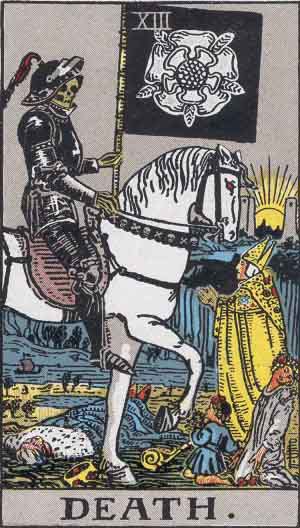
The Death card depicts a skeleton riding a horse. Surrounding it are dead and dying people from all classes, including kings, bishops and commoners. The skeleton carries a black standard emblazoned with a white flower. Some decks depict the Crashing Towers from The Moon with The Sun rising behind them in the background.
In the background, where the sun is rising, we see the shadow of New Jerusalem, God’s Heavenly Town or in some translations, God’s House with many rooms.
This card doesn’t  represents a physical death,  it implies an end and therefore implies an increased sense of self-awareness. This can also mean ... finally found Enlightenment and self-consciousness.


resurrection
part of my being is dying
finally found myself


The Death (XIII) follows The Hanged Man (XII), not on purpose, but chosen to be there, because (as we saw in The Hanged Man) death is a new beginning. We lose our Ego to become a whole new person. In many religions and spiritual philosophies it’s said that there is a new life after death, I personally think we will reincarnate after our death. Reincarnation isn’t an accepted idea in Christianity, however we say “we will be resurrected on the day when Jesus will return to Earth”.
The Death (XIII) is a doorway to deeper insight and self-development. After death we all will be better people. Not the physical death, but the death of Ego will transform us into better souls and better people.


Source: Tree of Life

What is said about The Death (XIII) if we look at the ancient and mystical wisdom of the Kabbalah? Let us look closer to the Tree of Life (the Kabbalistic glyph).
It wasn’t easy to find the correct words for this connection with the Kabbalah, but on the Tree of Life, The Death (XIII) is the Path between Tifereth (the 6th sephira, Beauty, the Place of Christ Consciousness) and  Netzach (the 7th sephira, Eternity) and that says: ‘in death there is beauty, death leads to eternal life’. There is nothing beautiful on death, but as we embrace death as a part of our life, than we will see and understand that death is beautiful, because it will bring us eternal life. That’s of course right for physical death, but it also is right for the death of Ego, as we saw in The Hanged Man (XII). With The Hanged Man we started to walk on the path between beauty and eternity and we will arrive there were The Death is awaiting us.

And Christianity? What is said about this Tarot card The Death (XIII) in Christianity? Let us look at that right now and here and take a Christian look at this Tarot-card.

There is no death.  There is only resurrection.  Live your  life of fulfillment, taking advantage of every opportunity of every moment of every day.  When the miracle of resurrection has passed on, then you are at peace to recognize that things have simply returned to their natural state. 
That is why this card is in the Tarot deck.  It is meant to be embraced.  It is meant to be a gateway to a new birth.  If we can embrace death, then our lives are transformed.  That is the physical realm.  This is also a card of immense spiritual power.  The crucifixion of ego, that we saw in the Hanged Man, can and will become reality.  As that ego dies, we then live in a glorious resurrection.  As we continue to look at the card, we see several important elements.
Death is a secret, death is a darkness which we do not wish to look at nor embrace.  So if we are not going to supplicate death and we're not going to ignore death, what response do we have?  The response of the little child.  Unless we have faith like a little child, we will never enter the Kingdom of Heaven and recognize all truth.  The little child does not seek to turn death into a friend.  The little child does not seek to ask death to go away.  The little child does not turn her eyes and pretend that death is not there.  The little child opens her eyes, sees death in the face, recognizes death as what it is, and has a simple straight forward natural acceptance of this reality. Here we can see what is said in the Gospel of Matthew Chapter 19 verse 14:

Source: Matthew 19:14


Jesus said: "Let the little children come to me, and do not hinder them, for the Kingdom of Heaven belongs to such as these".

Back to the card The Death (XIII) Notice that in the background there is a ship sailing on the river.  Life goes on.  For every death, there is a rebirth. This is the eternal cycle of God's plan.
As the final element, look at the right hand side of the card, just above the head of the Pope.  Notice, that we have two towers (some sources say that these are a prophecy, hidden in the Tarot-card The Death, of 9/11), and we have the Sun beginning to rise.  Death is a stripping away of the veils--physical, emotional, mental and spiritual veils.  And as we strip away veils, we can see more clearly into the heart of truth.  That heart of truth is the light.  God is the light.  That is the Sun, and that sun will become our destiny in the next cards.
That halo of light which surrounds the head of the Hanged Man is nothing less than the presence of infinite God himself, and we must now, as we follow with these cards, take a journey, a long journey up and over the hills, until finally we will come to these two towers again.  We will come to the Sun again.  Death is the beginning of the pathway to resurrection, not instantaneous, not immediate, not overnight.  Death is rather just the beginning. As we follow this path we finally will enter the New Jerusalem as is forseen in:

Revelations Chapter 21: 1-4

1 Then I saw “a new heaven and a new earth,” for the first heaven and the first earth had passed away, and there was no longer any sea. 2 I saw the Holy City, the new Jerusalem, coming down out of heaven from God, prepared as a bride beautifully dressed for her husband. 3 And I heard a loud voice from the throne saying, “Look! God’s dwelling place is now among the people, and he will dwell with them. They will be his people, and God himself will be with them and be their God. 4 ‘He will wipe every tear from their eyes. There will be no more death’ or mourning or crying or pain, for the old order of things has passed away.”


Source: New Jerusalem as fortold in Revelations 21: 1-4

leaving this world
seeking sanctuary in God's House -
the New Jerusalem


The disciples were engaged upon the start of the spiritual pathway when they began to understand the resurrection of Jesus.  You must start there to understand the death and resurrection of Jesus.  But as we have said before, Jesus’ death and resurrection are only the beginning, because they are an instruction booklet for you and your personal death and resurrection.  That is the power that enables you to embrace death, look it squarely in the face with the faith of a little child, and rise beyond the human limitations to a glorious and infinite resurrection.

And so this episode on The Death (XIII) ends in rejoicing and maybe embracing death as part of our life. I hope you enjoyed the read and I hope that you don't think of it as a sermon, because that wasn't my intention.
This prompt will stay on 'til May 20th 11.59 AM (CET) and I will draw our new card, Temperance (XIV), later on today around 10.00 PM (CET).

Namaste.


Carpe Diem's Kamishibai #2


Dear Haijin, visitors and travelers,

What a joy to publish another episode of Carpe Diem's Kamishibai, the place of story-telling and writing haibun. In the last weeks I have written a lot of haibun-like posts for our Tarot-Journey and I enjoyed it very much.

Kamishibai (紙芝居), literally "paper drama", is a form of storytelling that originated in Japanese Buddhist temples in the 12th century, where monks used emakimono (picture scrolls) to convey stories with moral lessons to a mostly illiterate audience. 
Kamishibai endured as a storytelling method for centuries, but is perhaps best known for its revival in the 1920s through the 1950s. The gaito kamishibaiya, or kamishibai storyteller, rode from village to village on a bicycle equipped with a small stage. On arrival, the storyteller used two wooden clappers, called hyoshigi, to announce his arrival. Children who bought candy from the storyteller got the best seats in front of the stage. Once an audience assembled, the storyteller told several stories using a set of illustrated boards, inserted into the stage and withdrawn one by one as the story was told. The stories were often serials and new episodes were told on each visit to the village.

For this episode of Carpe Diem's Kamishibai I have chosen a wonderful photograph to use for your inspiration to write a haibun. So I challenge you all to write a haibun inspired on the photograph.


Well ... let it happen, let your inspiration flow and write your haibun inspired on this wonderful Ancient Magic Egypthian Art-work.


Friday, May 17, 2013

Carpe Diem #198, The Hanged Man (XII) Tarot


Dear Haijin, visitors and travelers,

We are going further on our journey through the Tarot-cards and on our quest for the deeper divine (Christian) meaning of this wonderful game of cards. Today we have arrived at The Hanged Man (XII). The first thing which came in mind was a few crucifixions of which I know or have heard, e.g. Jesus Christ and Saint Peter. And I thought of Judas Iskariot who hanged himself. Let us take a look at this card from the RW-Tarot-deck:


What do we see?

We see a man hanging upside-down by one foot. The figure is suspended from a wooden beam (as in a cross or gallows) or a tree.


In his book The Pictorial Key to the Tarot, A. E. Waite, wrote of the symbol:
[...] The gallows from which he is suspended forms a Tau cross (It has been a symbol to many cultures before Christianity, including a mention in the Old Testament book of Ezekiel. It has been adopted by Christianity as a representation of the Cross. It is said by St. Jerome (Eusebius Sophronius Hieronymus 347-420) and other Catholic Church Fathers that the Tau is an Old Testament allusion to the cross and crucifixion of Jesus mentioned in Ezekiel "Mark Thau upon the foreheads of the men that sigh". (Ezekiel 9:4 ), while the figure—from the position of the legs—forms a fylfot  cross (a swastika). There is a nimbus about the head of the seeming martyr. It should be noted :
1.) that the tree of sacrifice is living wood, with leaves thereon;
2.) that the face expresses deep entrancement, not suffering;
3.) that the figure, as a whole, suggests life in suspension, but life and not death.
I will say very simply on my own part that it expresses the relation, in one of its aspects, between the Divine and the Universe.
He who can understand that the story of his higher nature is imbedded in this symbolism will receive intimations concerning a great awakening that is possible, and will know that after the sacred Mystery of Death there is a glorious Mystery of Resurrection [...]


Saint Jerome in his study painted by Dominico Ghirlandaio
Church of Ognissanti - Florence (Italy

The symbolism of The Hanged Man (XII) has to do with divinity and is associated with the Passion of Christ, especially the Crucifixion. Jesus had the choice in the Garden of Getsemane were He was praying to His Father, short before the Crucifixion, to go on with His Life or Give His Life up for rescuing mankind. A pure form of altruism. As we know He gave His Life for us.
With His sacrifice He destroyed Self, Ego, and gave mankind a new chance. The Hanged Man shows that too. O
n the card, this is symbolized respectively by the person of the hanged man and the living tree from which he hangs bound. Saint Peter was crucified upside down and in a way similar with The Hanged Man. Saint Peter was really a Saint and he died for the love of Jesus, the Messiah who he once had denied knowing.


Crucifixion upside down of Saint Peter, similar with The Hanged Man

Let us look a bit closer to The Hanged Man. As we look closer we see that he hangs on an Oak Tree, which represents courage, endurance and the protective power of faith. He wears a radiant halo, a symbol for enlightenment attaining higher awareness and insight. The young lad looks like he's androgynous, without sex. That we can see in the reversed four of his legs which is a symbol for masculinity and the triangle of his arms which is a feminine shape. This symbolizes that you have to follow your inner voice, discover your inner self, and gain insight into the forces that influence your life story.
It also stands for bringing in balance your masculinity and feminity or in other words ... unfold and discover the male and female in you.

unfolding the quest
become an androgyn creature
and be whole


As you hang, like the hanged man, upside down at a monkey bars than the world looks different and you become aware that the world has her other side, another sight. It's a free choice to look in a different way (upside down) to the world, to your surroundings. If you hang a little while upside down, your blood streams to your head and you become dizzy and your sight will become blurred, as looking through your eyelashes e.g. can be. The world becomes mysterious and mystical and than you realize that the world can be different and that you, maybe, can help to chance it.


Source: The Crucifixion of Christ

This is the Christian meaning of The Hanged Man. Jesus Christ gave, out of altruism, His Life to save mankind. He saw the world through divine eyes, as looking through his eyelashes, and saw that the world was in danger. His sacrfice was physical as The Fall was spiritual. Adam and Eve were driven out of Eden, because they would be like God, knowing all of Good and Evil, to gain Ego. With the sacrifice of Jesus, purely physical, He turned The Fall right, so concluding the circle of wisdom and knowledge, because His sacrifice gave mankind a chance to change.

full circle
after The Fall, the Cross stands tall,
wisdom regained


The Hanged Man (XII) a difficult card to interpret, but I think I have succeeded. After re-reading this episode it feels like a sermon, that wasn't my intention, but ... well ... maybe this whole month feels like a sermon, because we are on a journey, a quest, through the divine Tarot.
With this episode, The Hanged Man (XII), we are a step closer to the divine Tarot and we will go on further on our journey through the Tarot tomorrow with Death (XIII). Another not so easy prompt I think, but we will see.

For now: I hope you enjoyed the read and forgive me if it was to much a sermon, that wasn't my intention. This prompt will stay on 'til May 19th 11.59 AM (CET) and I will draw our following card later on today around 10.00 PM (CET).

Namaste


Thursday, May 16, 2013

Carpe Diem Special #37, Kyoshi Takahama's 'the night of Spring'


Dear Haijin, visitors and travelers,

No Tarot today, but a new Special haiku written by Kyoshi Takahama, our haiku-master of May. Kyoshi isn't a well known haiku poet, but he has written wonderful haiku. This month I introduced him to you and shared a few haiku already.

Todays haiku by Kyoshi is written at the end of Spring and in this haiku he said that very nice and calls it 'the night of Spring'. I think that's a wonderful imagery for the departure of Spring. Well ... let us look at that Special haiku:


haru no yo ya tsukue no ue no hiji-makura

the night of Spring -
an elbow-pillow
on the desk


Makura (elbow-pillow)

Isn't this a nice haiku? I hope it will inspire you to write a new haiku in the same sense, tone and Spirit as the one by Kyoshi. Have fun, be inspired and share.


This haiku by Kyoshi inspired me to write:

last moon of Spring
leaning on the windowsill

watching her beauty


This prompt will stay on 'til May 18th 11.59 AM (CET) and I will post our next episode, our next Tarot-card, The Hanged Man (XII), later on today around 10.00 PM (CET).


Wednesday, May 15, 2013

Carpe Diem #197, Justice (XI) Tarot


Dear Haijin, visitors and travelers,

As you maybe have seen earlier today I have introduced a new feature on Carpe Diem. I have called it Carpe Diem's Oasis and as the name already says it's a place to be alone with your thoughts writing and composing haiku, senryu, tanka, kyoka, haibun and haiga, without a given prompt. Just a space to create your haiku which you already would have been sharing if there was a prompt for it. Now there is a place to share that haiku, without a given prompt, so without boundaries, just a place full of freedom where you can share (maybe, or not) your deeper thoughts which inspire you.

Back to our topic for today. I have drawn the card Justice (XI) from our divine Tarot and we go on with our journey, our quest to see the all positive (and Christian) meaning of Tarot. Today I will use a different approach, I will look from another angle to this card., but first I will share this card from the RW-Tarot-deck with you all.


In other decks than the RW-Tarot-deck Justice comes as the card numbered with VIII, which we have seen as Strength (VIII) earlier in this month. In those decks Strength comes as XI, but on this moment that's not so important to know, because I use the RW-Tarot-deck and in that deck it's numbered XI.


Lady Justice
blind folded she stands strong
weighing her thoughts


As I first saw this card I thought of Lady Justice. The personification of justice balancing the scales of truth and fairness  dates back to the Goddess Maat, and later Isis, of ancient Egypt. The Hellenic deities Themis and Dike were later goddesses of justice. Themis was the embodiment of divine order, law, and custom, in her aspect as the personification of the divine rightness of law.
Ancient Rome adopted the image of a female goddess of justice, which it called Justitia. Since Roman times, Justitia has frequently been depicted carrying scales and a sword, and wearing a blindfold. Her modern iconography frequently adorns courthouses and courtrooms.
Lady Justice is most often depicted with a set of scales typically suspended from her right hand, upon which she measures the strengths of a case's support and opposition. She is also often seen carrying a double-edged sword in her left hand, symbolizing the power of Reason and Justice, which may be wielded either for or against any party. This idea is also meant through the blindfold she wears.


As we look closer to Justice (XI) we see a male who is holding a double-edged sword in his right hand and a scale in his left hand. He wears a three-pointed crown. He sits on his throne between two pillars and wears a red gown, which stands for fire and action, the passionate love for doing justice.


King Solomon
rightful judge in God's presence -
a child is saved


What does the card of Justice (XI) tell me? What can I learn from it to fulfil my quest for the Divine meaning of Tarot? I think a lot.
Without justice our world should be in chaos (as it maybe is already through corruption and so on), but the judge sitting on his throne, holding his double-edged sword and his scales rules with hard hand, but to rule without overruling he needs the guidance of God. That guidance is shown in the sword pointing upwards to Heavens and the scales pointing downwards to Earth. It's the same image we saw in other Tarot-cards such as The Hierophant. The positions of the hands, in this card the sword and scales holding, means that the judge prays for knowledge to do the right justice.


Jachin and Boaz, Law and Liberty, the two pillars in front of King Solomon's Temple

The pillars, Jachin and Boaz (Law and Liberty) stood also in front of King Solomon's Temple and we saw them earlier in The Highpriestess (II) and The Hierophant (V). These pillars stand for Justice. Justice is based on the Law and will set you free, give you your Liberty through praying and fairness of God the Father. 
The Holy Trinity, God the Father, God the Son and God the Holy Spirit, is depicted in the crown the male wears and with that crown we are in the Higher Spheres of the Tree of Life, the Kabbalastic glyph. Justice is part of the first triade, but it also is part of Malkuth, Earth, the tenth sephira on the Tree of Life. So Justice has influence on everything, from Heaven to Earth all what's in between.


justice done
through saying the prayers
God have mercy


Let us dive a bit deeper in the Justice-card. The pillars on both sides of the throne are pointing to the Wisdom of King Solomon. King Solomon was a good and fair judge and his judgements were all righteous. One of his judgements we can find in the First Book of Kings chapter 3 verses 16-28. I will reproduce that text hereafter. It's in the New International Version (NIV).


King Solomon's Judgement (1 Kings 3: 16-28 NIV)
Fresco in the rectory of the Pilgrimage Church of Frauenberg (Austria)

A Wise Ruling

16 Now two prostitutes came to the king and stood before him. 17 One of them said, “Pardon me, my lord. This woman and I live in the same house, and I had a baby while she was there with me. 18 The third day after my child was born, this woman also had a baby. We were alone; there was no one in the house but the two of us.
19 “During the night this woman’s son died because she lay on him. 20 So she got up in the middle of the night and took my son from my side while I your servant was asleep. She put him by her breast and put her dead son by my breast. 21 The next morning, I got up to nurse my son—and he was dead! But when I looked at him closely in the morning light, I saw that it wasn’t the son I had borne.”
22 The other woman said, “No! The living one is my son; the dead one is yours.”But the first one insisted, “No! The dead one is yours; the living one is mine.” And so they argued before the king.
23 The king said, “This one says, ‘My son is alive and your son is dead,’ while that one says, ‘No! Your son is dead and mine is alive.’”
24 Then the king said, “Bring me a sword.” So they brought a sword for the king. 25 He then gave an order: “Cut the living child in two and give half to one and half to the other.”
26 The woman whose son was alive was deeply moved out of love for her son and said to the king, “Please, my lord, give her the living baby! Don’t kill him!”
But the other said, “Neither I nor you shall have him. Cut him in two!”
27 Then the king gave his ruling: “Give the living baby to the first woman. Do not kill him; she is his mother.”
28 When all Israel heard the verdict the king had given, they held the king in awe, because they saw that he had wisdom from God to administer justice.


So in this RW-Tarot-deck card named Justice (XI) we find also God's Wisdom, and another step forward in our journey ... a little bit closer to the Divine meaning of the Tarot.

I hope you all have enjoyed the read and that it will inspire you all to write and share haiku with Carpe Diem. This prompt will stay on 'til May 17th 11.59 AM (CET) and I will post our new Special episode, a haiku written by Kyoshi Takahama, later on today around 10.00 PM (CET). That Special haiku will be:


haru no yo ya tsukue no ue no hiji-makura

the night of Spring -
an elbow-pillow
on the desk


Carpe Diem's Oasis (May 2013)


Dear Haijin, visitors and travelers,

A new feature? Maybe, maybe not? Carpe Diem's Oasis is just a place to sit down and lean back, seeking the silence within. Just a place for contemplation, let your thoughts flow, maybe you will find that special spot, that special haiku, where your deeper and secret desires are hiding. Let us say: 'The place where our Inner Self rests 'til it's awakened'.


in deep silence
thoughts tumbling through my mind
awakening


An oasis in the middle of the desert, a place where someone, you and I, can rest for a while after a busy day or a long journey (such like the journey we are in the middle of, the Tarot). We can eat, drink, sleep and be silent enjoying the eachother's companionship or the bedouin, the camels, the palmtrees, the sun, the moon and the stars. In a short line: Be one with the Universe.


Source: Bedouin Tent

one with the Cosmos
laying down in the sand, listening,
to my heartbeat


We need the silence, our world is to loud to be one with the Universe. Give your mind freedom, let flow the thoughts, ideas and find your creativity and inspiration in that silence.

I hope that Carpe Diem's Oasis can be that place to become one with the Universe. No prompts, just an open space to let flow your creativity and inspiration. Just you, I and the haiku we are all in love with (smiles). Let the stream of inspiration flow. Let your thoughts free and share your haiku or senryu, tanka, kyoka, haibun or haiga.
I will post every month, around the 15th, a Carpe Diem's Oasis episode for pleasure and inspirational silence, Inner peace and everlasting freedom for your thoughts, your deeper source of wisdom, knowledge, love, peace and so on. No limitations, no rules, just freedom of thought to activate your haiku heart.
Don't be afraid or shy, just compose haiku and share them in our Oasis, a place where you can be alone with your thoughts. A place to explore the well of creativity and inspiration deep within you.


deep down inside
hiding in the deeper layers of the soul
divine inspiration


This Carpe Diem's Oasis will stay open 'til June 15th 11.59 AM (CET) and later on that day I will publish our new Carpe Diem's Oasis episode. Just let flow your inspiration without the 'must' of a prompt, maybe try some new haiku forms, or maybe you have written a haiku which you think it needs an upgrade or something.