Showing posts with label Islam. Show all posts

Monday, September 9, 2019

Carpe Diem #1742 Hajj ... the muslim trail to Mecca


Dear Haijin, visitors and travelers,

Welcome at a new "act of devotion", all different pilgrimages around the world. Today I have chosen for the once in a lifetime pilgrimage of our muslim citizens ... the Hajj. As I was preparing this episode something strange happened. As I read Hajj ... I thought immediately to the first word of my salutation ... Hajin. Both words look very similar and even the sound of the both words is almost the same. The next thought I had ... "Is there a connection between Islam and Haiku?" Isn't it a strange idea? Our beloved haiku, originaly from Japan, and Islam. So I thought maybe there are haiku themed "Islam".

Mosque

I found a few haiku on Islam created by Ken Gaertner:

Sun glares on white sand.
Abayas flow with the wind,
Prayers float into thin clouds.


© Ken Gaertner

Or this one, also by Ken Gaertner:

Apple blossoms fall,
Sunlight in an empty cup.
Morning prayers chanted.


The ultimate goal of the Hajj is to walk around the Kaaba at Mecca in honor of Allah and as a tribute to The Prophet.


Kaaba Mecca

The Hajj ("pilgrimage") is an annual Islamic pilgrimage to Mecca, Saudi Arabia, the holiest city for Muslims, and a mandatory religious duty for Muslims that must be carried out at least once in their lifetime by all adult Muslims who are physically and financially capable of undertaking the journey, and can support their family during their absence.

The literal meaning of the word Hajj is heading to a place for the sake of visiting. In Islamic terminology, Hajj is a pilgrimage made to Kaaba, the "House of Allah", in the sacred city of Mecca in Saudi Arabia. The rites of Hajj are performed over five or six days, beginning on the eighth and ending on the thirteenth day of Dhu al-Hijjah, the last month of the Islamic calendar. It is one of the five pillars of Islam, alongside Shahadah, Salat, Zakat and Sawm. The Hajj is the second largest annual gathering of Muslims in the world, after the Arba'een Pilgrimage in Karbala, Iraq.The state of being physically and financially capable of performing the Hajj is called istita'ah, and a Muslim who fulfils this condition is called a mustati. The Hajj is a demonstration of the solidarity of the Muslim people, and their submission to God (Allah).The word Hajj means "to attend a journey", which connotes both the outward act of a journey and the inward act of intentions.

walking around
the house of the Creator
once in a lifetime


© Chèvrefeuille

This episode is NOW OPEN for your submissions and will remain open until September 16th at noon (CEST). I will try to publish our new episode later on. For now ... be inspired and have fun!


Thursday, March 8, 2018

Carpe Diem #1385 Mary, Mother of Jesus


Dear Haijin, visitors and travelers,

Welcome at a new episode of our wonderful Kai. This month we are exploring the Quran as a book of wisdom. Today I love to share a quote in which we can read (almost) the same thing as we can read in the Bible. The announcement that Mary will become the Mother of the Son of God, Jesus Christ. Christians believe that Jesus is the Son of God, but in the Quran Jesus is seen as a righteous man, a prophet. A Man of pure love.

Let me give you the quote taken from Surah 19, Maryam:

[...] "And mention in the Scripture Mary, when she withdrew from her people to an eastern
location. She screened herself away from them, and We sent to her Our spirit, and He appeared to her as an immaculate human. She said, “I take refuge from you in the Most Merciful, should you be righteous.” He said, “I am only the messenger of your Lord, to give you the gift of a pure son.”  She said, “How can I have a son, when no man has touched me, and I was never unchaste?” He said, “Thus said your Lord, `It is easy for Me, and We will make him a sign for humanity, and a mercy from Us. It is a matter already decided.'" [...] (Source: Surah 19, Maryam, Ayah 16-21)

The Angel Gabriel announces to Mary her pregnancy with Jesus (17th century)

And I also love to share the same words taken from the Bible:

[...] "God sent the angel Gabriel to Nazareth, a town in Galilee, to a virgin pledged to be married to a man named Joseph, a descendant of David. The virgin’s name was Mary. The angel went to her and said, “Greetings, you who are highly favored! The Lord is with you.” Mary was greatly troubled at his words and wondered what kind of greeting this might be. But the angel said to her, “Do not be afraid, Mary; you have found favor with God. You will conceive and give birth to a son, and you are to call him Jesus. He will be great and will be called the Son of the Most High. The Lord God will give him the throne of his father David, and he will reign over Jacob’s descendants forever; his kingdom will never end.”  “How will this be,” Mary asked the angel, “since I am a virgin?” The angel answered, “The Holy Spirit will come on you, and the power of the Most High will overshadow you. So the holy one to be born will be called[b] the Son of God. Even Elizabeth your relative is going to have a child in her old age, and she who was said to be unable to conceive is in her sixth month. For no word from God will ever fail.” “I am the Lord’s servant,” Mary answered. “May your word to me be fulfilled.” Then the angel left her." [...] (The Gospel of Luke 1: 26-38 NIV)

Statue of the Virgin Mother Mary in Karachi were she is known as Our Lady of Valenkanni

The Quran is given to the people by God through Muhammed, a very wise man. 

blessed Mother
brings together all devotees
bridging the gap

© Chèvrefeuille

Well I hope you did like this episode. I was excited to read that Mary also is part of Hinduism and  Zoroastrian. Again Hinduism is mentioned ... isn't that the oldest religion on earth? Is this another reference that the Quran was compiled after a spiritual journey by Muhammed? I respect the idea that the Quran was given by God to Muhammed, but I think we may ask questions ...

This episode is NOW OPEN for your submissions and will remain open until March 15th at noon (CET). I will try to publish our new weekend-meditation later on. For now ... be inspired.


Wednesday, March 7, 2018

Carpe Diem #1384 Afterlife ...?


Dear Haijin, visitors and travelers,

If I had known how difficult it would be to create this month than I had given it a thought again, because it's difficult to create this month. I have read the Quran, as a wonderful book of wisdom, but I also experience a kind of doubtfulness, because I am a little sceptic about the idea that the Quran was given to Muhammed by God the Almighty. I for sure have doubts on that idea, because Islam is a very young religion (born in the 7th century CE) and there are to much similarities between the Quran and other holy books. But as I stated in earlier posts I respect the idea that the Quran was given to Muhammed.

Because of my doubts its very difficult to write these posts, but on the other hand I enjoy writing them. I think we have all the opportunity to question the things we experience or the books we read, or the believes around the globe. I am a spiritual being and I love everyone and everything unconditional, but sometimes ... well I think you all understand what I mean.


Today's episode is about the so called "afterlife". I ran through the Quran and found a few wonderful Ayah in several Surah about the idea of "afterlife". Maybe you can remember our special Theme Week about the "Tibetan Book of Living and Dying", or maybe you can remember what I wrote back in 2013 in that beautiful month about the Tarot. In those posts I already mentioned "afterlife" and "reincarnation". And I was a little bit surprised to read about the "afterlife" in the Quran. The ideas about "afterlife" are almost the same as I know them from the Bible, or from the Hindu and Buddhism ideas I have read about. So there is a source, a well, from which all those ideas flow and that makes the idea that Muhammed compiled the Quran from all other religions and philosophies a bit stronger. I even think that all known and unknown religions have the same roots ... nature and how mankind looked at it and learned from it. How mankind was honoring and praising nature, because isn't that the true religion ... nature?

Nature ... source of all religions
Well ... that was my introduction, let me now share the verses of the Quran that I mentioned above.

[...] "Until, when death comes to one of them, he says, “My Lord, send me back. That I may do right in what I have neglected.” By no means! It is just a word that he utters. And behind them is a barrier, until the Day they are resurrected. When the Horn is blown, no relations between them will exist on that Day, and they will not ask after one another. Those whose scales are heavy—those are the successful. But those whose scales are light—those are they who have lost their souls; in Hell they will dwell forever." [...](Source: Surah 23: Ayah 99-103)

What does this mean, I found a wonderful website that gave a nice explanation of these verses.

[...] "This ayah describes the end of worldly life as we know it and the immediate thing that will happen afterwards. The end of this life will begin with the blowing of Horn. Once the Horn is blown, it will stand as a signal for the start of Judgment procedure and what happens afterwards is the weighing of the deeds of a person. The ones who have deeds heavy than their sins are the ones who are successful and will go on to the heaven and the ones who are on the contrary will go to hell. It is the latter, who will then beg to Allah to send them back to world so that they could do good deeds, but by then it will be too late for them and they will have nothing but the eternal life of damnation." [...] (Source: Qurantutor)

Higher Self
In addition to the life after death that each and everyone of us will have, there is an exception as well. It is of the people who die in the name of God. Such Muslims are called ‘Martyrs’ and as per Islamic doctrines the martyrs don’t die once their worldly body ceases to breathe, rather they are the ones who keep on living even before the Judgment day forever. Regarding them, God says in Quran:

[...] "Do not consider those killed in the cause of God as dead. In fact, they are alive, at their Lord, well provided for."[...] (Source: Surah 4: Ayah 169)

[...] "The belief in the life of martyrs soon after death is another example that ascertains the belief of a Muslim that with the end of this life the life does not end, rather, we go into the next life and start living it. Therefore, a Muslim is never to grow skeptic of the life that comes after death, rather one needs to prepare for it and spend the hours and minutes of this life in performing good deeds so that when the Day of Judgment comes, the scale stays heavier on the good deeds and consequently Jannah (or paradise) is awarded to the Muslim.

The problem of what happens after the tomb is one of the absolute problems that has been haunting mankind since its existence. In this regard, perhaps the most satisfying answer is provided by Islam where it tells people that life does not end, rather a new life begins and that is the life that is in the environment which man is destined to live in, however, to achieve that a person has to do good with this life and spend it in the right way." [...] (Source: qurantutor)

Jannah (Paradise) (Persian miniature)

In these verses we can read that in Islam there is an idea about reincarnation, as we know it from Buddhism or Hinduism, when you didn't reach your life's goal as given to you by God, Spirit, Higher Self or what ever you call it. In the idea of "afterlife" I think all religions find eachother. Isn't that a great idea? Maybe ... just maybe all the religions and philosophies will once see that and will leave their differences and find eachother in the love of God.

fountain of life
eternal river of youth
paradise

© Chèvrefeuille

phoenix spreads its wings
after the dark cold winter night
finally spring

© Chèvrefeuille (2017-06)

This episode is NOW OPEN for your submissions and will remain open until March 14th at noon (CET). I will try to publish our new episode later on.


Tuesday, March 6, 2018

Carpe Diem #1383 Moses (Musa)


Dear Haijin, visitors and travelers,

Welcome at a new episode of our wonderful Kai in which we are exploring the holy scripture of Islam, the Quran. I have said it several times this month ... there are a lot of similarities between the Quran and other holy scriptures, especially the Bible.
Today I love to look at a very important prophet in the Quran and in the Bible, Moses. You all will (maybe) know the story of Moses, the jewish boy who was placed in the river and became a prince of Egypt. He became the "voice of God" as God decided to free his people from the slavery in Egypt. This same story we find in the Quran, another clue that the Quran is written through the wisdom and knowledge of Muhammed as I stated yesterday in our post, but as I also have said often this month of course I respect the idea that the Quran was given by God to Muhammed, but I also think that everyone has the right to have his / her ideas and thoughts.

Moses (Musa) Persian miniature 15th century

Let me give you the verses for today's inspiration:

[...] "When Moses said to his people: “O my people! Remember the favor of God on you when He made prophets among you and made you kings and gave you what He has not given to any of the other peoples. O my people! Enter the holy land which God has decreed for you and do not turn back, otherwise you would turn about losers”. They said: “O Moses! There is a mighty people in it; we will not enter it until they go out of it. If they go out, we will enter it”. Then two men who fear [God] whom God has given favor to said: “Enter on them by the gate. Once you have entered you will be victorious. Put your trust in God if you are believers”. They said: “O Moses! We will never enter it as long as they are in it. Go you and your Lord and fight. We will sit here”. He said: “My Lord! I do not control other than myself and my brother, so separate between us and the rebellious people”. He said: “It shall then be forbidden for them for forty years in which they shall wander in the earth, so do not grieve for the rebellious people”. [...] (The Chapter of al-Ma’ida (The Table) (5.20-26)

The above verses could have been taken directly from the Bible, because in almost the same words, you find this story in the Bible.

clouds fighting
a spring wind is raging
through nature

© Chèvrefeuille

With this verse I conclude this episode, a short one, just because of lack of time. 

This episode is NOW OPEN for your submissions and will remain open until March 13th at noon (CET). I will try to publish our new episode later on.


Monday, November 20, 2017

Carpe Diem #1309 Earth's First Clay


Dear Haijin, visitors and travelers,

Well ... I don't really know if this quatrain for today will inspire you. At least it didn't inspire me, just because of it's difficulties hidden it. This quatrain tells us about the first man, Adam, created from the Earth's first clay, but with this creation he also created the last man ...

Let me give you the quatrain for today:

With Earth's first Clay They did the Last Man's knead,
And then of the Last Harvest sowed the Seed:
Yea, the first Morning of Creation wrote
What the Last Dawn of Reckoning shall read.

© Omar Khayyam (Tr. FitzGerald)

modern art: The Creation of Adam

Background: (source: bob forrest web)

This verse can be taken as a pessimistic suspicion that everything is predestined: with the Earth’s first Clay, from which God created (moulded, as a sculpture) the first man, Adam, God also created (“knead” = shape, as in shaping the dough for a loaf of bread) the clay for the Last Man. The second line likens God’s creation of Man to planting a crop: the Harvest at the End of the World is predetermined by the Seed which God planted at the Beginning. The last two lines neatly contrast WRITE at the Creation, with READ at the End (Last Dawn of Reckoning.)

There are similarities in the creation of Adam in several religions, here it's used as in Islam, but also as used in Christianity.

This episode is NOW OPEN for your submissions and will remain open until November 27th at noon (CET). I will try to publish our new episode later on. For now ... have fun!


Thursday, November 2, 2017

Carpe Diem #1297 White Hand of Moses


Dear Haijin, visitors and travelers,

I hope you did like the first two episodes of our new CDHK month about "The Rubaiyat" by Omar Khayyam. Those were the first two quatrains of "The Rubaiyat", Today we skip to the 4th verse. The title of this episode "White Hand of Moses" is extracted from the 4th verse.

As I read "The Rubaiyat" I was amazed by the beauty of the quatrains, but what amazed me the most was that in "The Rubaiyat" the verses not only are about Islam, but also about Christianity. It gave me the idea that Khayyam wasn't sure about being a Moslim or a Christian. I don't know that of course, but it sounds like a nice hypothetical question.

In the verse of today he talks about Moses, but as I recall my (limited) knowledge about the Islam, Moses was also a prophet in Islam and in Christianity (or Judaism). So maybe Khayyam wasn't all that uncertain.

Mohammad leading Moses, Abraham and Jesus into prayer

Here is the verse for today, as used in the first edition by Edward FitzGerald:

Now the New Year reviving old Desires,
The thoughtful Soul to Solitude retires,
Where the WHITE HAND OF MOSES on the Bough
Puts out, and Jesus from the Ground suspires.

© Omar Khayyam (Tr. FitzGerald)

Background:

This is a puzzling verse at first. The “New Year reviving old Desires” is, as FitzGerald indicates in his notes, a symbolic reference to the renewal of Nature associated with the Spring Equinox, here associated with human thoughts and feelings. The spring revival is here illustrated with the twinned references to blossoms bursting forth on the trees (“the White Hand of Moses on the Bough puts out”) and flowers bursting forth from the ground (“Jesus from the Ground suspires”).

Another suggestion is that the White Hand of Moses and Jesus are both blossoming plants of spring named after the two prophets (in Islam, Jesus is regarded as just another prophet, like Moses). The name of the first, a white tree-blossom (“on the Bough”), relates to two verses in the Qur’an (Surahs 7.108 and 26.33), and to a similar verse in the Bible (Exodus 4.6), in which the hand of Moses is miraculously turned as white as snow (or leprous) by God. (In Persian poetry, hand and leaf are poetically interchangeable.) As for “Jesus from the ground suspires”, this means that the plant bursts forth in life from the ground – the word “suspires” = “breathes forth” is used because the life-giving power of the prophet Jesus was believed to reside in his breath.

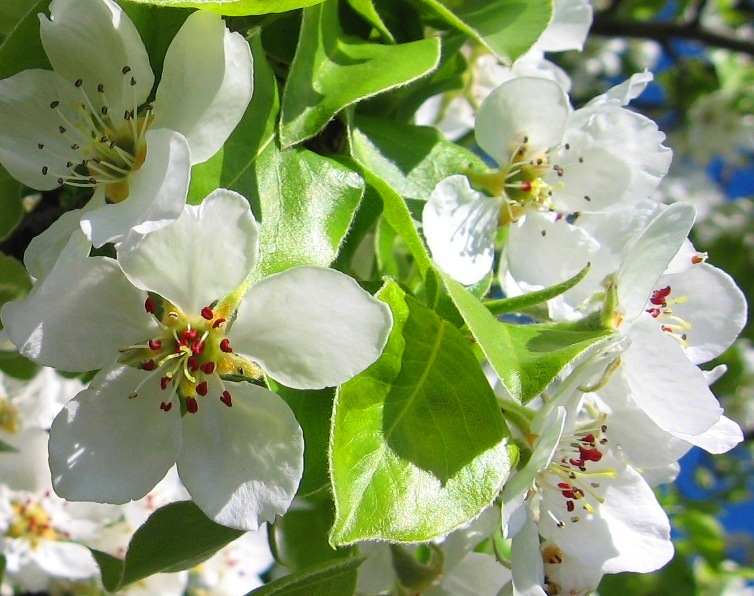
Pear blossom (instead of White Hand of Moses)

However, a rather more likely suggestion is that though the White Hand of Moses may be the name of a particular tree-blossom, Jesus is not the name of any particular flower. Rather the reference is to spring flowers generally bursting forth from the ground, as if enlivened by the life-giving breath of Jesus.

winter's gone
tree blossoms bloom
breath again

© Chèvrefeuille

What a wonderful quatrain this was and what a joy to look inside to its background ... this will be a wonderful month as we are exploring the beauty of "The Rubaiyat" by Omar Khayyam.

This episode is open for your submissions tonight at 7:00 PM (CET) and will remain open until November 9th at noon (CET). I will try to publish our new episode, a new "weekend-meditation", later on.


Saturday, May 7, 2016

Carpe Diem Extra May 7th 2016 Carpe Diem Theme Week 4th edition.


Dear Haijin, visitors and travelers,

A few months ago I started with Carpe Diem Theme Week. This month we will have our 4th edition of the CD Theme Week. I recently read an article about Sufism, but more specific, the Latifa Prayer and I love to introduce that powerful prayer to you in the upcoming CD Theme Week which will start on Sunday May 15th and will 'run' to Saturday May 21st.
I am looking forward to this new theme week.

Namaste,

Chèvrefeuille, your host.