Showing posts with label Hinduism. Show all posts

Friday, September 13, 2019

Carpe Diem #1745 Kumbh Mela (Hindu pilgrimage India)


Dear Haijin, visitors and travelers,

Today we are continuing our "act of devotion" with a Hindu pilgrimage, Kumbh Mela. Let me tell you a little background on this Hindu pilgrimage.

Kumbh Mela is a mass Hindu pilgrimage of faith in which Hindus gather to bathe in a sacred or holy river. Traditionally, four fairs are widely recognized as the Kumbh Melas: the Prayagraj Kumbh Mela, Haridwar Kumbh Mela, the Nashik-Trimbakeshwar Simhastha, and Ujjain Simhastha. These four fairs are held periodically at one of the following places by rotation: Allahabad (Prayagraj), Haridwar, Nashik district (Nashik and Trimbak), and Ujjain. The main festival site is located on the banks of a river: the Ganges (Ganga) at Haridwar; the confluence (Sangam) of the Ganges and Yamuna and the invisible Sarasvati at Allahabad; the Godavari at Nashik; and the Shipra at Ujjain. Bathing in these rivers is thought to cleanse a person of all their sins.


Kumbh Mela at Haridwar

At any given place, the Kumbh Mela is held every 12 years. There is a difference of around 3 years between the Kumbh Melas at Haridwar and Nashik; the fairs at Nashik and Ujjain are celebrated in the same year or one year apart. The exact date is determined, following the Vikram Samvat calendar and the principles of Jyotisha, according to a combination of zodiac positions of Jupiter, the Sun and the Moon. At Nashik and Ujjain, the Mela may be held while a planet is in Leo (Simha in Hindu astrology); in this case, it is also known as Simhastha. At Haridwar and Allahabad, a Maha ("Great") Kumbh Mela is held every 12 years, with an Ardha ("Half") Kumbh Mela six years later. The priests at other places consider their local fairs to be Kumbh Melas; for example, the Mahamaham festival at Kumbakonam, held every 12 years, is described as a Kumbh Mela. Other places where fairs have been called Kumbh Mela include Kurukshetra and Sonipat.

The exact age of the festival is uncertain. According to medieval Hinduism, Lord Vishnu spilled drops of Amrita (the drink of immortality) at four places, while transporting it in a kumbha (pot). These four places are identified as the present-day sites of the Kumbh Mela.


Kumbh Mela in Prayagraj (postal stamp, India)

The festival is the largest peaceful gathering in the world, and considered as the "world's largest congregation of religious pilgrims". There is no precise method of ascertaining the number of pilgrims, and the estimates of the number of pilgrims bathing on the most auspicious day may vary. An estimated 120 million people visited Maha Kumbh Mela in 2013 in Allahabad over a two-month period. (Source: Wikipedia)

Wow ... what a wonderful pilgrimage this must be. 

evening prayers
while cleansing the sinners
the sound of water

© Chèvrefeuille

This episode is NOW OPEN for your submissions and will remain open until September 19th at noon (CEST). I will try to publish our new weekend meditation later on. For now ... take a nice bath, say your prayers and feel connected with the Kumbh Mela ... have fun!


Thursday, March 8, 2018

Carpe Diem #1385 Mary, Mother of Jesus


Dear Haijin, visitors and travelers,

Welcome at a new episode of our wonderful Kai. This month we are exploring the Quran as a book of wisdom. Today I love to share a quote in which we can read (almost) the same thing as we can read in the Bible. The announcement that Mary will become the Mother of the Son of God, Jesus Christ. Christians believe that Jesus is the Son of God, but in the Quran Jesus is seen as a righteous man, a prophet. A Man of pure love.

Let me give you the quote taken from Surah 19, Maryam:

[...] "And mention in the Scripture Mary, when she withdrew from her people to an eastern
location. She screened herself away from them, and We sent to her Our spirit, and He appeared to her as an immaculate human. She said, “I take refuge from you in the Most Merciful, should you be righteous.” He said, “I am only the messenger of your Lord, to give you the gift of a pure son.”  She said, “How can I have a son, when no man has touched me, and I was never unchaste?” He said, “Thus said your Lord, `It is easy for Me, and We will make him a sign for humanity, and a mercy from Us. It is a matter already decided.'" [...] (Source: Surah 19, Maryam, Ayah 16-21)

The Angel Gabriel announces to Mary her pregnancy with Jesus (17th century)

And I also love to share the same words taken from the Bible:

[...] "God sent the angel Gabriel to Nazareth, a town in Galilee, to a virgin pledged to be married to a man named Joseph, a descendant of David. The virgin’s name was Mary. The angel went to her and said, “Greetings, you who are highly favored! The Lord is with you.” Mary was greatly troubled at his words and wondered what kind of greeting this might be. But the angel said to her, “Do not be afraid, Mary; you have found favor with God. You will conceive and give birth to a son, and you are to call him Jesus. He will be great and will be called the Son of the Most High. The Lord God will give him the throne of his father David, and he will reign over Jacob’s descendants forever; his kingdom will never end.”  “How will this be,” Mary asked the angel, “since I am a virgin?” The angel answered, “The Holy Spirit will come on you, and the power of the Most High will overshadow you. So the holy one to be born will be called[b] the Son of God. Even Elizabeth your relative is going to have a child in her old age, and she who was said to be unable to conceive is in her sixth month. For no word from God will ever fail.” “I am the Lord’s servant,” Mary answered. “May your word to me be fulfilled.” Then the angel left her." [...] (The Gospel of Luke 1: 26-38 NIV)

Statue of the Virgin Mother Mary in Karachi were she is known as Our Lady of Valenkanni

The Quran is given to the people by God through Muhammed, a very wise man. 

blessed Mother
brings together all devotees
bridging the gap

© Chèvrefeuille

Well I hope you did like this episode. I was excited to read that Mary also is part of Hinduism and  Zoroastrian. Again Hinduism is mentioned ... isn't that the oldest religion on earth? Is this another reference that the Quran was compiled after a spiritual journey by Muhammed? I respect the idea that the Quran was given by God to Muhammed, but I think we may ask questions ...

This episode is NOW OPEN for your submissions and will remain open until March 15th at noon (CET). I will try to publish our new weekend-meditation later on. For now ... be inspired.


Monday, March 5, 2018

Carpe Diem #1382 Adam and Eve


Dear Haijin, visitors and travelers,

Peace be with you. What does it mean to say that? Well ... I think it's a wonderful greeting, because I wish you all peace of heart, mind and soul. This was what made me doubt if I should do a whole CDHK month about the Quran, the Holy Book of Islam. I love everyone unconditional and therefore I also love muslim, but as you all know the last years Islam became a feared religion through IS and that made me sad and doubtful. After thinking it over and over again I decided to create this month full of the wisdom from the Quran. Of course it's not my goal to convert you to Islam, but the Quran is a wonderful Book full of wisdom. Given to the world, especially for muslim, but there are also wonderful words in the Quran that can give peace of mind to everyone, not only muslim.

This month I love to share with you the wonders and beauties of the wisdom in the Quran and of course I will, without losing respect for the Quran, try to find similarities between the religious books we all know. (By the way as you have noticed maybe, I don't use Allah, but God, in our episodes. Not to be disrespectful, but because my philosophy is stated on the idea "All Gods Are One God".


Today I have chosen a verse from Surah 4: Ayah 1 (an-Nisa' or "women"). In this verse we can easily see the story of Adam and Eve as we know it from the Bible. Let me give you first the mentioned verse:

[...] "O people! Fear your Lord, who created you from a single soul, and created from it its mate, and propagated from them many men and women. And revere God whom you ask about, and the parents. Surely, God is Watchful over you." [...] (Surah 4: Ayah 1)

And this is what the Bible says about this:

[...] "So the Lord God caused the man to fall into a deep sleep; and while he was sleeping, he took one of the man’s ribs and then closed up the place with flesh. Then the Lord God made a woman from the rib he had taken out of the man, and he brought her to the man.

The man said,

“This is now bone of my bones
    and flesh of my flesh;
she shall be called ‘woman,’
    for she was taken out of man.”

That is why a man leaves his father and mother and is united to his wife, and they become one flesh." [...] (Genesis 2: 21-24 NIV)

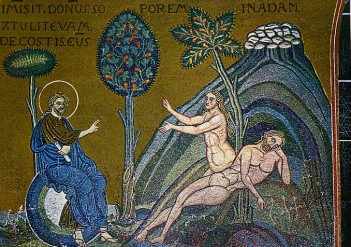
ADAM AND EVE . This mosaic from the Cathedral of Monreale, Sicily, depicts the creation of woman in the Bible. Eve is shown emerging from Adam’s side. Most translations of the Adam and Eve story say that Eve was created from Adam’s rib, but Ziony Zevit contends that she was created from a very different part of Adam’s body.

The creation of mankind is in both scriptures the same, the only thing is the use of the words, but in it's origin the stories are alike.

As I said in earlier posts, Islam is a young religion and there are a lot of similarities with other religions. I however respect the idea that the Quran was given to Muhammed. Is it possible without being disrespectfull to look at this somewhat closer?

In my opinion, without being disrespectfull, I think that Muhammed was a very wise man seeking for inner peace and was wandering around the world to find peace of mind. Than he ran into all the different beautiful religions and philosophies and wrote it down? But isn't that the same statement I have made about the Bible? Because if we look at e.g. Jesus Christ, it sounds like Krishna. Hinduism is in my opinion the oldest religion on earth, except of course the religion of nature.

Isn't that wonderful in this short episode I said "All Gods Are One God" and if we look closer to all the different kinds of religions and analyze them we always arrive at the idea of only one God.

new life rises
after the cold winter
daffodils bloom
taken from her man's body
she was created by God's hand

© Chèvrefeuille

What a story this is ... and what a joy to read this in both the Quran and the Bible. God works in mysterious ways.

Hinduism

I also love to share how man and woman were created according to Hinduism, just to give you an idea, that there are similarities between all the religions:

[...] "He (Yājñavalkya) was not at all happy. Therefore people (still) are not happy when alone. He desired a mate. He became as big as man and wife embracing each other. He parted this very body into two. From that came husband and wife. Therefore, said Yājñavalkya, this (body) is one-half of oneself, like one of the two hálves of a split pea. Therefore this space is indeed filled by the wife. He was united with her. From that men were born." [...] (Brihadaranyaka Upanishad 1.4)

This episode is open for your submissions tonight at 7:00 PM (CET) and will remain open until March 12th at noon (CET). I will try to publish our new episode later on. For now ... have fun, be inspired and share your Japanese poetry with us all.


Sunday, March 4, 2018

Carpe Diem #1381 Thunder and Lightning


Dear Haijin, visitors and travelers,

I have said it in earlier posts this month, but there are several similarities between the Quran and The Bible. One of those similarities is the story about the Creation. In the Quran and The Bible the creation stories are completly the same. What does that mean?
We all know that Islam is a young religion (7th century CE) and the story is the same as in the Bible. Of course we know that the Quran was reveealed to Muhammed the Prophet, but can Muhammed be the Prophet of the Christian God? Or is he really a prophet of Allah, I think we have to respect that idea, but I also think we can ask us these questions too.

Did Muhammed knew about the Bible? And was he just another interpreter of the Holy Bible? This could be an explanation of the similarities between the Quran and the Bible. Both holy books tell the story of the Creation.

The Beauty of Nature
 The following verses are from the Surah ar-Ra'd or thunder. Thunder and Lightning is the title of this episode and I have chosen that title, because thunder and lightning are energies "used" by God. Maybe He used it as He was creating the flood that re-created Earth (the story of Noah). The Quran mentions thunder and lightning as a kind of punishment for Earth and its inhabitants.

[...] "It is He who shows you the lightning, causing fear and hope. And He produces the heavy clouds. The thunder praises His glory, and so do the angels, in awe of Him. And He sends the thunderbolts, striking with them whomever He wills. Yet they argue about God, while He is Tremendous in might." [...] (Surah 13: 12-13)

A similar verse we find in the book of Exodus:

[...] "And all the people were watching the thunderings and the flames and the sound of the horn and the mountain smoking; and when they saw it, they kept far off, shaking with fear. And they said to Moses, To your words we will give ear, but let not the voice of God come to our ears, for fear death may come on us." [...](Exodus 20: 18-19)

In both examples we see that the voice of God is heard as thunder and lightning, and that's very similar to the Scandinavian idea of Thor, God of Thunder. Or in that wonderful Hindu book Mahabharata you can find several verses in the same tone with the same idea and emotion.

[...] "Even as he said this, the clouds above thundered and everyone knew that the god of the thunderbolt was coming, and trembled in fear.' [...] (Source: Mahabharata)

Raijin Shinto god of thunder (wooden sculpture)

The same idea is also mentioned in several Shinto scriptures. Often the Shinto god of thunder and lightning is named Raijin (His name is derived from the Japanese words rai ("thunder") and "god" or "kami" (shin). He is typically depicted as a demon-looking spirit beating drums to create thunder, usually with the symbol tomoe drawn on the drums. During a thunderstorm parents say to their children to hide their belly bottoms (navel), because the god of thunder will eat their belly bottom.

All wonderful ideas and thoughts I think, all can be a source for the Quran, but we have to respect the idea that the Quran was given to Muhammed by God.

frogs jump in -
the sound of rain far away
thunder and lightning

© Chèvrefeuille

The Beauty of Nature

Another one also from my archives:

rolling thunder
between green banks
clear waterfall

© Chèvrefeuille

And here is a new one, a tanka this time:

rolling thunder
my heart jumps of love
embracing her
she the one I love so dearly
cries in fear of lightning

© Chèvrefeuille

Well ... I hope you did like this episode and that it will inspire you to create haiku, tanka or other Japanese poetry form.

This episode is open for your submissions tonight at 7:00 PM (CET) and will remain open until March 11th at noon (CET). I will try to publish our new episode later on.


Monday, October 16, 2017

Carpe Diem #1280 Wheel of Creation


Dear Haijin, visitors and travelers,

Let us go further on our trip along memory lane. We enter a new year in this trip and have arrived at 2015. 2015 Was a wonderful year in which we started to read more and more to seek for the Peace Within. The Peace Within was the reason why we started to read the Bhagavad Gita that wonderful chapter of the Hindu "bible", the Mahabaratha. We started reading in April 2015 and it was a real journey through Hinduism. We disputed Hinduism as the Mother of all Religions, of course just hypothetical.

The Bhagavad Gita is a really wonderful story to read. It's the heart of Hinduism. It gives a report from a conversation that Arjuna had with Krishna at the start of a great war between good and evil. Arjuna dares not to start the war, because he sees friend, relatives and family between the army of the enemy. He doesn't want to kill his beloved ones. Than Krishna teaches him the path of life.

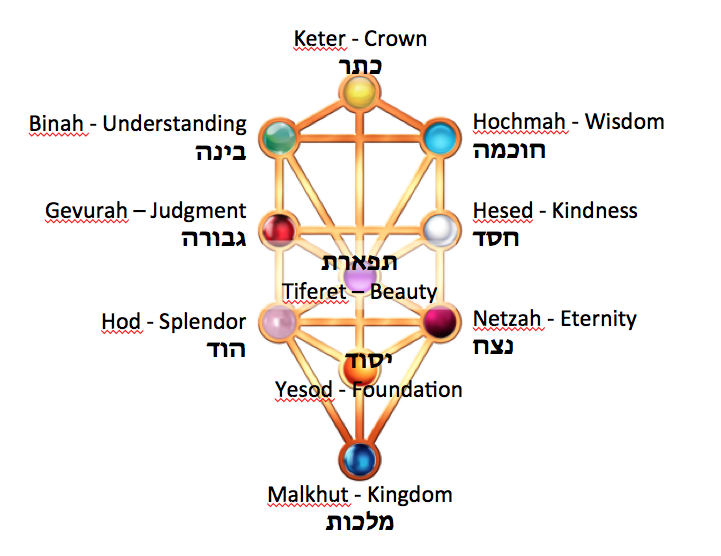
During that month we explored nt only Hinduism, but we also tried to find connections between religions and philosophies from all around the world. We even could find connections with the Tarot and the Kabbalah.

Tree of Life (Kabbalah)
We are on our way to find Peace of Mind and Heart ... and I hope you have found that while we were reading the Bhagavad Gita.

Haiku is not only the poetry of nature, but it is also a way to find that peace. While strolling through nature we become one with nature, become part of nature (as it was once meant to be) and than we experience the beauty of our Earth. We have to cherish her beauty, Earth is the only source to find peace of mind and heart. Isn't that what we all see as our goal?

cherry blossom
long cold night
reborn

© Chèvrefeuille (experimental haiku)

Well ... I hope I didn't sound like a preacher, this was not a sermon, only a flow of thoughts ...

This episode is open for your submissions tonight at 7:00 PM (CET) and will remain open until October 23rd at noon (CET). I will try to publish our new episode, Suzuran, later on. Have fun!


Sunday, October 23, 2016

Carpe Diem Special (2nd guest) Kala Ramesh #4 jasmine rain


Dear Haijin, visitors and travelers,

First a few announcements:

1. I am behind with commenting on all of your beautiful art-work of haiku- and tanka poetry. I hope to catch up a.s.a.p.
2. On our Tumblr "Carpe Diem Haiku Kai" you can find a sneak preview for the upcoming months. You can find this Tumblr HERE
3. Next month, because of the still running "autumn"-kukai I have a unique series of CD Specials in mind for you all ... here is the new CD Special logo for November (© photo):


I love to introduce haiku- and tanka poets from The Netherlands to you. I am busy with gathering the permissions for these CD Specials and I hope to surprise you all.

Okay ... back to our 4th CD Special by our second guest Kala Ramesh. Kala is a renown haiku- and tanka poetess from India and she really writes wonderful haiku and tanka. For this CD Special I have chosen a mixture of haiku and tanka created by her.

I hope her haiku and tanka will be bring you the inspiration you need ... in other words ... let Kala Ramesh be your muse for today.

I look at the blue sea
and the blue sky
in wonder . . .
gently they turn
into night


liquid twilight
the tilt of a water pot
on her hip

Banyan Tree
rain catchers
near our banyan tree
here and there
leaves of the pond lotus
roll raindrop-moons


fireflies
in their own world
jasmine rain


© Kala Ramesh, Pune, India

I wasn't familiar with the Banyan Tree, so I searched the Internet and found a nice piece of text (on wikipedia) in which the deeper spiritual meaning of the Banyan Tree is mentioned. There is also reference that the Banyan Tree stands for eternity and everlasting. In hindu images the god Shiva is seen very often sitting in silence under the Banyan Tree.

The banyan tree is the national tree of India. It is also called Indian or Bengal fig. This tree is considered sacred in India and can be seen near a temple or religious center. It is a big tree and gives shade to travelers in very hot summer months. An old custom offers worship to this tree.

In Hinduism, the leaf of the banyan tree is said to be the resting place for the god Krishna.
In the Bhagavat Gita, Krishna said, "There is a banyan tree which has its roots upward and its branches down, and the Vedic hymns are its leaves. One who knows this tree is the knower of the Vedas." (Bg 15.1) Here the material world is described as a tree whose roots are upwards and branches are below. We have experience of a tree whose roots are upward: if one stands on the bank of a river or any reservoir of water, he can see that the trees reflected in the water are upside down. The branches go downward and the roots upward. Similarly, this material world is a reflection of the spiritual world. The material world is but a shadow of reality. In the shadow there is no reality or substantiality, but from the shadow we can understand that there is substance and reality.

A Big Banyan Tree at Bangalore (photo © Kiran Gopi)

shadows move
up and down the wall
bare branches

© Chèvrefeuille

in the shadow of the old Banyan Tree I sit in peace seeking contact with the Universe leaves resonate the Vedas

© Chèvrefeuille

What a beautiful tree this is the Banyan Tree ... I was really surprised to read all the information on this "holy" tree and as you can read I was inspired. Now it is up to you ...

This episode is NOW OPEN for your submissions and will remain open until October 28th at noon (CET). I will try to publish our next episode, folding paper, later on. Have fun ... take a seat under the Banyan Tree.


Wednesday, April 29, 2015

Carpe Diem #716, Joy


Dear Haijin, visitors and travelers,

Today we are at the end of our journey through the Bhagavad Gita. We have explored this wonderful "Veda" and maybe you have found the "peace of mind" which was our central theme this month. It's with a little bit of pain in my heart that I write this last episode for April, but at the other hand it's a joy, as is our prompt for today, that this month is over, because this month wasn't easy to make.

We have tried to come in contact with Arjuna, the Archer, and Krishna, the Charioteer, who had a conversation about the goal of life ... Enlightenment. We even dared to step into the hypothetical question "Do all religions and life-philosophies derive from Hinduism, the oldest known religion?" This question stays unanswered, but it was worth to think it over.

Today our prompt is joy and as I started this episode I first thought of an abbreviation which which I once heard, but than I realized that that abbreviation was more based on the Christian believe and I don't think that I can refer to Christianity in our last episode of this "peace of mind" month in which we have read the Bhagavad Gita.
So I decided to reproduce the last 20 verses of the Bhagavad Gita here ... those last verses are full of joy and are giving us a kind of summary of the whole Bhagavad Gita.

50. Learn from Me in brief, O Arjuna, how he who has attained perfection reaches Brahman, that supreme state of knowledge.
51. Endowed with a pure intellect, controlling the self by firmness, relinquishing sound and other objects and abandoning both hatred and attraction,
52. Dwelling in solitude, eating but little, with speech, body and mind subdued, always engaged in concentration and meditation, taking refuge in dispassion,
53. Having abandoned egoism, strength, arrogance, anger, desire, and covetousness, free from the notion of “mine” and peaceful,—he is fit for becoming Brahman.
54. Becoming Brahman, serene in the Self, he neither grieves nor desires; the same to all beings, he attains supreme devotion unto Me.
55. By devotion he knows Me in truth, what and who I am; and knowing Me in truth, he forthwith enters into the Supreme.
56. Doing all actions always, taking refuge in Me, by My Grace he obtains the eternal, indestructible state or abode.
57. Mentally renouncing all actions in Me, having Me as the highest goal, resorting to the Yoga of discrimination do thou ever fix thy mind on Me.
58. Fixing thy mind on Me, thou shalt by My Grace overcome all obstacles; but if from egoism thou wilt not hear Me, thou shalt perish.
59. If, filled with egoism, thou thinks: “I will not fight”, vain is this, thy resolve; Nature will compel thee.
60. O Arjuna, bound by thy own Karma (action) born of thy own nature, that which from delusion thou wishes not to do, even that thou shalt do helplessly!
61. The Lord dwells in the hearts of all beings, O Arjuna, causing all beings, by His illusive power, to revolve as if mounted on a machine!
62. Fly unto Him for refuge with all thy being, O Arjuna! By His Grace thou shalt obtain supreme peace and the eternal abode.
63. Thus has wisdom more secret than secrecy itself been declared unto thee by Me; having reflected over it fully, then act thou as thou wishes.
64. Hear thou again My supreme word, most secret of all; because thou art dearly beloved of Me, I will tell thee what is good. 65. Fix thy mind on Me, be devoted to Me, sacrifice to Me, bow down to Me. Thou shalt come even to Me; truly do I promise unto thee, (for) thou art dear to Me.
66. Abandoning all duties, take refuge in Me alone; I will liberate thee from all sins; grieve not.
67. This is never to be spoken by thee to one who is devoid of austerities, to one who is not devoted, nor to one who does not render service, nor who does not desire to listen, nor to one who cavils at Me.
68. He who with supreme devotion to Me will teach this supreme secret to My devotees, shall doubtless come to Me.
69. Nor is there any among men who does dearer service to Me, nor shall there be another on earth dearer to Me than he.
!! NB. For this month's quotes from the Bhagavad Gita I used the version as given by Sri Swami Sivananda, the founder of the Divine Life Society !!

high above Mother Earth
I feel like an Eagle watching
searching for new life
inside with my Inner Eye
flight of an Eagle


© Chèvrefeuille (published earlier at my personal weblog)


Well ... it wasn't an easy month, but I hope you all did like this month and I am glad that this story could be told here at Carpe Diem Haiku Kai ... And now we are going "on the trail with Basho" next month .... I am looking forward to this new month of CDHK and I hope it will be a great success and a joy.

This episode is open for your submissions tonight at 7.00 PM (CET) and it will remain open until May 2nd at noon (CET). I will try to publish our first episode of our new month, Weather Beaten, later on.

Tuesday, April 28, 2015

Carpe Diem #715, Purity


Dear Haijin, visitors and travelers,

We are counting down, we have just two episodes to go this month in which we were searching for "peace of mind" through reading the Bhagavad Gita and following the conversation between Arjuna and Krishna while they are standing between two armies ready for battle.
The Bhagavad Gita is the most important "veda" for Hinduism, because in the Bhagavad Gita they learn how to become in peace with their own heart, mind and soul. I can only hope that the Bhagavad Gita has given you all a little bit of the "peace of mind", our central theme this month.

Purity is our prompt for today, but what is purity? Is it like a newborn child? Is the purity described here that what we call pure ... as in dark chocolate? Is the purity of white or unconditional love? Purity can be explained in a lot of ways. To me purity is honesty, righteousness, unconditional love, to me purity is the beauty of nature in all her different shapes. To me purity is the most important thought to be your host here at Carpe Diem.
Purity of haiku, that impression of a moment as short as the sound of a pebble thrown into water caught in just three lines. In my response on a comment in our yesterday's post I said: "Without my readers I am nothing. I need my readers to be what I am ... a haiku poet ... that's purity to me.


What is said about purity in the Bhagavad Gita? Let us take a look.

There are a lot of verses about purity. They mostly exist in the last chapter (18) and I ran into a verse which says it all:

"Serenity, self-restraint, austerity, purity, forgiveness and also uprightness, knowledge, realization and belief in God are the duties of the Brahmanas, born of (their own) nature".

In my opinion, without propagandizing my ideas or those in the Bhagavad Gita or in Hinduism, the above verse says it all. Purity could be our savior to bring the world finally ultimate peace, not only peace in mind, but also peace between countries and religions. Purity is the energy which we can use to become better people.

Purity ... in this episode from the ideas and thoughts in the Bhagavad Gita, is also the purity which all religions and life philosophies are seeking for. It is all based on becoming good people. This is what is called "the first triad" in the glyph of the mystical wisdom of the Kabbalah in which the three most important Sephira are gathered "Kether, Binah and Chochma" in those three Sephira purity is all what there is ....

pure of heart
white roses start to bloom
one with the Cosmos


© Chèvrefeuille

Purity ... is a great idea, a great thought, a great feeling ... it is part of us ... we may be pure in everything we do ...

This episode is NOW OPEN for your submissions and will remain open until May 1st at noon (CET). I will try to publish our next episode, joy, later on. For now ... be inspired and share ....

Saturday, April 25, 2015

Carpe Diem #714, Universal Self


Dear Haijin, visitors and travelers,

The final goal of our journey, peace of mind, is almost there and today we do one of our final steps. The Bhagavad Gita is a wonderful and spiritual story and the final goal is that Arjuna finds the meaning of life and death ... his (Arjuna) goal is to become One with all and everything ... he will find it and reach his goal .... Universal Self. One with the Universe, becoming only One with all ... this is what the Bhagavad Gita has to tell us.

We are part of all and everything. We are all one with God (or Spirit, Light ...) and God is one with us. Finally we will be only spirit .... oneness .... In this journey we have seen that through the veils of the Bhagavad Gita and we have seen it ... we are all one. We are all one with nature, not only we are in nature, we are nature ... isn't that wonderful? We are all nature .... as every haiku poet/ess is.
Maybe you can read the Little Creatures episode of today once again ... because Chiyo-ni was also nature ...

What a joy that we are nature, we are ONE with nature and ONE with God .... isn't that what all the religions and life-philosophies are saying? Is this Universal Self the answer on our hypothetical question "Are all religions born from Hinduism, the oldest known religion?
Christians, Buddhists, Muslim, Pentecostals and more are all searching for becoming one with God ... it just can't be different .... Hinduism is the source of all religions. Of course this idea is hypothetical, because I am not a professor in religion and spirituality ... maybe there are scientists who are busy with this idea ... I don't know ...

Credits: Universal Self

no boundaries left
all one with nature, the universe
a new day rises


© Chèvrefeuille

Not a strong verse this time, but as I say it aloud it feels strong and like a mantra ... am I one with the Universe? Have I found (finally) my Universal Self?

This episode is open for your submissions tonight at 7.00 PM (CET) and will remain open until April 28th at noon (CET).. I will (try to) post our new episode, our last haiku by Kala, our featured haiku poetess, later on


Friday, April 24, 2015

Carpe Diem #713, devotion


Dear Haijin, visitors and travelers,

As I was starting to create this episode I realized that I have done an earlier post on devotion. So in a way this will be a kind of reprise prompt, but I think that's ok.
We are busy with reading and exploring the Bhagavad Gita, the story in which Arjuna and Krishna have a conversation about the goals of life, life and death and so on. There they are in the middle of two big armies. Families, friends and teachers who are willing to start a battle against eachother. As Arjuna sees the both armies he isn't sure to start the battle.

The Bhagavad Gita is about devotion. Devoted to Krishna to become a better man. Discovering Self and selflessness. Arjuna learns this right from Krishna himself and that makes him a kind of prophet or even similar to the human idea of Jesus.

In several of our episodes we asked our self the question, hypothetically seen, if all religions have derived from Hinduism, because of the fact that Hinduism is the oldest religion we know of. There are a lot of similarities as we have seen already, but still the questions stays on "Did all religions derive from Hinduism?" That's a great question, but it will not be easy to find the answer, because historians have "made" history to point the Western world to the Romans and Greek as being the base of our history. The Eastern world isn't seen as the base of our history .... In this time the 21st century there are historians who finally are giving the world the insight that there was an Eastern world, that maybe there is a connection with the Eastern world and their religions. That's a very big change of ideas and it will take time to accept that idea.


Back to our prompt for today, devotion. Every one is devoted to something (or someone). For example I am devoted to my patients, but also to haiku. I am not a devotee of some religion, but I belief that there has to be something, a strong spiritual power, that leads me on the path I am going. Devotion to God, Allah, Krishna or what name the gods have, isn't really what I am doing, but of course I respect others who are devoted to something or someone ... and they will respect me (at least that's what I think is the best way to find peace of mind, and maybe peace all over the globe).

That's also the main theme in the Bhagavad Gita, devotion, peace of mind and peace all around the globe. And that's what (again) gives me the idea that our hypothetical question is close to the truth.

chanting their mantra
broomstick and rake in hand
true meditation


(c) Chèvrefeuille

We are almost at the end of our journey through the Bhagavad Gita and we have read and found wonderful insights in this gorgeous story .... just a few days and than we will go "on the trail with Basho" .... I am excited ....

This episode is open for your submissions tonight at 7.00 PM (CET) and will remain open until April 27th at noon (CET). I will (try to) publish our next episode, Universal Self, later on.

Thursday, April 23, 2015

Carpe Diem #712, Lotus


Dear Haijin, visitors and travelers,

What a joy this month gives me, of course it's a tough month to create the episodes, but I love doing it. It's a wonderful story this Bhagavad Gita and I think you all like this themed month too. For today I love to do it a little bit different.

Maybe you can recall our special feature "Carpe Diem Imagination" in which the goal was to create a haiku inspired on a given image (as I do e.g. in the Time Glass feature). As you can read in the title of this episode, Lotus, is our prompt for today and therefore I love to challenge you to create a haiku inspired on an image of the Lotus.

Credits: Lotus
A wonderful image I think and I hope it will inspire you to create an all new haiku. Feel free to use another image of a Lotus or to create a tanka or haiga instead of a haiku.

I have chosen to use a haiku from my archives, so no newly created haiku this time.

spirit grows -
from the bottom of the pond
into the light

into the light
the Lotus reaches from the deep -
spirit grows

© Chèvrefeuille

The stage of growth the lotus flower is in represents a different stage of enlightenment. A closed lotus flower represents the time before enlightenment. A lotus flower fully bloomed and open represents full enlightenment and self-awareness. And that's were it is all about in the Bhagavad Gita. This idea of the Lotus representing spiritual growth we also see in Buddhism.

This episode is open for your submissions tonight at 7.00 PM (CET) and will remain open until April 26th at noon (CET). I will (try to) publish our new episode, devotion, later on. For now .... have fun, be inspired and share your haiku with us all.


Wednesday, April 22, 2015

Carpe Diem #711, Harmony


Dear Haijin, visitors and travelers,

Today our prompt is harmony and it is based on the following verse from the 6th chapter of the Bhagavad Gita:
18. When the perfectly controlled mind rests in the Self only, free from longing for the objects of desire, then it is said: “He is united”.

Without union with the Self neither harmony nor balance nor Samadhi is possible. This is quit the same as the Emptiness idea in Buddhism, but also in the idea of living as a hermit in a lot of other religions or life philosophies. Let us step outside the Bhagavad Gita for a moment and look at the Hermit (IX), one of the cards of the Major Arcana of Tarot. What do we see?


We see an old man, cloaked and hooded, who holds a lantern in his right hand in which a light shines in the shape of The Star of David, two superimposed triangles. In his left hand he has a staff. He stands in the snow somewhere in the mountains as we can see in the background.


He looks like The Fool (0), but is older than The Fool. He is similar with The Fool, but there is a big difference. The Fool gathered his knowledge and wisdom by walking / travelling through the world and to look around him. He saw the beauty of nature, the beauty of God's Creation. The Fool's knowledge is of a low, but lived, level, which I call external knowledge.. The Hermit (IX) gathered his knowledge and wisdom through meditation and contemplation on his own, maybe he used secret scriptures when he sat down to meditate and contemplate or he had spiritual revelations, because he was just alone with God's Spirit. His knowledge and wisdom I use to call internal knowledge on a high level.

Anchorite
contemplates on love
seeking knowledge

s
eeking knowledge
insight the Inner Self
the hermit's choice

© Chèvrefeuille

The Hermit (IX) closes the third trinity of the Major Arcanum and stands for the Holy Spirit. As The Hierophant represents God the Son, the Redeemer who walked among us, The Hermit represents God the Holy Spirit. It's through the Power of the Holy Spirit that we are in touch with our emotions to grow spiritually and physically.
The Light of the World, depicted in this card by the lantern in the right hand, is one of the names of Jesus Christ (Krishna?). His Light shines upon us and He said of that Light: [...] "No one lights a lamp and puts it in a place where it will be hidden, or under a bowl. Instead they put it on its stand, so taht those who come in may see the light"[...] (Luke 11: 33)

There is a similar verse in the Bhagavad Gita 6th chapter verse 19:

As a lamp placed in a windless spot does not flicker—to such is compared the Yogi of controlled mind, practicing Yoga in the Self (or absorbed in the Yoga of the Self)"
let shine the light
don't hide it under a bowl -
share the Light of the World


© Chèvrefeuille

So The Hermit fulfills this task. He lets the light shine and through that light we can see the ancient knowledge and wisdom in the Tarot, the divine Tarot.
A Hermit lives alone in his cave, home, hut or something else. He lives in absolute isolation of mankind. All his days and nights are for becoming wiser through meditation and contemplation. Through his perseverance he comes in contact with his Inner Self, with the Holy Trinity of Father, Son and Spirit.
As we place The Hermit on the Tree of Life we will find him in Chochmah, the second sephira, right after Kether and before Binah. So he is placed in the same spot as Adam. Chochmah is the sephira of wisdom and it's also similar with the 'Third-Eye'. The Hermit is internal knowledge and wisdom and he knows all the ancient mystical secrets and as we all know so did Jesus.
I told earlier that The Hermit lives in complete isolation of the worldly things and manners. As I was preparing this episode through research, the first thought which came in mind was the Temptation of Christ (Matthew 4: 1-11). In which the devil tempted Him, but He succeeded and withstood the temptation.
Also The Hermit (IX) is tempted to leave his cave, but he didn't because he would learn all and everything about knowledge and wisdom.


Credits: Harmony (one with nature)

Another thing which came in mind as I was reading these verses in the Bhagavad Gita is the Prayer of Christ on the Mount of Olives (Luke 22: 39-46). He beseeches His Father to take the cup away. On that moment He was more human than ever, but He knew that He had to drink the cup.

This can point to open the Inner Self as is meant in the above verses of the Gita. Only when the heart, mind and soul are united than you become in harmony. Is this again part of our hypothetical idea that all religions are deriving from Hinduism?

Harmony in my opinion can reach through all boundaries and maybe we will once say “finally the World is united and in Peace”.
finding peace of mind
the soothing sound of rippling water
the rustling of leaves
strengthens my tired mind
that's fortitude


that's fortitude
deep inner peace, the beating of my heart,
the music of life


the music of life
caught in the rippling stream -
finding peace of mind


© Chèvrefeuille

It wasn't really easy to create this episode on harmony, because it has so much different meanings and ideas ...

This episode is open for your submissions tonight at 7.00 PM (CET) and will remain open until April 25th at noon (CET). I will (try to) publish our new episode, Lotus, later on. For now .... have fun, be inspired and share your haiku with us all.