Showing posts with label Christianity. Show all posts

Thursday, March 8, 2018

Carpe Diem #1385 Mary, Mother of Jesus


Dear Haijin, visitors and travelers,

Welcome at a new episode of our wonderful Kai. This month we are exploring the Quran as a book of wisdom. Today I love to share a quote in which we can read (almost) the same thing as we can read in the Bible. The announcement that Mary will become the Mother of the Son of God, Jesus Christ. Christians believe that Jesus is the Son of God, but in the Quran Jesus is seen as a righteous man, a prophet. A Man of pure love.

Let me give you the quote taken from Surah 19, Maryam:

[...] "And mention in the Scripture Mary, when she withdrew from her people to an eastern
location. She screened herself away from them, and We sent to her Our spirit, and He appeared to her as an immaculate human. She said, “I take refuge from you in the Most Merciful, should you be righteous.” He said, “I am only the messenger of your Lord, to give you the gift of a pure son.”  She said, “How can I have a son, when no man has touched me, and I was never unchaste?” He said, “Thus said your Lord, `It is easy for Me, and We will make him a sign for humanity, and a mercy from Us. It is a matter already decided.'" [...] (Source: Surah 19, Maryam, Ayah 16-21)

The Angel Gabriel announces to Mary her pregnancy with Jesus (17th century)

And I also love to share the same words taken from the Bible:

[...] "God sent the angel Gabriel to Nazareth, a town in Galilee, to a virgin pledged to be married to a man named Joseph, a descendant of David. The virgin’s name was Mary. The angel went to her and said, “Greetings, you who are highly favored! The Lord is with you.” Mary was greatly troubled at his words and wondered what kind of greeting this might be. But the angel said to her, “Do not be afraid, Mary; you have found favor with God. You will conceive and give birth to a son, and you are to call him Jesus. He will be great and will be called the Son of the Most High. The Lord God will give him the throne of his father David, and he will reign over Jacob’s descendants forever; his kingdom will never end.”  “How will this be,” Mary asked the angel, “since I am a virgin?” The angel answered, “The Holy Spirit will come on you, and the power of the Most High will overshadow you. So the holy one to be born will be called[b] the Son of God. Even Elizabeth your relative is going to have a child in her old age, and she who was said to be unable to conceive is in her sixth month. For no word from God will ever fail.” “I am the Lord’s servant,” Mary answered. “May your word to me be fulfilled.” Then the angel left her." [...] (The Gospel of Luke 1: 26-38 NIV)

Statue of the Virgin Mother Mary in Karachi were she is known as Our Lady of Valenkanni

The Quran is given to the people by God through Muhammed, a very wise man. 

blessed Mother
brings together all devotees
bridging the gap

© Chèvrefeuille

Well I hope you did like this episode. I was excited to read that Mary also is part of Hinduism and  Zoroastrian. Again Hinduism is mentioned ... isn't that the oldest religion on earth? Is this another reference that the Quran was compiled after a spiritual journey by Muhammed? I respect the idea that the Quran was given by God to Muhammed, but I think we may ask questions ...

This episode is NOW OPEN for your submissions and will remain open until March 15th at noon (CET). I will try to publish our new weekend-meditation later on. For now ... be inspired.


Monday, November 20, 2017

Carpe Diem #1309 Earth's First Clay


Dear Haijin, visitors and travelers,

Well ... I don't really know if this quatrain for today will inspire you. At least it didn't inspire me, just because of it's difficulties hidden it. This quatrain tells us about the first man, Adam, created from the Earth's first clay, but with this creation he also created the last man ...

Let me give you the quatrain for today:

With Earth's first Clay They did the Last Man's knead,
And then of the Last Harvest sowed the Seed:
Yea, the first Morning of Creation wrote
What the Last Dawn of Reckoning shall read.

© Omar Khayyam (Tr. FitzGerald)

modern art: The Creation of Adam

Background: (source: bob forrest web)

This verse can be taken as a pessimistic suspicion that everything is predestined: with the Earth’s first Clay, from which God created (moulded, as a sculpture) the first man, Adam, God also created (“knead” = shape, as in shaping the dough for a loaf of bread) the clay for the Last Man. The second line likens God’s creation of Man to planting a crop: the Harvest at the End of the World is predetermined by the Seed which God planted at the Beginning. The last two lines neatly contrast WRITE at the Creation, with READ at the End (Last Dawn of Reckoning.)

There are similarities in the creation of Adam in several religions, here it's used as in Islam, but also as used in Christianity.

This episode is NOW OPEN for your submissions and will remain open until November 27th at noon (CET). I will try to publish our new episode later on. For now ... have fun!


Tuesday, November 7, 2017

Carpe Diem #1300 The Rose


Dear Haijin, visitors and travelers,

Today is another day in a wonderful world in which poetry is the leading character. A few minutes ago I stood almost naked in the freezing cold of a late autumn night. We had our first period of frost here in The Netherlands and this morning it was awesome. The sunrise was awesome and blue sky steel like. It was a great morning. And now this same feeling I had as I stood outside my house in the backyard watching the dark blue starry night. It was almost magical, but also a little bit sad, because the amount of city-lights takes away that wonderful sight of a starry night. Sometimes, mostly in this time of year (inbetween two seasons) I climb on my bike and cycle into the surrounding areas of my hometown. Just to see the stars, it is such an awesome sight to see the stars and the Milky Way, without the pollution of city-light. I am in a bit of melancholical mood I think, but I need that sometimes. Just meditate and contemplate about the things that matter ... and to find a little bit peace of mind after a very busy day at work.

Starry Night in Winter (painting by Van Gogh)
This was just to give an idea of the mood I am in, nothing wrong with by the way, nothing wrong with me neither.

Today I have the first of two quatrains by Omar Khayyam from "The Rubaiyat" which (in my opinion) cannot be seen apart, but maybe you think otherwise. The title of this episode I have extracted from the quatrain I use today. It's a beauty I think. Of course I will give you some background too (with a little bit help of wikipedia and bob forrest).

Hyacinth (image found on Pinterest)

Here is the quatrain for today:

I sometimes think that never blows so red
The Rose as where some buried Caesar bled;
That every Hyacinth the Garden wears
Dropt in its Lap from some once lovely Head.

© Omar Kayyam (Tr. FitzGerald)

Background:

A poetic notion that the redness of a Rose is derived from the blood of some slaughtered King (Caesar) who died on the spot where it grows; that every Hyacinth marks the spot where some Beauty died. FitzGerald gives an interesting note on this in his 3rd and 4th editions of "The Rubaiyat":

[...] “Apropos of Omar's Red Roses...I am reminded of an old English Superstition, that our Anemone Pulsatilla, or purple ‘Pasque Flower’ (which grows plentifully about the Fleam Dyke, near Cambridge), grows only where Danish Blood has been spilt.” [...]

In Christian lore, Albertus Magnus wrote of “the rose made red by the blood of Christ in his Passion."  Likewise, St Louis de Montfort, in his devotional book The Secret of the Rosary, talks of the Rose made Red “because the Precious Blood of Our Lord has fallen upon it” (and of its thorns, which prick us to give us “pangs of conscience…in order to cure the illness of sin and to save our souls”!)

Red Rose

Again, the association of the colour red with blood led to the red rose becoming a symbol of martyrdom, the white rose, in contrast becoming a symbol of purity.
Both blood and fire enter into two different folktales of how the robin got its red breast, as Christina Hole tells us:

“The robin and the wren are both connected with fire, and an old legend tells how the wren braved the dangers of Hell to bring fire to mankind. He returned in flames, and the robin wrapped himself around the burning bird and so scorched himself that his breast has remained red ever since. Another story says the robin got his crimson breast by trying to draw a thorn from the Crown of Thorns; a drop of Our Lord’s blood fell on him and dyed his breast feathers for ever.”

In this explanation I also find a kind of reference to Shiki (1867-1902). Shiki suffered from tuberculosis (TB) much of his life. In 1888 or 1889 he began coughing up blood and soon he adopted the pen-name Shiki from the Japanese hototogisu, which is a word usually translated as cuckoo. It is a Japanese conceit that this bird coughs blood as it sings, which explains why the name "Shiki" was adopted.

Awesome ...

How to catch this in a haiku or tanka? It was really an ordeal to come up with my response, but I have given it a try:

red roses
all that remains
after the storm
between the walls
and my heart


© Chèvrefeuille (experimental tanka)

This episode is NOW OPEN for your submissions and will remain open until November 14th at noon (CET). I will try to publish our new episode, the follow up of this quatrain, later on.


Thursday, November 2, 2017

Carpe Diem #1297 White Hand of Moses


Dear Haijin, visitors and travelers,

I hope you did like the first two episodes of our new CDHK month about "The Rubaiyat" by Omar Khayyam. Those were the first two quatrains of "The Rubaiyat", Today we skip to the 4th verse. The title of this episode "White Hand of Moses" is extracted from the 4th verse.

As I read "The Rubaiyat" I was amazed by the beauty of the quatrains, but what amazed me the most was that in "The Rubaiyat" the verses not only are about Islam, but also about Christianity. It gave me the idea that Khayyam wasn't sure about being a Moslim or a Christian. I don't know that of course, but it sounds like a nice hypothetical question.

In the verse of today he talks about Moses, but as I recall my (limited) knowledge about the Islam, Moses was also a prophet in Islam and in Christianity (or Judaism). So maybe Khayyam wasn't all that uncertain.

Mohammad leading Moses, Abraham and Jesus into prayer

Here is the verse for today, as used in the first edition by Edward FitzGerald:

Now the New Year reviving old Desires,
The thoughtful Soul to Solitude retires,
Where the WHITE HAND OF MOSES on the Bough
Puts out, and Jesus from the Ground suspires.

© Omar Khayyam (Tr. FitzGerald)

Background:

This is a puzzling verse at first. The “New Year reviving old Desires” is, as FitzGerald indicates in his notes, a symbolic reference to the renewal of Nature associated with the Spring Equinox, here associated with human thoughts and feelings. The spring revival is here illustrated with the twinned references to blossoms bursting forth on the trees (“the White Hand of Moses on the Bough puts out”) and flowers bursting forth from the ground (“Jesus from the Ground suspires”).

Another suggestion is that the White Hand of Moses and Jesus are both blossoming plants of spring named after the two prophets (in Islam, Jesus is regarded as just another prophet, like Moses). The name of the first, a white tree-blossom (“on the Bough”), relates to two verses in the Qur’an (Surahs 7.108 and 26.33), and to a similar verse in the Bible (Exodus 4.6), in which the hand of Moses is miraculously turned as white as snow (or leprous) by God. (In Persian poetry, hand and leaf are poetically interchangeable.) As for “Jesus from the ground suspires”, this means that the plant bursts forth in life from the ground – the word “suspires” = “breathes forth” is used because the life-giving power of the prophet Jesus was believed to reside in his breath.

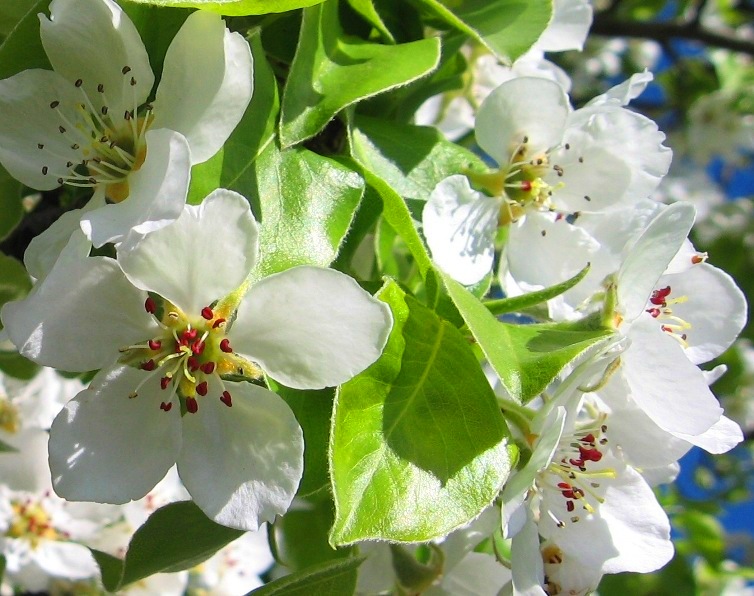
Pear blossom (instead of White Hand of Moses)

However, a rather more likely suggestion is that though the White Hand of Moses may be the name of a particular tree-blossom, Jesus is not the name of any particular flower. Rather the reference is to spring flowers generally bursting forth from the ground, as if enlivened by the life-giving breath of Jesus.

winter's gone
tree blossoms bloom
breath again

© Chèvrefeuille

What a wonderful quatrain this was and what a joy to look inside to its background ... this will be a wonderful month as we are exploring the beauty of "The Rubaiyat" by Omar Khayyam.

This episode is open for your submissions tonight at 7:00 PM (CET) and will remain open until November 9th at noon (CET). I will try to publish our new episode, a new "weekend-meditation", later on.


Monday, April 27, 2015

Carpe Diem Tokubetsudesu #45, The Beatitudes


Dear Haijin, visitors and travelers,

As I created our prompt-list for April I made a mistake. As you all know CD-Tokubetsudesu (former Ghost Writer) is published on every Wednesday, but it's already time to publish it according to the prompt-list, so this episode is just for one week on Tuesday instead of Wednesday. And for this episode I have chosen to share The Beatitudes as described in Matthew 5: 1-12 with you all for your inspiration. It fits really our central theme for April, Peace of Mind, and it's based on several ideas from Hinduism, Buddhism and other religions or life-philosophies.

I love to challenge you to bring The Beatitudes back to haiku or tanka or into a haibun ... no need to copy The Beatitudes, they are only used here for your inspiration. For those who love to "learn" more about The Beatitudes? I will bring them as prompts on Haiku Shuukan at WP after the ending of the prompts based on G.R.A.C.E.


Credits: Mount Arbel
The Beatitudes

3 “Blessed are the poor in spirit, for theirs is the kingdom of heaven.
4 Blessed are those who mourn, for they will be comforted.
5 Blessed are the meek, for they will inherit the earth.
6 Blessed are those who hunger and thirst for righteousness, for they will be filled.
7 Blessed are the merciful, for they will be shown mercy.
8 Blessed are the pure in heart, for they will see God.
9 Blessed are the peacemakers, for they will be called children of God.
10 Blessed are those who are persecuted because of righteousness, for theirs is the kingdom of heaven.
11 “Blessed are you when people insult you, persecute you and falsely say all kinds of evil against you because of me. 12 Rejoice and be glad, because great is your reward in heaven, for in the same way they persecuted the prophets who were before you.

It's wonderful and I think The Beatitudes will inspire you to compose haiku, tanka or haibun to share with us.

This episode is open for your submissions tonight at 7.00 PM (CET) and will remain open until April 30th at noon (CET). I will try to publish our new episode, purity, later on. For now .... just have fun!
 

Saturday, April 25, 2015

Carpe Diem #714, Universal Self


Dear Haijin, visitors and travelers,

The final goal of our journey, peace of mind, is almost there and today we do one of our final steps. The Bhagavad Gita is a wonderful and spiritual story and the final goal is that Arjuna finds the meaning of life and death ... his (Arjuna) goal is to become One with all and everything ... he will find it and reach his goal .... Universal Self. One with the Universe, becoming only One with all ... this is what the Bhagavad Gita has to tell us.

We are part of all and everything. We are all one with God (or Spirit, Light ...) and God is one with us. Finally we will be only spirit .... oneness .... In this journey we have seen that through the veils of the Bhagavad Gita and we have seen it ... we are all one. We are all one with nature, not only we are in nature, we are nature ... isn't that wonderful? We are all nature .... as every haiku poet/ess is.
Maybe you can read the Little Creatures episode of today once again ... because Chiyo-ni was also nature ...

What a joy that we are nature, we are ONE with nature and ONE with God .... isn't that what all the religions and life-philosophies are saying? Is this Universal Self the answer on our hypothetical question "Are all religions born from Hinduism, the oldest known religion?
Christians, Buddhists, Muslim, Pentecostals and more are all searching for becoming one with God ... it just can't be different .... Hinduism is the source of all religions. Of course this idea is hypothetical, because I am not a professor in religion and spirituality ... maybe there are scientists who are busy with this idea ... I don't know ...

Credits: Universal Self

no boundaries left
all one with nature, the universe
a new day rises


© Chèvrefeuille

Not a strong verse this time, but as I say it aloud it feels strong and like a mantra ... am I one with the Universe? Have I found (finally) my Universal Self?

This episode is open for your submissions tonight at 7.00 PM (CET) and will remain open until April 28th at noon (CET).. I will (try to) post our new episode, our last haiku by Kala, our featured haiku poetess, later on


Wednesday, April 22, 2015

Carpe Diem #711, Harmony


Dear Haijin, visitors and travelers,

Today our prompt is harmony and it is based on the following verse from the 6th chapter of the Bhagavad Gita:
18. When the perfectly controlled mind rests in the Self only, free from longing for the objects of desire, then it is said: “He is united”.

Without union with the Self neither harmony nor balance nor Samadhi is possible. This is quit the same as the Emptiness idea in Buddhism, but also in the idea of living as a hermit in a lot of other religions or life philosophies. Let us step outside the Bhagavad Gita for a moment and look at the Hermit (IX), one of the cards of the Major Arcana of Tarot. What do we see?


We see an old man, cloaked and hooded, who holds a lantern in his right hand in which a light shines in the shape of The Star of David, two superimposed triangles. In his left hand he has a staff. He stands in the snow somewhere in the mountains as we can see in the background.


He looks like The Fool (0), but is older than The Fool. He is similar with The Fool, but there is a big difference. The Fool gathered his knowledge and wisdom by walking / travelling through the world and to look around him. He saw the beauty of nature, the beauty of God's Creation. The Fool's knowledge is of a low, but lived, level, which I call external knowledge.. The Hermit (IX) gathered his knowledge and wisdom through meditation and contemplation on his own, maybe he used secret scriptures when he sat down to meditate and contemplate or he had spiritual revelations, because he was just alone with God's Spirit. His knowledge and wisdom I use to call internal knowledge on a high level.

Anchorite
contemplates on love
seeking knowledge

s
eeking knowledge
insight the Inner Self
the hermit's choice

© Chèvrefeuille

The Hermit (IX) closes the third trinity of the Major Arcanum and stands for the Holy Spirit. As The Hierophant represents God the Son, the Redeemer who walked among us, The Hermit represents God the Holy Spirit. It's through the Power of the Holy Spirit that we are in touch with our emotions to grow spiritually and physically.
The Light of the World, depicted in this card by the lantern in the right hand, is one of the names of Jesus Christ (Krishna?). His Light shines upon us and He said of that Light: [...] "No one lights a lamp and puts it in a place where it will be hidden, or under a bowl. Instead they put it on its stand, so taht those who come in may see the light"[...] (Luke 11: 33)

There is a similar verse in the Bhagavad Gita 6th chapter verse 19:

“As a lamp placed in a windless spot does not flicker—to such is compared the Yogi of controlled mind, practicing Yoga in the Self (or absorbed in the Yoga of the Self)"
let shine the light
don't hide it under a bowl -
share the Light of the World


© Chèvrefeuille

So The Hermit fulfills this task. He lets the light shine and through that light we can see the ancient knowledge and wisdom in the Tarot, the divine Tarot.
A Hermit lives alone in his cave, home, hut or something else. He lives in absolute isolation of mankind. All his days and nights are for becoming wiser through meditation and contemplation. Through his perseverance he comes in contact with his Inner Self, with the Holy Trinity of Father, Son and Spirit.
As we place The Hermit on the Tree of Life we will find him in Chochmah, the second sephira, right after Kether and before Binah. So he is placed in the same spot as Adam. Chochmah is the sephira of wisdom and it's also similar with the 'Third-Eye'. The Hermit is internal knowledge and wisdom and he knows all the ancient mystical secrets and as we all know so did Jesus.
I told earlier that The Hermit lives in complete isolation of the worldly things and manners. As I was preparing this episode through research, the first thought which came in mind was the Temptation of Christ (Matthew 4: 1-11). In which the devil tempted Him, but He succeeded and withstood the temptation.
Also The Hermit (IX) is tempted to leave his cave, but he didn't because he would learn all and everything about knowledge and wisdom.


Credits: Harmony (one with nature)

Another thing which came in mind as I was reading these verses in the Bhagavad Gita is the Prayer of Christ on the Mount of Olives (Luke 22: 39-46). He beseeches His Father to take the cup away. On that moment He was more human than ever, but He knew that He had to drink the cup.

This can point to open the Inner Self as is meant in the above verses of the Gita. Only when the heart, mind and soul are united than you become in harmony. Is this again part of our hypothetical idea that all religions are deriving from Hinduism?

Harmony in my opinion can reach through all boundaries and maybe we will once say “finally the World is united and in Peace”.
finding peace of mind
the soothing sound of rippling water
the rustling of leaves
strengthens my tired mind
that's fortitude


that's fortitude
deep inner peace, the beating of my heart,
the music of life


the music of life
caught in the rippling stream -
finding peace of mind


© Chèvrefeuille

It wasn't really easy to create this episode on harmony, because it has so much different meanings and ideas ...

This episode is open for your submissions tonight at 7.00 PM (CET) and will remain open until April 25th at noon (CET). I will (try to) publish our new episode, Lotus, later on. For now .... have fun, be inspired and share your haiku with us all.


Thursday, April 9, 2015

Carpe Diem #702, Immortality


Dear Haijin, visitors and travelers,

I hope you did like our CD-Special in which I shared a haiku by Kala Ramesh that fits our theme for this month "Peace of Mind". Today we will go on further with our journey, our exploration of the Bhagavad Gita. Today's prompt is not exclusively for Hinduism, today's theme we see in almost every religion or life-philosophy around the globe. Today is about immortality.

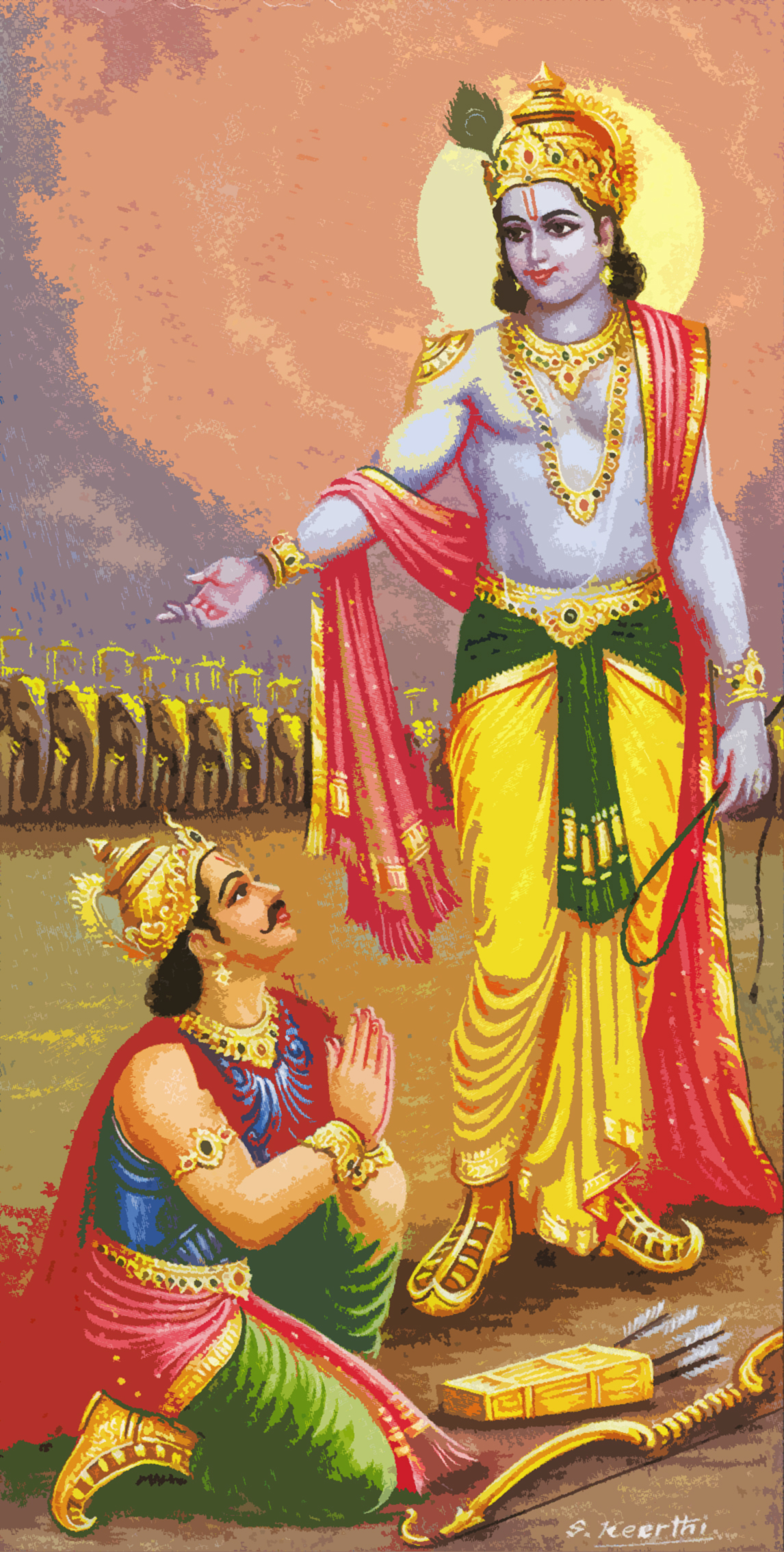
During his conversation with Krishna, Arjuna learns that those who follow the one Lord will become immortal. In the Bhagavad Gita, in the yoga of Wisdom (Chapter 4) these is one of the leading themes and we will start with a quote from an explanation of the Bhagavad Gita:

[...] One who has true union with the Lord is not subject to rebirth. He attains immortality. Such a union can only be achieved when one is free from attachment, fear and anger, being thoroughly purified by right knowledge. The Lord accepts the devotion of all, whatever path they may use to approach  Him. [...]

In this quote the first thing which occurred is "rebirth". As you maybe know in Christianity the idea of rebirth isn't an issue. You can be reborn (as a Christian) during your life, because in Christianity the idea of "rebirth" has to do with choice .... you will be a reborn Christian if you surrender your life to God. That's very different with the idea of the Bhagavad Gita. In Hinduism reincarnation is a strong belief, but (as we can read in the above quote) if the believer has real union with the Lord there is no "rebirth" or "reincarnation" than the believer attains immortality.
"Immortality" is an important issue in the Bhagavad Gita and in several chapters this is be said by Krishna. We those words on immortality he tries to tell Arjuna that he will be immortal as he goes into this all deciding battle to bring peace to the world.

universal experience
walking on the path of wisdom
finding the truth


© Chèvrefeuille

Credits: Bhagavad Gita

The battle in the Bhagavad Gita is a kind of parable of the inner battle to come to enlightenment and that's the goal to reach for Arjuna.

Immortality ... in Christianity that's a theme too, because after dying we enter God's Heavenly Place, the New Jerusalem (as told in the book of Revelations) it's similar to Atman or the Buddhist Nirvana or entering Allah's realm.
As we die ... our soul will be free and immortal, but immortality can only be reached as we have become enlightened (and I think this "enlightenment"-idea can be used for every religious or spiritual path that humankind follows).

Immortality ... is that our goal? Is that what we are striving for?

In the Tarot there is a Great Arcana card titled Death and it's the turning point in the Great Arcana, because the cards before death are all connected to learning the right way to live, the Great Arcana cards after Death are all connected to the right path to grow spiritual ... Death is the gate to immortality.
RWS XIII Death

As we step aside of the Bhagavad Gita and look for a moment to the Tree of Life (Kabbalistic glyph) than we see that Death is in the middle of the glyph, there were Christ Consciousness, the sephiroth Tifareth, has been placed. Also a turning point. Is this what Krishna and Arjuna are having their conversation about? That turning point in life? I think that's what they are discussing ... in the middle of the both armies ... there they have that conversation ... from out of the middle Arjuna has to decide which path he will take ...

I think everyone of us has such points in life in which they had to make a decision which path to take. As I look at myself ... I had such a turning point right at the moment (more than ten (10) years ago) that I became ill because I had made the bad choice to go the path of the occult ... that illness brought me insight ... I had to turn my life in another direction, I let go of the occult and turned to the light to me that was a philosophy based on three things:

+ unconditional love
+ the idea of NaraNaraYana or "in everything and everyone there is God", that's also the reason why I use Namaste often as a greeting.
+ don't do to another one what you don't want to do to yourself


This is what made me who I am now ...

the final frontier
to become newly born -
conquering death


© Chèvrefeuille

This episode wasn't easy to create, but I think I have succeeded ...

This episode is open for your submissions tonight at 7.00 PM (CET) and will remain open until April 12th at noon (CET). I will (try to) publish our new episode, karma, later on. For now ... be inspired and share your haiku with us all.


Sunday, April 5, 2015

Carpe Diem #700, Govinda (the bow)


Dear Haijin, visitors and travelers,

Isn't it amazing? This is our 700th episode of our Carpe Diem Haiku Kai, the regular episodes of course. So we have a little celebration ... I have presented you with 700 (regular) episodes in which I challenged you to write an all new haiku inspired on a given prompt. Awesome!

This month we are on a journey to discover the beauty of the Bhagavad Gita and maybe find "peace of mind", as is the central theme this month. Today it's not really a part of the Bhagavad Gita, but more a kind of exchanging thoughts between a few sources. Why? Well ... today our prompt is Govinda (the bow), and it refers to the bow of Arjuna, the Archer, who has the leading role in the Bhagavad Gita.
Maybe you have visited Haiku Shuukan at WP, another part of our Haiku Kai Family. Recently the theme there was "The Way of the Bow", based on a short story by Paulo Coelho. In that short story he describes the path to enlightenment through archery. As the arrow has left the bow ... there is no returning back it will seek its way to the goal. That's how our spiritual growth works ... we are once at a certain point in our lives and then we realize that our life must chance ... this occurs around the age of 20 ...

Maybe you know the novel "Siddhartha" by Hermann Hesse. In that novel Siddhartha and his best friend Govinda are on a journey to discover their path. They were great friends, but after years of searching for the truth their lives depart ... Siddhartha becomes a wealthy merchant and learns "the worldly pleasures" while Govinda is staying at the Buddha's place and becomes a monk. At first Siddhartha is very sad as he and his best friend are split up ... he loses his goal, he had to let go Govinda.

What has this to do with the Bhagavad Gita? All and everything, but also nothing. There is just that name Govinda who hold those different ideas together. There has to be a connection between Hinduism and Buddhism ... the both religions saw the light of life in India and maybe those religions were connected with Christianity, Islam and other religions. All we know is that Hinduism is the oldest religion known. All other religions have grown from Hinduism ... It's just a hypothesis but it's worth thinking it over.

don't hide your light
let it shine bright without regret -
Lotus will bloom again

© Chèvrefeuille


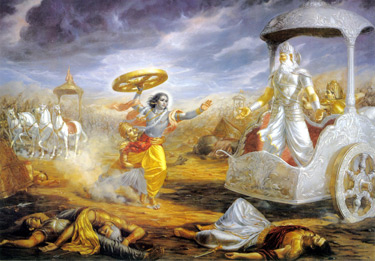
There are similarities in the world religions, there was once the idea of a lot of gods and goddesses, even in the ancient religion of Judaism there was a moment that they thought there were multiple gods ... One way or another it brings us all the ideas for life ... the everlasting battle between good and bad, as we also see in the Bhagavad Gita. There he stands in the middle of two big armies, Arjuna, the Archer. He becomes anxious and let his bow, Govinda, slip from his hands. He doesn't know what to do .... how can he go to battle against an army in which there are friends and family of him?
This is the ultimate inner battle ... and is it a coincidence that that inner battle has been fought by Jesus Christ in the Garden of Gethsemane? No ... it isn't. Maybe you think this is blasphemy, but that's certainly not what I think it is. It's part of the hypothesis that all world religions have grown from Hinduism.

Govinda (the bow), can make the difference. Jesus made the difference by giving his own life to save humankind .... and that's also what is told in the Bhagavad Gita ... Arjuna is the savior of humankind and he is now at that point ... will he choose right? Krishna teaches him about life and death teaches him about Atman, heaven, in which there will be no differences anymore. How wonderful is this idea?

Remember the Tarot month! There was one of the last cards, "The World" in which we see that there will be a New Heaven, a New Jerusalem ... that's the place were we all will come after all ... that New Jerusalem is the same as Atman ...

Credits: Govinda (the bow) slips from Arjuna's hands

This episode wasn't easy to create ... it's triggered by Hamish (see his comment at episode 699) and I thought, no I had to use it for this episode in which we see that Arjuna loses Govinda as he is desperate in the middle of the battle ... Govinda (the bow) cannot be without the hand of the Archer, but also cannot be without the arrow ... the arrow as it has left the bow there is no returning back ... as Arjuna shoots his arrow than the battle will be fought .... at that moment as he looses Govinda (the bow) as is Siddhartha in Hermann Hesse's novel loosing his best friend to the wisdom of Buddha he makes the decision to take another path ... a path that will lead him to salvation ... isn't that what we celebrate today? Easter .....

narcissus bloom
shining their light on our path -
He has risen

(c) Chèvrefeuille

Well .... happy Easter to you all ... and I hope this episode, maybe in a way controversial, but remember this idea exposed here is just a hypothesis. Let this episode inspire you to write an all new haiku ...

This episode is open for your submissions tonight at 7.00 PM (CET) and will remain open until April 8th at noon (CET). I will (try to) publish our new episode, ancestors, later on. For now ... just have fun!


Thursday, February 27, 2014

Carpe Diem #408, Kongofukuji (Temple 38)


Dear O-Henro ... Haijin, visitors and travelers,

I am in the nightshift, so I can catch up a little. My dad is still in hospital, but will be this weekend released from the hospital. So we are glad that he his starting to recover, however it goes slowly, but he also is glad that he can go home, because at home (Home Sweet Home) he can recover further. Thank you all for your kind words and prayers for my dad and our family. Your prayers are very appreciated by my dad, my mum and myself.

one heartbeat away
I feel the strenght of prayers
send by my haiku-family

(c) Chèvrefeuille

Kongofuku-ji (Temple 38)

We are going on with our pilgrimage along the 88 temples on Shikoku Island and today we arrive at temple 38, Kongofuku-ji, which is devoted to Senju Kannon or the Boddhisatva of Motherly Love and Mother of the World. She has similarities with Mother Mary the Virgin and in the Edo Period (1663-1867) as Christianity was forbidden and was punishable with death. However Japanese Christians in that time were very clever and disguised The Virgin Mother Mary as Senju Kannon.

Maria Kannon (The Virgin Mary diguised as Senju Kannon)

In that Edo Period al lot of Christians died because of their religion and they were forced to go underground and if they were found and persecuted they could win back their life by trampling on an image of the Christ of The Virgin Mary (Fumi-e) and if they didn't they were tortured 'til death followed. These underground Christians were called Kakure Kirishitans.

Fumi-e (a floorstone with an image of Jesus Christ or The Virgin Mary on which the Japanese Christians had to trample to regain their life)


trampling His face
to save their own life -
a broken rose


a broken rose
on the floor in front of Him;
the sound of raindrops


(c) Chèvrefeuille

Not a strong set I think, but they give a well formed imagery of what I described in the above post. This episode of Carpe Diem is NOW OPEN for your submissions and will remain open until March 1st 11.59 AM (CET). I will post our last episode of this first part of our Shikoku Pilgrimage in which we will be visiting Temple 39, Enko-ji, at Sukumo, Kochi Prefecture. The last temple in Kochi Prefecture. With this new episode we have reached our first goal ... 44 temples visited and on our way to Enlightenment.