Carpe Diem Haiku Kai is the place to be if you like to write and share Japanese poetry forms like haiku and tanka. It’s a warmhearted family of haiku poets created by Chèvrefeuille, a Dutch haiku poet. Japanese poetry is the poetry of nature and it gives an impression of a moment as short as the sound of a pebble thrown into water. ++ ALL WORKS PUBLISHED ARE COPYRIGHTED AND THE RIGHTS BELONG TO THE AUTHORS ++ !!! Anonymous comments will be seen as SPAM !!!
Pages
- Home
- Carpe Diem Lecture 1
- Carpe Diem Lecture 2
- Carpe Diem's Library
- Carpe Diem's Kukai ...
- All My Years a tribute CDHK E-book for Jane Reichhold
- TROIKU, A new form of haiku
- Preview CDHK E-book "Flamingo Clouds" Troiku
- Tan Renga the short linked chain of two stanza
- Preview "Chained Together" an anthology of Tan Ren...
- Prompt Suggestions
Showing posts with label Kikaku. Show all posts
Wednesday, November 13, 2019
Tan Renga Wednesday (5) White Crane
Dear Haijin, visitors and travelers,
It's Wednesday again, so time for a new episode of "Carpe Diem's Tan Renga Wednesday", that special feature in which I challenge you to complete a Tan Renga inspired on a given haiku.
This week I have chosen a haiku by Kikaku, a contemporary and disciple of Matsuo Basho. Kikaku was one of Basho's favorite 10 disciples (students) and he was a very gifted haiku poet too. He wrote wonderful haiku, all in the way as been taught by Basho.
The haiku I have chosen written by Kikaku is one of his most beautiful haiku in my opinion. He wrote it to comfort Basho in his last days of his life:
how I wish to call
a white crane from Fukei,
but for this cold rain.
© Kikaku
And now it is up to you to complete this Tan Renga by adding your two lined stanza (approx. 7-7 syllables) and share it with us all.
This Tan Renga Wednesday is NOW OPEN for your submissions and will remain open until November 19th at noon (CET). I will try to publish our new episode later on. For now ... have fun!
Labels:
Basho,
Carpe Diem Tan Renga Wednesday,
haiku,
Kikaku,
Tan Renga
Tuesday, May 28, 2019
Carpe Diem #1669 Tan Renga Challenge Month May 2019 (16) white crane
Dear Haijin, visitors and travelers,
Welcome at a new episode of our TRC Month May 2019. This month is almost over and I am looking forward to June, than we will be challenged to create Troiku, that creative way of haiku-ing I invented back in 2912, but now it's still Tan Renga.
Today I have a beautiful haiku by a classical master, Kikaku, an apprentice and very close friend of Basho. The loved eachother dearly.
Here is the haiku to work with, it's a haiku Kikaku wrote to comfort Basho because he was very ill, a few days later Basho died.
How I wish to call
A white crane from Fukei,
But for this cold rain.
© Kikaku
![]() |
| White Crane (Japanese Woodblock Print) |
Monday, February 18, 2019
Carpe Diem #1609 Tan Renga Challenge Month 2019 (13) water reflection
Dear Haijin, visitors and travelers,
Welcome at a new episode of our wonderful Haiku Kai. This month we are busy with creating Tan Renga, a short chained verse written by two poets. The Tan Renga looks similar with the tanka, but the tanka is written by one poet.
Today I have a haiku by a disciple of Matsuo Basho, Takarai Kikaku. Kikaku was one of the most renown disciples of Basho and he had a very warm relation with his master. Let me tell you a little bit more about Takarai Kikaku.
![]() |
| Takarai Kikaku (image found on Pinterest) |
Takarai Kikaku was a Japanese haikai poet and among the most accomplished disciples of Matsuo Bashō. His father was an Edo doctor, but Kikaku chose to become a professional haikai poet rather than follow in his footsteps. Kikaku’s poetry is known for its wit and its difficulty. Whereas Basho, especially in his later years, focused on the countryside and espoused an aesthetic of simplicity, Kikaku preferred the city and the opportunities it provided for extravagant play. He also preferred a more demanding form of poetry, one laced with wordplay, allusions, and juxtapositions of images that defy easy explanation. At the time of his death, he was perhaps the leading poet in Edo (today’s Tokyo), which then had a population of around one million, making it perhaps the largest city in the world at the time.
And here is the haiku to work with:
water reflection–
a flying squirrel across
the wisteria’s mantle
© Takarai Kikaku (Tr. unknown)
In this haiku Kikaku describes a wonderful scene ... and you can easily see his talent and you can even sense the master, Matsuo Basho, in it.
![]() |
| Vintage Japanese Shin Hanga Woodblock Print by Toshi Yoshida - Wisteria at Ushijima |
Tuesday, September 18, 2018
Carpe Diem Tan Renga Challenge September 2018 Chained Together III (13) Withered Pampas Leaves
Dear Haijin, visitors and travelers,
Welcome at a new episode of our Tan Renga Challenge Month 2018. Today I have a very special haiku for you. It was written by Takarai Kikaku, and apprentice of Matsuo Basho. Kikaku wrote an account about Basho's last days. Kikaku was also known as Shinshi and he wrote a tribute haiku for his master and placed it on his memorial stone at the Gichuji Temple in Awazu.
A hat to cover
The body of our master,
Withered pampas leaves.
© Shinshi (haigo of Takarai Kikaku)
![]() |
| Basho's Memorial Stone at the Gichuji Temple in Awazu |
By the way you can find the above mentioned Account on the last days of Basho at Simply Haiku, an online haiku magazine. It's a real nice piece of prose (and haiku) written by Kikaku.
Add your 2nd stanza of two lines of approximately 14 syllables and make the Tan Renga complete.
This episode is NOW OPEN for your submissions and will remain open until September 25th at noon (CEST). I will try to publish our new episode later on. For now ... have fun!
Location:
Nederland
Friday, May 25, 2018
Carpe Diem Weekend Meditation #34 Revise That Haiku ... Kikaku's Dragonfly
!!! Open for your submissions next Sunday May 27th at 7:00 PM (CEST) !!!
Dear Haijin, visitors and travelers,
Welcome at the last weekend-meditation of this month. The weekend-meditation is a feature that gives you (and me) time to meditate and contemplate before submitting to our Kai. Every weekend I choose another feature (from our rich history or newly created) for you to work with.
This weekend I love to challenge you to revise a haiku by a classical haiku poet. Try to make the haiku better without loosing the scene the haiku is about. For this "revise that haiku" I have chosen a haiku by Kikaku (1661-1707), one of Basho's disciples.
Takarai Kikaku also known as Enomoto Kikaku, was a Japanese haikai poet and among the most accomplished disciples of Matsuo Bashō. His father was an Edo doctor, but Kikaku chose to become a professional haikai poet rather than follow in his footsteps.
![]() |
| Red Dragonfly (photo © Michael Hawk) |
Kikaku is best known for his haiku, such as the one in this anecdote about him and his master:
One day, Kikaku composed a haiku,
Red dragonfly / break off its wings / Sour cherry
which Bashō changed to,
Sour cherry / add wings to it / Red dragonfly;
thus saying that poetry should add life to life, not take life away from life. His master is known to have denigrated Kikaku's 'flippant efforts'. Kikaku wrote of coarser subjects than Bashō, and in this respect his poetry was closer to earlier haikai. Kikaku set the tone for haikai from Bashō's death until the time of Yosa Buson in the late 18th century.
Kikaku left an important historical document, describing Bashō's final days, and the immediate aftermath of his death, which has been translated into English.
(By the way the above photo is made by Michael Hawk, he has a wonderful website about Nature. For sure worth a visit. website: https://www.naturesarchive.com )
| Red Dragonfly haiga |
Here is the haiku to revise, can you re-create this haiku as for example Basho did?:
red dragonfly
break off its wings
sour cherry
© Kikaku
A lot to meditate and contemplate about ... well you have a whole weekend to think this over and create your revised haiku ...
Have fun!
This weekend-meditation is open for your submissions next Sunday, May 27th at 7:00 PM (CEST) and will remain open until Sunday June 3rd at noon (CEST).
Labels:
Basho,
Carpe Diem weekend-meditation,
haiku,
Kikaku,
Revise That Haiku
Location:
Nederland
Sunday, September 17, 2017
Wandering Spirit - Masutaa no kaigi (meeting the master)
Masutaa no kaigi (Meeting the master)
Kichirou had made us breakfast and after morning tea he introduced me to Kikaku, one of Basho's apprentices and close friend. Kikaku was a handsome man with a bright smile and an open mind. As I let him read a few of my haiku he was excited.
"These are beautiful Yozakura".
I blushed. "Thank you, but those are just the first haiku I ever created. I just wrote them from my heart, without knowing the rules of writing haiku", I said.
"Kichirou, you have never told me that you have such a gifted, such a talented brother. His haiku are amazing".
"I didn't told you about him Kikaku, because I hadn't met him before yesterday. I knew I had a brother, we have the same father, but I didn't know when I would meet him. We ran into eachother yesterday while we were visiting our mothers graves", Kichirou said.
"Praise the gods", Kikaku laughed. "It's a great day. You my friend have found your brother".
a new day
life starts again
spring has come
© Kikaku
We enjoyed the morning. Kikaku was a nice guy to have around. He told us about his life and how he met Basho, his sensei and friend.
"I love Basho", he said. "But not as in a love relation, but as my friend. I love him for his friendship and his work as a haiku master and renga master. You have to meet him Yozakura and show him your haiku".
"I would love to meet him", I said. "And let him read my haiku. He is the goal of my journey to Edo, but I am afraid that he will be disappointed as he reads my haiku".
Kikaku laughed. "Don't worry about that. He will praise you for the beauty of your haiku Yozakura. Basho once said to me: "Kikaku now you know the rules of writing haiku ... forget them immediately. Look at the pine as it is a pine. Write from the heart and not from the mind or by using my education. Be your own master. You can do it Kikaku". Yes Yozakura that's what he said. So don't worry he will surely praise your haiku".
I was astonished. This ... Basho, that famous haiku master, saw a master in every apprentice of him. In every haiku poet!
"I would love to meet him".
"Later this afternoon I will be back at Kichirou's home and than we will visit him in his "Basho-hut". He will be glad to meet you Yozakura. I even think he will be giving you some points to work with to make your haiku better and more beautiful. I see you later today". With that said Kikaku embraced us and left.
![]() |
| Banana tree (Basho) |
"I am so excited my brother. I don't think I can eat or drink. Finally I will meet Basho", I said.
finally
I will see
banana tree in bloom
© Yozakura
After lunch Kichirou and I walked into the city. "Do you think we can visit the spot were dad's grocery once was?" I asked.
"Yes we can visit it".
A while later we stood at the spot were my father once had his grocery. It was now an empty spot were the people of Edo had created a beautiful garden in honor of all those Edo-people who died in the Great Fire. It was really a wonderful garden were all kinds of blossoming trees and bushes were planted. there was a nice pond in which Lotuses floated on the surface and Koi-carps were swimming around. The pond was surrounded by a path of shells and several garden lanterns. It was a wonderful, peaceful, place to be. I enjoyed the beauty and the sound of water falling made the silence stronger and deeper. It was ... like the pure land. I felt the presence of my father's spirit.
"This garden is wonderful", I whispered.
"I know my brother. I am visiting this garden regularly, because it feels like a place in honor of father", Kichirou said. I could hear the tears in his voice and my heart opened up to him. He had loved father and he had the same experiences as I had. The same memories. I kissed him on his forehead.
"I am glad that I have found you".
in the garden
between blossoms
family reunion
© Yozakura
Later that afternoon Kikaku brought me to the master. Kichirou was invited too, but he decided not to come with us.
"It's your wish Yozakura to meet Basho. You came back for him. So I will not spoil your moment with him".
It made me a bit sad, but I understood why Kichirou wouldn't come. He granted me this special moment, because he loved me and he knew how much I wished to meet Basho. I hugged him.
"Thank you my brother. I love you".
A little later Kikaku and I arrived at the "Basho hut". It was really just a hut, but it was surrounded by a garden in which the Basho tree he got from Rika, one of his apprentices, was obvious present. Next to that tree the garden was planted with Cherry trees, Jasmine and Snowball. At the back of the "Basho hut" the Wisteria was in full bloom.
In the garden, under a cherry tree, I saw a small group of people, male and female, sit on the grass. They all listened to a young handsome man who was telling them about the beauty of nature and how to become one with nature.
"That must be him", I thought. "He looks so small, but in a way he is bigger than all others".
![]() |
| Matsuo Basho (1644-1694) |
Kikaku coughed to get Basho's attention. Basho looked at him and smiled.
"Kikaku, my friend".
He got on his feet and walked towards us. He embraced Kikaku and gave him a kiss on his forehead.
"It is good to see you Kikaku". Than he saw me.
"And whom is this good looking young man?" He asked.
"This my friend is Yozakura he is a young haiku poet who wanted to meet you".
Basho bowed. "Welcome Yozakura. Welcome in my garden. My name is Basho". He took my hand.
"Come Yozakura let me introduce you to the others gathered here".
The others were already on their feet too as we walked towards them. I saw a nice group of people all with their own characteristics. All happy and smiling.
Basho introduced me to them one by one. Than we sat down together.
"Tell us something about yourself Yozakura", Basho said.
I told them the story of my life and how I had heard about Basho, than known as Tosei. "I was anxious to get to know you Basho. I had heard a lot of stories along the roads about you. You are the reason why I started to write haiku".
"Did you write haiku while on your way?" Ransetsu, one of Basho's apprentices, asked. I nodded.
"Please can you declaim a few of your haiku for us?"
I became nervous and I felt that I blushed.
"Don't be shy Yozakura", Kikaku said. "Your haiku are excellent".
Basho encouraged me too. "Please Yozakura".
I grabbed my rice-paper booklet from my knapsack. "These are just pieces I wrote that look like haiku, but they were written from the heart. As I told you my life wasn't easy and that made my heart cry".
"That, Yozakura, is the only way to write haiku. Right from the heart", Basho said. His disciples agreed.
spearflower berries
tempting the sparrows with their color -
graveyard in the mist
bare branches
a painting against the blue sky
leaves under my feet
moonlight on the river
thousand lanterns float to the horizon
honoring the dead
I looked around and waited. They applauded.
"Wonderfully crafted haiku Yozakura", Basho said. "But that last one can be so much stronger. Allow me to redo it?"
"Yes please", I answered. "I love to learn from you".
Basho took a piece of rice-paper and after a while he calligraphed his interpretation of the haiku I just had declaimed.
on the river
lights float to the horizon
the dead rejoice
© Basho
He gave this haiku to me.
"Thank you", I stammered. "I will keep this close to my heart in memory of today. The day I met you ... my sensei".
to be continued
Labels:
Basho,
Carpe Diem Haiku Kai,
feuilleton,
Kikaku,
Ransetsu,
Rika,
wandering spirit,
Yozakura
Location:
Netherlands
Friday, September 15, 2017
Wandering Spirit - Edo ni modoru (Back to Edo)
Edo ni moduru (Back to Edo)
I traveled on with joy in my heart. Finally I would be meeting this Tosei, now known as Basho, after that seemingly not beautiful banana-tree with its tiny vague yellow blossoms and its useless wood. This banana-tree is beautiful through its ugliness and uselessness.
While I was on my way back home to Edo I contemplated about that banana-tree asking myself "why this famous poet had chosen this pseudonym.
banana-tree
unworthy to look at
beautiful ugliness
© Yozakura
After a few days I almost was at Edo. I sat down next to the road I was walking and looked at Edo. The town was rebuild and looked even more beautiful then it ever was. I saw the people, children playing and every were I looked I only saw happiness. As I sat there my mind went on a roll. Thoughts of my happy childhood and the sadness of losing both my parents fought for my attention. While I let go my thoughts and memories, tears covered my cheeks. "I still miss you both", I whispered.
I sat there for a few hours and when the shadows became longer and the sky started to change into the beauty of the sunset I walked into the city. Edo my home-town.
tears
thoughts of days gone
coloring sky
© Yozakura
![]() |
| Edo suburb lodging house (image found on Pinterest) |
I found a small lodging house in the suburb of Edo named "Fuji no Hana", Wisteria flowers, and rented a room for a few days. It was a nice, not very expensive, lodging house and the owner was a beautiful former geisha with a bright smile, named Shiori, "poem". She was a great host and she wrote haiku also.
small faces
violets in thousand colors
bees humming
© Shiori
After a good meal I decided to go to sleep. I said goodnight to my host and went to my room. I was exhausted, but couldn't find sleep. I turned and turned on my sleeping mat, but the sleep wouldn't come. After a while I went downstairs to the dinner of the lodging house. All guests were already at sleep and only the host, Shiori, was still there. She sat at one of the tables with a booklet of paper that was still virgin white.
I coughed to get her attention. She looked up from the virgin paper. "Couldn't sleep", I said. "Can I sit with you?"
She nodded. "Tell me something about your wanderings", she said. "For starters ... what's your name?"
"My name is Yozakura", I answered.
She smiled. "I once knew a young guy named Yozakura", she said. "He was the son of a grocer". She looked closer to me. "You look somewhat like him".
"Would you like to tell me a little bit more about him?" I asked.
" His mother died when she was giving birth to him. I remember that his father wasn't loving him, but that was more a reaction, I think, on the fact that his wife died during labor".
Tears rolled down my cheeks. Shiori, in shock, looked at me as she saw me crying.
"What's the matter Yozakura?"
" I am that Yozakura you are telling about. My mother died in labor and my father was angry about that. As I became five years he decided to send me away to the shogun to get educated. After several years I returned to Edo and my father. He forgave me and asked my forgiveness for all he had said and done. We became closer then we ever had been. I lost him in the Fire of Meireki". My tears rolled freely now.
Shiori laid an arm around me and kissed me on my forehead. "Yozakura you are a righteous man and you needed this. You never mourned about them, maybe you fled for the thoughts and memories of them, but this ... death belongs to life, without that knowledge your life will never be complete. Come on let me help you to your room".
I awoke around noon and right then Shiori knocked on the door and entered my room.
"Did you sleep well Yozakura?"
" Yes, thank you. Thank you for all you have done".
Shiori smiled. "It's okay. Come go wash yourself and have lunch with me", she laughed. Her laugh sounded like a crystal brook and touched me. For the first time I felt something I never had experienced in my life. I knew right than ... I was in love.
After lunch Shiori and I made a chained poem together. This was the starting verse:
crystal brook
reflects the willow trees
birds sing their song
© Yozakura
After a few days at the Wisteria flowers lodging house I went into Edo on my way to meet my soon to be haiku master Basho, but before that I visited my mother's garden.
tears fall
on this lonely grave
Wisteria blossoms
© Yozakura
As I was sitting in front of her grave stone a young handsome guy walked into my mother's garden. In a way I felt a connection with him.
"What are you looking for?" I asked him.
He looked at me and smiled. "Finally I meet you Yozakura, son of Kyoshi and Fujiko, my brother".
"Who ... who are you?"
" I am your brother Yozakura. After your father send you away he and my mother became acquainted and married soon after. My mother, Sachiko, happy child, died shortly after I was born. Father send me to my grandmother. He couldn't handle the situation, because of your mother, who died during labor of you'.
I saw tears on his face and I saw similarities in his features with my father. "My brother ... I know what you are feeling right now. I felt the same. Please don't cry or let us cry together. What's your name ... my brother?"
" My name is Kichirou (lucky son)", he whispered.
" Where do you live?"
" Just around the corner of this memorial garden for both our mothers. My mother also was buried here by father".
![]() |
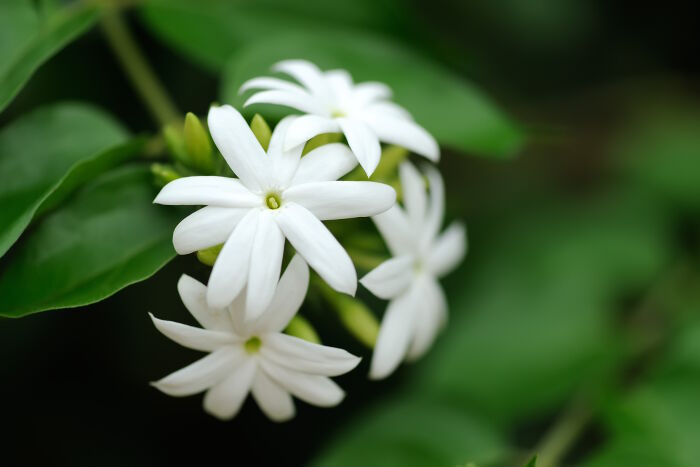
| Jasmine flowers |
He took my hand. "Let me show you her grave".
Not far of my mother's grave I saw another marble stone, surrounded by Jasmine.
" This is my mother's grave". Kichirou said. "He planted Jasmine in her honor. She loved the sweet perfume of Jasmine".
sweet perfume
memories of a loved one
Jasmine blossom
© Yozakura
A little later Kichirou invited me to his home. It was a small, but cozy, home and it felt awesome. I smelled the sweet perfume of Jasmine and saw a small garden behind his home in which the Jasmine was in full bloom.
We walked into the garden and sat down on the cushions on the small wooden veranda. Kichirou presented me Jasmine tea. In silence we drank our tea. The sweet perfume of the Jasmine seems to become stronger and not a minute later it started to rain softly.
"Why have you come to Edo?" Kichirou asked me. I looked at him.
" I am hoping to become an apprentice of Basho, a famous haiku poet from Edo. Maybe you have heard of him".
" Yes I have heard of him. Recently he settled down in a small hut along the river. One of his apprentices gave him a Basho-tree and his hut is now called the "Basho hut" and he, Tosei, changed his name into Basho. I have visited him once. He is a handsome guy, not extraordinary beautiful, but handsome. He has a very loving character and his apprentices adore him. A friend of mine, Kikaku, is an apprentice of him, a very close relation they have. There is a rumor that they are not only friends, but also lovers. Basho is openly about his preference for guys, but as far as I know he and Kikaku don't have a relationship. They are just close friends".
![]() |
| Kikaku (image found on Pinterest) |
Kichirou nodded. "I will introduce him to you tomorrow if that's okay with you?"
" Sure that's okay. Do you write haiku?"
" No I have tried it but it's to difficult for me. And you? Do you write haiku? "
" In fact I do, but they aren't really good in my opinion. Friends however say that my haiku are really beautiful and the encouraged me to go on and make them even more beautiful. That's the reason why I love to meet Basho. I hope he will be my sensei, my master, to help me to improve my haiku writing skills".
" Do you have a few examples of haiku you have written?"
" Yes, I have".
" Can I read them?"
" Yes of course". I picked up my knapsack and gave him a booklet of rice-paper on which I had calligraphed my haiku.
" Wow ... these are real beauties. For sure I know that Basho will take you as his apprentice".
I blushed. "Thank you Kichirou". I gave him a kiss on his forehead. "My brother ... I love you".
" I love you too Yozakura. I am glad to have found you my brother. Let us celebrate that. Do you drink sake?"
" Yes I do, but I do like it cold".
![]() |
| Sake set Wisteria blossom |
Kichirou came back to the veranda with a bamboo tray on which he presented sake in a wonderful earthenware jar and two earthenware bowls. I remembered them. This sake set was decorated with Wisteria blossom and I knew that they once were in the possession of my father.
" This set I know", I whispered. " Father has made it".
Kichirou nodded. "I got them as a gift from father. He said "One day you and your brother Yozakura will meet. Please save them for that day". Well ... that day has come today. So let us drink to the health of our parents, and to the health of you and me. Finally we have found each other".
Wisteria blossoms
bloom in front of the veranda
feeling blessed
© Yozakura
to be continued
Labels:
Basho,
Edo,
feuilleton,
Great Fire of Meireki,
haiku,
Kikaku,
wandering spirit,
Yozakura
Location:
Nederland
Monday, May 22, 2017
Carpe Diem Tan Renga Challenge Month 2017 #14 Springtime (Kikaku)
Dear Haijin, visitors and travelers,
Here is our new "hokku" to work with and create a Tan Renga. This "hokku" is by one of Basho's students, Kikaku.
Springtime in Edo,
Not a day passes without
A temple bell sold.
© Kikaku
Sorry for the delay and the short episode.
This episode is NOW OPEN for your submissions and will remain open until May 27th at noon (CET).
Wednesday, May 27, 2015
Carpe Diem Special #148a, Kikaku's "above the sea"
Dear haijin, visitors and travelers,
Yesterday (May 27th) I had planned a CD-Special, but through lack of time I couldn't write that episode, so I do that now.
Our CD-Specials this month are all haiku written by disciples of Basho and today I have chosen a haiku by Kikaku (1661-1707), one of Basho's closest friends and students. Kikaku has almost the same attraction to the beauty of nature as Basho had and he (Kikaku) has written wonderful haiku. Later in his life Kikaku fell in love with the city and his haiku changed dramatically, but were all beauties. Here are two haiku written by Kikaku to inspire you all.
this wooden
gate
shuts me out for the night
winter moon
shuts me out for the night
winter moon
a rainbow, erased by
a flock of swallows
© Kikaku (Tr. Michael K. Bourdaghs)
a flock of swallows
© Kikaku (Tr. Michael K. Bourdaghs)
Both are really beautiful in my opinion and that first one comes close to the beauty of the haiku by the master, Basho, himself. In our regular episode for today, from all directions, we also see a haiku with "gate" in it, so I think that Basho was in love with the city too, but that's just a guess.
finally home
I shut the gate of my garden
ah! the Honeysuckle
© Chèvrefeuille
finally home
I shut the gate of my garden
ah! the Honeysuckle
© Chèvrefeuille
![]() |
| Honeysuckle (my pseudonym) |
This CD-Special is NOW OPEN for your submissions and will remain open until May 30th at noon (CET). Have fun!
Labels:
Basho's disciples,
Carpe Diem Special,
Chèvrefeuille,
haiku,
honeysuckle,
Kikaku
Location:
Netherlands
Tuesday, October 28, 2014
Carpe Diem Ghost Writer #31, "One of a Kind"
Dear Haijin, visitors and travelers,
It's my pleasure to present you all a new Ghost Writer post. As you all know Shiba Sonome is our featured haiku poetess this month. Today our CD-Special and GW-post are bound together, because I planned them both on the same date. So I thought to let Sonome write both this GW-post and CD-Special.
This week's Ghost Writer is Shiba Sonome. I hope you all like this GW-post (and CD-Special) written by her.
++++++++++++++++++++++++++++++++++++++++++++++
++++++++++++++++++++++++++++++++++++++++++++++
One of a Kind
Dear Haijin,
What a privilege this is to write this week's GW-post for Carpe Diem Haiku Kai. I love to tell you about my master Matsuo Basho. I had the opportunity to be a disciple of the greatest haiku-poet I know, Basho.
It wasn't easy to become an apprentice, disciple, of Basho, but I succeeded. The most disciples of Basho were already friends of the master and therefor for them it was easy to become acquainted with him.
Maybe you know who his disciples were and I think it would be awesome to share in this GW-post not only haiku by myself, but also by e.g. Kikaku, Yozakura, Ransetsu and Kyorai. And of course I will share a few haiku written by the master himself.
Let me first tell you how Basho came on the idea to take the hokku out of the Haikai no Renga to make it a poem on it's own. Maybe you can recall the GW-post by Yozakura, the unknown haiku-poet. In that GW-post he told you the story about Basho's famous frog haiku, his first attempt to make hokku a poem on it's own. You all surely know that it wasn't Basho who re-named the hokku into haiku. That name was given to hokku by Masaoka Shiki. I have never had the opportunity to speak with Shiki about this choice, but I know that haiku is nowadays the name for the hokku as a poem on itself, and I think that's ok.
Do you know how Shikiu came to that name, haiku? I will tell you. The Renga (chained verse) was known as Haikai no Renga and the starting verse was called hokku. Shiki took the first onji (sound/syllable) from haikai "hai" and the second onji of hokku "ku" and so haiku got it's name.
![]() |
| Credits: Haiga Shiba Sonome's "deep in the woods" |
Back to Basho. I was a disciple of Bashoand he admired me. After the death of my husband, I earned my living as an eye doctor and as a judge of haikai. It should be noted that it is due to Basho and his ability to work with women that the amount of woman's haikai writings have been preserved which we have. One sees that most of these women gained access to the inner circle around Basho by being related either by marriage or blood to one of his disciples. I was one of the few to be accepted as a poet on my own. He even wrote a haiku especially for me:
White chrysanthemum
I look holding it straight
no dust at all
no dust at all
© Basho
I felt honored as he wrote this haiku especially for me. I have calligraphed it and now it hangs on the wall. It's really a nice haiku and I still dream that there will be a day that I can write my haiku as good as Basho did. When I was his disciple and encountered a lot of other haiku poets, Basho had almost 100 disciples, and they were all great. Basho admired them all and was proud on what they accomplished during their time at his home. For example there was Yozakura, the unknown haiku poet. Yozakura was very much on his own, but at Basho's home he turned out to be one of the best disciples of the master.
Anexample of haiku by Yozakura:
feeling
alone
lost in the woods around Edo -
just the autumn wind
lost in the woods around Edo -
just the autumn wind
© Yozakura
And than there was Kikaku, a very talented young haiku-poet, who (together with Yozakura) helped Basho tho write his famous frog-haiku with which he turned the hokku into an own poem. Kikaku has written wonderful haiku e.g.:
A single
yam leaf
contains the entire life
of a water drop
contains the entire life
of a water drop
Over the
long road
the flower-bringer follows:
plentiful moonlight
the flower-bringer follows:
plentiful moonlight
I begin
each day
with breakfast greens and tea
and morning glories
with breakfast greens and tea
and morning glories
© Kikaku
Aren't they beautiful and so in the spirit of Basho's haiku-school with the idea of Karumi, lightness or enlightenment? Just the view, just the things you can see all around you when you are outside (or in your home) and give words to it.
One of the most popular and talented disciples of Basho was Kyorai, he was one of the best ...
Its not
easy
to be sure which end is which
of a resting snail
to be sure which end is which
of a resting snail
Chanting
and humming
gongs immerse the green valley
in cool waves of air
gongs immerse the green valley
in cool waves of air
© Kyorai
Or what do you think of this haiku written by Ransetsu, also a disciple of Basho:
On the plum
tree
one blossom, one
blossomworth
one blossom, one
blossomworth
At dusk the
harvest moon
paints a pine-tree
against the blue
paints a pine-tree
against the blue
© Ransetsu
![]() |
| Credits: Calligraphed haiku by Ransetsu (1654-1707) |
And than there was Hokushi, whom also wrote wonderful haiku. Sometimes full of sadness, or full of happiness.
For that
brief moment
when the fire-fly went out...
the lonely darkness
when the fire-fly went out...
the lonely darkness
Experimenting
I hung the moon on various
branches of the Pine
© Hokushi
Well all wonderful examples of haiku written by other disciples of Basho, but of course I love to share a few haiku written by myself ... just to show you ... that we, all Basho's disciples, could write haiku with Karumi.
Each time
they roll in,
the beach waves break up
the plovers
the beach waves break up
the plovers
Spilled
from a tree-searing wind
a bull's midday voice
from a tree-searing wind
a bull's midday voice
discontented
violets have dyed
the hills also
violets have dyed
the hills also
stumbling
on a rock
the warbler's call
on a rock
the warbler's call
© Shiba Sonome
All beauties, as I may say so (smiles). Basho was "One of a Kind". I have understood that I have to give you all a kind of task to fulfill after reading the Ghost Writer posts? Let me see .... what kind of task I can give you?
![]() |
| Matsuo Basho, One of a Kind |
In this Ghost Writer post I mentioned a few times Karumi.
Master Basho said: "Learn
about a pine tree from a pine tree, and about a bamboo plant from a bamboo
plant.”
What he meant was that the poet should detach the mind from his own
self. Nevertheless, some people interpret the word 'learn' in their own ways
and never really 'learn'. 'Learn' means to enter into the object, perceive its
delicate life, and feel its feeling, whereupon a poem forms itself. Even a poem
that lucidly describes an object could not attain a true poetic sentiment
unless it contains the feelings that spontaneously emerged out of the object.
In such a poem the object and the poet's self would remain forever separate,
for it was composed by the poet's personal self.
He also said: "In my
view a good poem is one in which the form of the verse, and the joining of its
two parts, seem light as a shallow river flowing over its sandy bed”.
That my dear Haijin is what Karumi means. My task for you, dear Haijin ... try to write a haiku with Basho's idea of Karumi.
I hope you did like this Ghost Writer post and I hope it will inspire you all to write all new haiku with the lightness of Karumi in it ... I love to thank Chèvrefeuille that he has given me the opportunity to write this Ghost Writer post for Carpe Diem Haiku Kai.
+++++++++++++++++++++++++++++++++++++++++++++
+++++++++++++++++++++++++++++++++++++++++++++
I hope you all did like this GW-post and I hope to read wonderful haiku written by you inspired on this post and with that touch of Basho's Karumi. I have given it a try with the next haiku:
cherry blossoms
fall
after a glorious time
tears in my eyes
after a glorious time
tears in my eyes
pebble stone
sharpened by the brook
nature’s art
sharpened by the brook
nature’s art
I don't know if I have touched Karumi with these two haiku, but I like the simplicity in both ... so maybe I have touched Karumi ...
This episode is open for your submissions tonight at 7.00 PM (CET) and will remain open until October 31st at noon (CET). I will publish our next episode, A Departed Soul (July 2014), later on. For now ... have fun!
Labels:
Basho,
Carpe Diem,
Ghost Writer,
haiku,
Hokushi,
Kikaku,
Kyorai,
Ransetsu,
Shiba Sonome
Location:
Nederland
Saturday, October 4, 2014
Carpe Diem "Sparkling Stars" #8, Kikaku's "in the rays of the setting sun"
Dear Haijin, visitors and travelers,
Another week has gone and it's already time for a new episode of our "Sparkling Stars" feature in which I am introducing "masterpieces" by our classical haiku-ancestors. This week I have chosen for a haiku by Kikaku (1661-1707) a contemporary of Basho and one of his leading disciples.
yuhi kage machinaka ni tobu kocho kana
in the rays of the setting sun
there flutters along the city street,
a butterfly
© Kikaku
In the Gogenshu, a complete collection of Kikaku's poetical works, there is a proscript, which was a common use in the Japanese classical haiku society, in which Kikaku says: "without the noise of horses and carts". This "proscript" catches in a great way the time of the scene in which this haiku took place.
In this haiku, there is no talking of distant realms, no philosophizing, no poet to be seen; only a white butterfly flickering in the level rays of the yellow sunlight, aimless and lost in the city street. The pathos of life is seized and expressed, - so strongly, so quickly, that the intellectual and emotional factors are all subsumed into the life of the sun and the street and the wandering butterfly. (source: R.H. Blyth)
What an awesome scene ... if I re-read the 'description' of the scene than a thought came in mind ... "Could it be that Kikaku has written this haiku for Yozakura? And ... if he did ... than they must have known each other ...
![]() |
| Credits: Giboshi (Japanese Mountain flower) photo © John Osaki |
A similar haiku by Yozakura comes in mind:
tandokude wasurete watashino nagusameni dake ippan tekina yamano hana
alone, forgotten,
only a common mountain flower
to comfort me
© Yozakura
Wow! And of course it brought another haiku in my mind. I certainly have told you all when I started to write/compose haiku and when I wrote my first haiku in English ... That first haiku in English I wrote in 2005 or so and it was in the same sphere/spirit as this one I share here composed by Kikaku. I think I share my very first haiku in English here another time ... if you don't mind ...
a lonely flower
my companion
for one night
© Chèvrefeuille (2005, first English haiku ever)
This episode of Carpe Diem "Sparkling Stars" is NOW OPEN for your submissions and will remain open until next Saturday October 11th at noon (CET). For now .... have fun, be inspired and share your haiku inspired on this episode with us all. By the way ... for this "Sparkling Stars" episode you don't need to use the classical haiku-rules.
Labels:
Carpe Diem Sparkling Stars,
haiku,
Kikaku,
Yozakura
Location:
Nederland
Saturday, August 23, 2014
Carpe Diem Sparkling Stars #2, Kikaku's "The beggar"
Dear
Haijin, visitors and travelers,
I love to publish a new episode of our Sparkling Stars feature here at Carpe Diem Haiku Kai. It's a bit similar with the
CD-Specials, but there is a little difference. In every episode (once a week on Saturday) I will introduce a 'masterpiece' of one of the classic haiku-poets
(well-known and less-known) to inspire you to write a new haiku. Here is the
difference with the CD-Specials. Those new haiku, inspired on the
'masterpiece', have to follow the classical rules of haiku:
1. 5-7-5
syllables
2. a kigo
(or seasonword)
3. a kireji
(or cutting word, in Western languages mostly interpunction)
4. a moment
as short as the sound of a pebble thrown into water
5. a deeper
meaning (could be Zen-Buddhistic or other spiritual or religious thought)
6. and the
first and the third line are interchangeable.
Of course I
will tell also something about the scene and background of the haiku which you
can use for your inspiration. I hope you all will like this new episode.
Many people look upon Kikau as the obverse, or complement of Basho, and there is a good reason for this. He is the non-religious, non-moral poet. He and Basho correspond to Ritaihaku and Hakurakuten in Chinese poetry and to Byron and Wordsworth in English poetry. In the "sparkling star"-haiku hereafter by Kikaku, haiku is doing something which it was never intended, perhaps, to do. There is a similar passage at the end of Soshi; there may be some relation between the two:
[...] "When Soshi was about to die, his disciples wished to bury him in a grand style, but Soshi said, "My coffin will be Heaven and Earth; for the funeral ornaments of jade, there are the sun and moon; for my pearls and jewels I shall have the stars and constellations; all things will be my mourners. Is not everything ready for my burial? What should be added to this?" [...]
the beggar!
he has Heaven and Earth,
for his summer clothes
© Kikaku
What a gorgeous haiku, don't you think too. As we look again at the part by Soshi, than it is obvious that that piece of poetry was his inspiration ...
at the cemetery
beneath cherry blossoms in full bloom
grandmother's fresh grave
© Chèvrefeuille
Step back and look at the scene ... peacefull ...
This episode is NOW OPEN for your submissions and will stay open until next Saturday August 30th at noon (CET).
Labels:
Carpe Diem,
classical way,
haiku,
Kikaku,
Sparkling Stars
Tuesday, August 27, 2013
Carpe Diem Special #54, Kikaku's "The beggar!
Dear Haijin, visitors and travelers,
Today, we can look back on a wonderful August month. We had wonderful music and the haiku by Kikaku were all masterpieces which inspired you all to write your own masterpieces. I am grateful that I can and may be you host here at Carpe Diem.
As I look forward ... a new stunning month of Carpe Diem's daily haiku meme is ahead of us and we will have our first anniversary next October. It's exciting to look forward, but it's also fun to look back. Yesterday (8/26) I launched a new feature Carpe Diem's Distillation in which I challenge you all to distil haiku from another poem. As I write this episode I have just published the first episode of this new feature and I can already say that it starts to be a success ... we will see how things go on ...
This month all our Specials were haiku by Takarai Kikaku, a contemporary and disciple of Matsuo Basho, who also had part in the composing of Basho's famous "old pond" haiku. As we look at the haiku by Kikaku we can see the influence of the master, but we also can see Kikaku's own way of composing haiku. Basho was always searching for Karumi (Enlightenment) and in Kikaku's work we find that quest also.
The following haiku by Kikaku has that Karumi in it. It's a masterpiece in which he 'paints' 'selflessness', one of the pillars of Zen BUddhism. It's in my opinion really a masterpiece.
kojiki kana tenchi wo kitaru natsugoromo
the beggar!
he has Heaven and Earth
for his summer clothes
This refers to the common use of changing clothes. Many people look upon Kikaku as the obverse, or compliment of Basho, and there is good reason for this. He is the non-religious, non-moral poet. He and Basho correspond to Ritaihaku and Hakurakuten in Chinese poetry and to Byron and Wordsworth in English poetry. In the above verse of Kikaku, haiku is doing something which it was never intended, perhaps, to do. There is a similar passage at the end of Soshi; there may be some relation between the two:
[...] When Soshi was about to die, his disciples wished to bury him in a grand style, but Soshi said: "My coffin will be Heaven and Earth; for the funeral ornaments of jade, there are the sun and moon; for my pearls and jewels I shall have the stars and constellations; all things will be my mourners. Is not everything ready for my burial? What should be added to this?" [...]
Isn't it a wonderful haiku? And the idea Soshi talks about his burial ... isn't it a wonderful thought also?
Well ... now I have to reach the goal of this Special haiku by Kikaku to write an all new haiku in the same tone, sense and spirit as the one by Kikaku. Not an easy task, but ... well I have to try of course (smiles).
![]() |
| Credits: Butterflies on Buddleia |
butterflies attend
the flowers of summer lilac (*)
nothing more, nothing less
(*) Buddleia or Butterfly-bush
Well ... what do you think? Did I succeed? Let me know ...
This Special prompt will stay on 'till August 29th 11.59 AM (CET) and I will post our next regular episode of Carpe Diem, Hidden Places, later on today around 7.00 PM (CET). Have fun, be inspired and share your inspired haiku on the one by Kikaku with us all here at Carpe Diem. !! This Special by Kikaku is open for your submissions at 7.00 PM (CET) !!
Labels:
Basho,
Carpe Diem Special,
haiku,
Kikaku
Location:
Nederland
Thursday, August 22, 2013
Carpe Diem Special #53, Kikaku's "a flock of swallows"
Dear Haijin, visitors and travelers,
Today I have another wonderful haiku written by Kikaku to share with you all. I think this is not an easy haiku to be inspired through, but ... it's a challenge to try to write a haiku in the same tone, sense and Spirit as Kikaku.
![]() |
| Credits: Swallows flying through willows |
above the
sea
a rainbow,
erased by
a flock of swallows
(c) Kikaku
over the meadow
flies a flock of whimbrels -
poppies trembleThis Special episode will stay on 'till August 23th 11.59 AM (CET) and I will post our new episode later on today around 7.00 PM (CET). That will be another nice musical piece by Karunesh, Japanese Spring. !! Kikaku's "a flock of swallows" is open for submissions at 7.00 PM (CET) !!
Labels:
Carpe Diem Special,
haiku,
Kikaku
Location:
Nederland
Thursday, August 15, 2013
Carpe Diem Special #52, Kikaku's "a white crane from Fukei"
!! I post this episode for August 16th already now, because I am in the nightshift and I don't know if I am on time publishing later on today. This Special is open for submissions at 7.00 PM (CET) !!
Dear Haijin, visitors and trvaelers,
Today we have another Special haiku written by Kikaku, our haiku poet for this month of Carpe Diem. I love to share a piece of literature written by Kikaku while his master Matsuo Basho was in the last days of his life. I haven’t copied the whole piece but I love to share here a part of this piece of literature by Kikaku. (Chèvrefeuille)
![]() |
| Kikaku |
An Account
of Our Master Basho's Last Days
By Takarai
Kikaku
Translated
by Nobuyuki Yuas
(Source: simply haiku)
Our master
spent October the ninth and tenth in a serious condition, but he inquired after
me, and hearing from Otokuni that I was in the vicinity of Tannowa in the
province of Izumi, sent me a letter, saying that he yearned to see me. The
letter, however, failed to reach me in time. I boarded a boat together with
Gano and Kio and enjoyed the sights along the coast of Fukei, spending the
night at Sakai. I reached Osaka on the evening of the eleventh, and inquiring
after my master, I was told that he was in a bad condition. So I went at once
to see him in his sick bed. We spoke our inexpressible thoughts in weak voices,
feeling that it was the god of Sumiyoshi that had brought us together,
appreciating our devotion over the years. I had also prayed at Wakanoura for
the health of our master, and had asked the gracious god of Aridoshi to refrain
from inflicting misfortune on him. So I had had no premonition of his illness,
but now seeing him in bed, I could not help melting into tears. I was crouched
at my master's bedside, but Kyorai and Shiko signaled with their hands to come
away. I left my master and tried to regain my composure. Sitting somewhat at
ease, I looked at my master’s ailing face. It seemed almost dead, and the rain
that fell constantly only aggravated my grief. So I wrote:
How I wish
to call
A white
crane from Fukei,
But for
this cold rain.
I tried to
comfort my master with this poem of prayer for his long life.
Our master
said jokingly, "Genjuan, where I found my first prop in a pasania tree, is
too far from any human abode, I would rather have my grave by the side of Lord
Kiso." These words later became a legacy among his disciples. Our master
was of the same mind as Saigyo, who wished to die under the full moon in the
second month of spring. He constantly thought about his end and wrote poems
expressing his premonitions of death. Therefore, he did not have to write any
poem of farewell on his death bed
About four
o’clock on the afternoon of the twelfth, our master passed away. His dead face
was beautiful, like a face asleep. We covered his body and placed it in a large
coffer. We then dressed ourselves like traders carrying their merchandise, and,
putting the coffer on a river boat, we sailed, ten of us together; Kyorai,
Otokuni, Jyoso, Shiko, Izen Masahide, Bokusetsu, Donshu, Jutei's son called
Jirobei, and myself. Under drops of night dew, similar to those that came down
from the rush roof of our boat, our master must have slept many times with cold
sleeves. We did not know how many, we said to ourselves, and talked in small
voices about the miraculous connection we had with him. We all sat like priests
in meditation and said prayers for him, remembering the precious words and
gentle admonitions with which he had taught us over the years. Now that we had
lost him, this great light in the art of haikai, we thought that we should
remember his teachings as if they were his relics, and repeated old tales about
him, yearning after him in our hearts.
+++++++++++++++
The haiku which I love to share here for your inspiration and to write (or try to write) a haiku in the same tone, sense and Spirit as Kikaku is the one which is to read in the above piece of literature.
![]() |
| Credits: Cranes |
The Crane is in Japanese spirituality a symbol for a long life, so it's a very strong imagery for the eternal existence of Matsuo Basho. And I think with that image he is honored.
how I wish to call
a white crane from Fukei,
but for this cold rain
(c) Kikaku
I think this is one of the most beautiful haiku written by Kikaku, so it's a real challenge to write a haiku in the same sense, tone and Spirit. So good luck, be inspired and share your haiku with us here on Carpe Diem.
a white crane
visits the graveyard of the temple -
peach blossoms bloom
visits the graveyard of the temple -
peach blossoms bloom
(c) Chèvrefeuille
![]() |
| Credits: Peach (means longevity) |
What a wonderful haiku, I know it's a bit immodest, but this haiku feels good and the deeper thoughts in this one are so strong present. So I think this one is in tune with the haiku by Kikaku.
This prompt will stay on 'till August 17th 11.59 AM (CET) and I will post our next episode, Sapphire, later on today around 7.00 PM (CET). Have fun, be inspired and share. !! Kikaku's third haiku is open for submissions at 7.00 PM (CET) !!
Labels:
Carpe Diem Special,
haiku,
Kikaku
Location:
Nederland
Subscribe to:
Posts (Atom)