Showing posts with label shakuhachi. Show all posts

Sunday, January 28, 2018

Carpe Diem #1357 The Flute


Dear Haijin, visitors and travelers,

What a joy this weekend was. It was a busy weekend but I had no worries. We moved our daughter back in with her boyfriend. They had a tough time and they needed to be separated for a few weeks, but it turns out that the both of them need each other. So it was a joy this weekend.

This episode is titled "The Flute" and it brought a nice haiku in mind by Jane Reichhold, I still miss her, that I love to share here again:

shadows of leaves
cover the open holes
her flute forgotten

© Jane Reichhold

Maybe you can remember this haiku. I used it in one of our Tan Renga Challenge months, I think it was the year 2016. Here is another haiku in which "flute" is used:

dreams come alive
the old monk plays the bamboo flute
becomes young again

© Chèvrefeuille


The Flute:

Long since, there lived in Yedo a gentleman of good lineage and very honest conversation. His wife was a gentle and loving lady. To his secret grief, she bore him no sons. But a daughter she did give him, whom they called O’Yoné, which, being interpreted, is “Rice in the ear.” Each of them loved this child more than life, and guarded her as the apple of their eye. And the child grew up red and white, and long-eyed, straight and slender as the green bamboo.

weeping willow
slender as the green bamboo
child's laughter

© Chèvrefeuille

When O’Yoné was twelve years old, her mother drooped with the fall of the year, sickened, and pined, and before the red had faded from the leaves of the maples she was dead and shrouded and laid in the earth. The husband was wild in his grief. He cried aloud, he beat his breast, he lay upon the ground and refused comfort, and for days he neither broke his fast nor slept. The child was quite silent.
Time passed by. The man perforce went about his business. The snows of winter fell and covered his wife’s grave. The beaten pathway from his house to the dwelling of the dead was snow also, undisturbed save for the faint prints of a child’s sandalled feet. In the spring-time he girded up his robe and went forth to see the cherry blossom, making merry enough, and writing a poem upon gilded paper, which he hung to a cherry-tree branch to flutter in the wind. The poem was in praise of the spring and of saké. Later, he planted the orange lily of forgetfulness, and thought of his wife no more. But the child remembered.

Bamboo flute

Before the year was out he brought a new bride home, a woman with a fair face and a black heart. But the man, poor fool, was happy, and commended his child to her, and believed that all was well.
Now because her father loved O’Yoné, her stepmother hated her with a jealous and deadly hatred, and every day she dealt cruelly by the child, whose gentle ways and patience only angered her the more. But because of her father’s presence she did not dare to do O’Yoné any great ill; therefore she waited, biding her time. The poor child passed her days and her nights in torment and horrible fear. But of these things she said not a word to her father. Such is the manner of children.
Now, after some time, it chanced that the man was called away by his business to a distant city. Kioto was the name of the city, and from Yedo it is many days’ journey on foot or on horseback. Howbeit, go the man needs must, and stay there three moons or more. Therefore he made ready, and equipped himself, and his servants that were to go with him, with all things needful; and so came to the last night before his departure, which was to be very early in the morning.
He called O’Yoné to him and said: “Come here, then, my dear little daughter.” So O’Yoné went and knelt before him.
“What gift shall I bring you home from Kioto?” he said.
But she hung her head and did not answer.
“Answer, then, rude little one,” he bade her. “Shall it be a golden fan, or a roll of silk, or a new obi of red brocade, or a great battledore with images upon it and many light-feathered shuttlecocks?”
Then she burst into bitter weeping, and he took her upon his knees to soothe her. But she hid her face with her sleeves and cried as if her heart would break. And, “O father, father, father,” she said, “do not go away—do not go away!”
“But, my sweet, I needs must,” he answered, “and soon I shall be back—so soon, scarcely it will seem that I am gone, when I shall be here again with fair gifts in my hand.”

The Flute - Warwick Goble (image found on Pinterest)

“Father, take me with you,” she said.
“Alas, what a great way for a little girl! Will you walk on your feet, my little pilgrim, or mount a pack-horse? And how would you fare in the inns of Kioto? Nay, my dear, stay; it is but for a little time, and your kind mother will be with you.”
She shuddered in his arms.
“Father, if you go, you will never see me more.”
Then the father felt a sudden chill about his heart, that gave him pause. But he would not heed it. What! Must he, a strong man grown, be swayed by a child’s fancies? He put O’Yoné gently from him, and she slipped away as silently as a shadow.

Ah! the beauty of nature -
geisha, peonies in her hair,
playing the Shakuhachi

© Chèvrefeuille

But in the morning she came to him before sunrise with a little flute in her hand, fashioned of bamboo and smoothly polished. “I made it myself,” she said, “from a bamboo in the grove that is behind our garden. I made it for you. As you cannot take me with you, take the little flute, honourable father. Play on it sometimes, if you will, and think of me.” Then she wrapped it in a handkerchief of white silk, lined with scarlet, and wound a scarlet cord about it, and gave it to her father, who put it in his sleeve. After this he departed and went his way, taking the road to Kioto. As he went he looked back thrice, and beheld his child, standing at the gate, looking after him. Then the road turned and he saw her no more.


The city of Kioto was passing great and beautiful, and so the father of O’Yoné found it. And what with his business during the day, which sped very well, and his pleasure in the evening, and his sound sleep at night, the time passed merrily, and small thought he gave to Yedo, to his home, or to his child. Two moons passed, and three, and he made no plans for return.

-0-0-0-0-0-0-0-0-

The story goes on above in the menu

This episode is NOW OPEN for your submissions and will remain open until February 4th at noon (CET). I will try to publish our new episode, Green Willow, later on.


Friday, June 26, 2015

Carpe Diem #763 outdoor concerts


Dear Haijin, visitors and travelers,

Today I have two different episodes for you all. First there is this regular episode outdoor concerts and second we have another episode of Carpe Diem Time Machine, the feature in which we dive into the rich history of Carpe Diem Haiku Kai Indian Summer (Koharu). This is our regular episode.

"Outdoor concerts" are really something for summer. Here in The Netherlands we have that kind of concerts very often and not only in summer, we have them also in spring and autumn of course if the weather is good.

One of the most known outdoor concerts is Woodstock back in the late sixties and I love to share a video of this outdoor concert hereafter.


It just brings memories back ... sweet memories and a lot of joy. I wasn't there of course, but as became a teenager I enjoyed the music of Woodstock very much.

Here are the haiku which Jane uses as examples for this modern kigo of summer:

after the concert
my souvenir is the tune
I can hum

call of the flute
answer of drums
among redwoods

flute concert
in the surf sea stones
move at sunset

flute concert
speaking Japanese fluently
the shakuhachi

island fishermen
singing with foreigners
learning to clap

shakuhachi
calling through the trees
with two notes

© Jane Reichhold

All wonderful haiku inspired on the theme "outdoor concerts". To close this episode I love to share a piece of shakuhachi music:


Awesome ... I love the sound of the Shakuhachi to me this is really Japanese culture, next to haiku of course. I think this kind of music can inspire to write new haiku too. So here I go ....

sultry summer night
the sound of the shakuhachi
deepens the silence

(C) Chèvrefeuille

I can see the above picture, the scene, in front of me .... I hope we will have such summer nights this summer ...

This episode is open for your submissions tonight at 7.00 PM (CET) and will remain open until June 29th at noon (CET). I will try to publish our new episode, stones, later on.


Sunday, August 31, 2014

Carpe Diem "Sparkling Stars" #3 "when the peonies bloomed" by Kiitau


Dear Haijin, visitors and travelers,

It's my pleasure to publish an all new episode of our special feature "Sparkling Stars" in which I introduce haiku, masterpieces, by classic and non-classic haiku-poets. The goal is to compose a new haiku inspired on the given haiku, similar with our regular CD-Specials, but with the classical haiku-rules:
  • 5-7-5 syllables
  • a kigo (seasonword)
  • a kireji (cuttingword or punctuation)
  • a moment as short as the sound of a pebble thrown into water
  • a deeper, spiritual, meaning
  • the first and third line are interchangeable
For this episode I have chosen a haiku by Kiitau, a not so well-known haiku-poet, who has written just one haiku as far as I know.

botan saite atari ni hana no naki gotoshi

when the peonies bloomed,
it seemed as though there were
no flowers around them

© Kiitau

Credits: Peonies
An occidental poet will have this experience in regard to a woman with whom he is in love. When she enters the room, all other women cease to exist for him, become soulless automata. An oriental poet personalizes the flowers in the sense that their life is as vivid and meaningful to him as that of human beings. It may be thought that per se the interest in flowers must be of a lower order, an inferior content poetically compared with that in human beings. But the distinction is not in the standpoint, in the world view; not in the treatment; whether it is classical or romantic; not in the culture, occidental or oriental; neither is it in the object, the material that is assimilated and spiritualized. It is depth alone which matters, depth alone which admits of comparison. (Source: R.H.Blyth, Haiku Vol. 3, summer - autumn).

In the haiku by Kiitau I see the beauty of peonies, those awesome rose-like flowers. Several years ago I had a wonderful bush of peonies in my backyard. I can still see their pinkish-white colors in front of my eyes. When they were still in their buds they were visited (frequently) by thousands of ants, and than ... they bloomed ... an explosion of flowers ... all the other plants, trees and flowers became "over-shadowed" by the beauty of "my" peonies ... awesome.
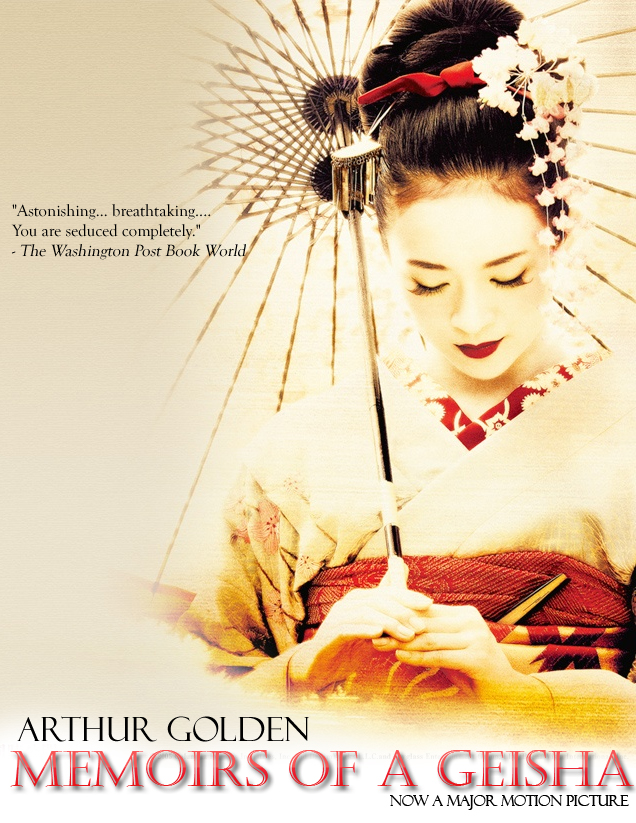
Credits: Book-cover "Memoires of a Geisha" by XMarr
As I was writing this post the movie "Memoires of a Geisha" came in mind. In front of my eyes a peony appeared with the face of a geisha. It hit me ... what a beauty. I have tried to catch that image in my haiku in response on the one by Kiitau. I hope I succeeded. I love to share here my way of composing haiku ... I call that process "giving birth".
As I am starting to write our posts, I also start to compose the haiku in my mind. During the writing of the posts images start to flow in front of my eyes. Images, or flashes of images, appear and flow, emerging in and out, like breathing. The images are constantly changing as I write the posts. During writing a lot of images come and go. There are always images that stay. As I am almost ready writing the post, a few images remain in my mind, I know I have to use them in my haiku.
Than the 'sculpting' begins. I write my haiku and re-write them until I know, don't ask me how, that I have the right haiku. Sometimes, and I know that the classical haiku-poets (e.g. Basho or Shiki) did that also, I have to re-do the final haiku a few times again.

the beauty of nature (4 syllables)
a geisha with peonies in her hair (9 syllables)
the sweet sound of a bamboo flute (7 syllables)

© Chèvrefeuille

Credits: Woodblock print "geisha"

The above haiku, for example, is one of the "pre-haiku" of the haiku to share here. This "pre-haiku" I have to re-do, because of the classical rules we have to use here in this "Sparkling Stars"-feature. And ... as you maybe know, I am not a haiku-poet of the classical way of writing. Here another kind of 'sculpting' starts, to got 5-7-5 syllables. As you all know I am not that familiar with the syllables-rules of English, so I use a syllable-counter on the Internet.

This is my "composing-path" to make the (above) haiku, a classical one (after every line between () you can read the syllables-count). This is the first 're-make':

nature's beauty (3)
a geisha with peonies in her hair (9)
the sound of a flute (4)

In this second version I have not enough syllables, so I have to try other words, without losing my image as I have planned; "nature's beauty" (3), not enough syllables, what to do? I will add  astonishment  to the beginning of this line.

Ah! the beauty of nature (5)

The first line is ok, so up to the second line.

"a geisha with peonies in her hair" (9), to much syllables. How to re-do this line without losing the scene? I have to get a few words out of this line, and than ... the "aha-erlebnis":

geisha, peonies in her hair (7)

To make the image complete I have to come up with a wonderful third, closing, line. So I seek for other words for example instead of "a flute" I use "Shakuhachi" (a Japanese end-blown flute. During the medieval period, shakuhachi were most notable for their role in the Fuke sect of Zen Buddhist monks, known as komusō ("priests of nothingness," or "emptiness monks"), who used the shakuhachi as a spiritual tool. Their songs (called "honkyoku") were paced according to the players' breathing and were considered meditation (suizen) as much as music). And so I have found my third line too.

playing the shakuhachi (5)

Credits: Komuso Buddhist monk beggar playing the Shakuhachi

Finally I have caught the image, which came in mind as I was writing this post. And now I can share the haiku which I distilled from the images in my mind inspired on the haiku by Kiitau:

Ah! the beauty of nature -
geisha, peonies in her hair,
playing the Shakuhachi


© Chèvrefeuille

Not completely according to the rules of this feature, because the first and third line aren't interchangeable. You can try to interchange it, but than the haiku loses it's beauty. So ... I am sorry that I didn't succeeded, forgive me ... (smiles)

I love to share a nice piece of Shakuhachi music. Enjoy the music. (This piece of Shakuhachi-music is called 'kyuden no kurayami' and is performed by Rodrigo Rodriguez )


This episode of "Sparkling Stars" is NOW OPEN for your submissions and will remain open until next Saturday September 6th at noon (CET). Have fun! I hope you enjoyed this post and the insight story about 'giving birth' to a haiku.