Showing posts with label sunflower. Show all posts

Friday, February 1, 2019

Carpe Diem Weekend Meditation #70 The Quest For A New Masterpiece continues ... sunflower


!! Open for your submissions next Sunday February 3rd at 7:00 PM (CET) !!

Dear Haijin, visitors and travelers,

Welcome at a new weekend meditation ... that feature that gives me the opportunity to take a few days of. I love this feature and it's every weekend a new challenge to come up with a new feature episode. This weekend meditation I have chosen to challenge you (again) with an episode of our "Quest For A New Masterpiece".


What makes a haiku (or tanka) a masterpiece? Well ... I will give it a try to tell you what a haiku (or tanka) makes a masterpiece in my opinion:

First: It has to describe a moment that got your attention.
Second: You have to use the right words. Words that describe the moment in its true way.
Third: Maybe ... use the classical way of creating haiku (or tanka) (as mentioned in CDHK Lecture One above in the menu).
Fourth: It has been written right from the heart or soul not the mind.
Fifth: It's (maybe) in the sense and tone of the classical haiku (tanka) poets.
Sixth: It has to be ... how shall I say it ... be your child, your creation ... in a masterpiece we can read, between the lines, the poet who created it.

I think you all can name several masterpieces of the classic haiku poets, but also of modern haiku poets.

Sunflower Fields Tuscany Italy

For this weekend meditation I love tochallenge you to create a (new) masterpiece themed "sunflowers". I will give you an example:

on the piazza
drinking wine with my love
sunflower field in front

© Chèvrefeuille (2016)

This weekend meditation is open for your submissions next Sunday February 3rd at 7:00 PM (CET) and will remain open until February 11th at noon (CET). Have a wonderful weekend.


Friday, November 10, 2017

Carpe Diem weekend-meditation #6 Kamishibai challenge "sunflower"


!!! Open for your submissions Sunday November 12th at 7:00 PM (CET) !!!

Dear Haijin, visitors and travelers,

Welcome at a new weekend-meditation here at our Haiku Kai. This week's weekend-meditation I have a nice challenge for you ... a haibun ... Maybe you are a long-time participant of CDHK and than you will remember that we had a special feature titled "Kamishibai". That special feature was about haibun (prose and haiku). Let me tell you a little bit more about "Kamishibai" first.

Kamishibai (紙芝居), literally "paper drama", is a form of storytelling that originated in Japanese Buddhist temples in the 12th century, where monks used emakimono (picture scrolls) to convey stories with moral lessons to a mostly illiterate audience.
Kamishibai endured as a storytelling method for centuries, but is perhaps best known for its revival in the 1920s through the 1950s. The gaito kamishibaiya, or kamishibai storyteller, rode from village to village on a bicycle equipped with a small stage. On arrival, the storyteller used two wooden clappers, called hyoshigi, to announce his arrival. Children who bought candy from the storyteller got the best seats in front of the stage. Once an audience assembled, the storyteller told several stories using a set of illustrated boards, inserted into the stage and withdrawn one by one as the story was told. The stories were often serials and new episodes were told on each visit to the village.

Kamishibai performer
It's similar with haibun, but there is a difference. In haibun the poet describes his / her "adventures", like e,g, Basho did in his "Oku No Hosomichi" (Small Road Into The Deep North) in words, the Kamishibai-performer tells stories.

I love to challenge you this weekend to create / write a haibun, but there are a few rules:

First I will give you a haiku which you have to use, of course you can include a few other haiku created by yourself, but the given haiku (or an interpretation or revision of that haiku) you have to use.
Second The classical rules, for haiku, are to be used. Those rules you can find above in the menu in CD Lecture 1
Third Your haibun may have a maximum of 250 words (including the haiku).

"broken" sunflower

To give you a little bit more 'freedom' I have two haiku for you from which you can choose:

blooming sunflowers
reaching for the early light of the sun -
birds praise their Creator

© Chèvrefeuille

Or this one, also created by me:

broken sunflower
seeds spread all around his stem;
bringing joy next year

© Chèvrefeuille

Well ... I hope you all have a wonderful weekend full of inspiration. Enjoy your weekend. This weekend-meditation is open for your submissions next Sunday November 12th at 7:00 PM (CET) and will remain open until November 19th at noon (CET). I will try to publish our new episode, another nice quatrain written by Omar Khayyam, next Sunday around 7:00 PM (CET).


Tuesday, May 30, 2017

Carpe Diem Tan Renga Challenge Month 2017 #19 in the light of dawn (Chèvrefeuille, your host)


Dear Haijin, visitors and travelers,

Welcome at the last episode of this Carpe Diem Tan Renga Challenge Month 2017. This month we have created wonderful Tan Renga inspired on wonderful "hokku" by classical and non-classical haiku poets. To conclude this month I have a nice haiku (how immodest) written by myself. This haiku I wrote in February 2016 as part of our first Theme Week. In this haiku I used the haiku writing technique "baransu" or "balance through association", a haiku writing technique which I created myself for our first series of CDHK Haiku Writing Techniques. More about this "baransu" technique you can find HERE.

Here is the "hokku" to work with for this last episode of this Tan Renga Challenge Month:

in the light of dawn
sunflowers reach to the blue sky
praising their Creator

© Chèvrefeuille

sunflowers (image found on Pinterest)
A wonderful challenge I think. Of course I cannot create a new 2nd stanza towards this one, because Tan renga is written by two poets and not by one. On the other hand ... I can create a Tanka with it, maybe that's what I am going to do.

in the light of dawn
sunflowers reach to the blue sky
praising their Creator
while a choir of birds falls in
she my love has to go home

© Chèvrefeuille

Not bad, not bad at all ... I even think this one is based on my experience, because when my wife and I met more then 25 years ago, she stayed several nights at my home, but had to leave at the break of dawn.

Well ... this was it ... our second Tan Renga Challenge Month at CDHK. I enjoyed creating it for you and I hope you all did like it.

This episode is NOW OPEN for your submissions and will remain open until June 4th at noon (CET). I will try to publish our first episode of our next month, prayer flags, later on. For now ... have fun!


Saturday, June 20, 2015

Carpe Diem Utabukuro #2 theme: summertime

Dear Haijin, visitors and travelers,

Last Saturday I started a new feature here at our Haiku Kai. In this new feature you have no prompts or something it's just for sharing your favorite haiku or tanka with us all here at our Haiku Kai and put them into the "poem bag" or Utabukuro.

For this episode however I have a theme. That theme has to be found in the shared haiku or tanka and this week I love to ask you to share your favorite haiku or tanka about "summertime". This favorite haiku can be from a modern haiku poet or a classical haiku poet.
As you have found your favorite haiku or tanka than please tell us why you have chosen that specific haiku or tanka and than write an all new haiku or tanka inspired on the haiku or tanka of your choice.

For this episode of Carpe Diem Utabukuro I have ran through my archives and found the following haiku which I wrote back in 2012 as spring was departing and summer almost started. This is a cascading haiku about sunflowers. I like sunflowers, because I associate them with summer, even when the sun is not there through the sunflowers I can feel summer.

Sunflowers - Vincent Van Gogh
hopeful new day
available in yellowish
a great sunflower

a great sunflower
desirable to bright sunlight
bows its head to earth

bows its head to earth
a possible new flower opens
promising dreams


© Chèvrefeuille

And here is my all new haiku inspired on this cascading haiku written by myself:

bruised sunflower
it bowed its head to deep -
departure of summer


© Chèvrefeuille

Not as strong as I had hoped, but I like the opposite scene ...

This episode of Carpe Diem Utabukuro is open for your submissions at noon (CET) and will remain open until next Saturday June 27th at noon (CET). Have fun!


Monday, April 21, 2014

Carpe Diem's ''Only the First Line'' #6, ''reaching for the sun'''


Dear Haijin, visitors and travelers,

It is time for a new episode of CD's "Only the First Line" in which I challenge you all to write a haiku starting with the given first line. It's really a joy and a challenge to be part in this special feature.

For this episode I have chosen the following first line:

reaching for the sun

I think you can write several new haiku starting with this first line and here is my attempt:

reaching for the sun
stretching towards the bleu sky -
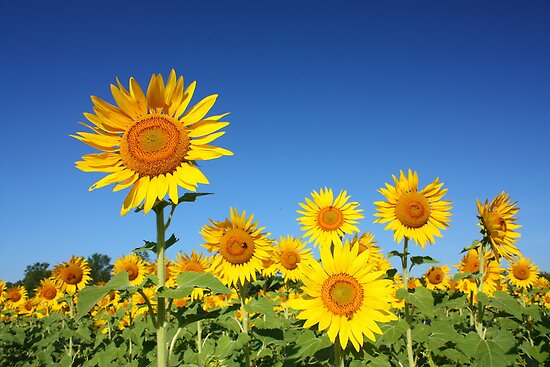
field of sunflowers


(c) Chèvrefeuille

Credits: Sunflower Field

This episode of Carpe Diem's "Only the First Line" is now open for your submissions and will remain open until May 5th 11.59 AM (CET). Have fun, be inspired and share your haiku starting with the first line reaching for the sun.


Friday, March 21, 2014

Carpe Diem Special #83, The Way of St. James (part 9)


Dear Haijin, visitors and travelers,

We are flying back from Japan to Europe to go on with our pilgrimage to Santiago De Compostela together with Paulo Coelho and his companion Petrus. This pilgrimage to Santiago De Compostela is almost at his end, we have still (including this one) two parts to go and than we will know if Paulo has retrieved his sword.
In our last Special I talked about Agape and today we will go even a bit further ... conquering Self.

As Paulo and his companion Petrus are going on with their pilgrimage they find a awesome waterfall and Petrus decides to take a dive in the cold water completely naked and challenges Paulo to do the same. As Petrus has got in to the cold water he yells at Paulo to do the same and that he will climb the waterfall to reach the magnificent top of the moutain from which the waterfall is throwing down its water. Petrus does what he says and climbs the waterfall naked only with his hands and feet.
As Petrus has conquered the waterfall and stands on the top of the mountain Paulo decides to do the same.

[...] "I trusted completely in my hands and feet. My hands had, after all, already held an ancient sword, and my feet had trod the Road to Santiago. They were my friends, and they were helping me." [...] (source: The Pilgrimage by Paulo Coelho)


Paulo succeeds in his task to climb the waterfall just like Petrus, but he had to fought against his thoughts to let go ... He describes it as follows:


[...] "I fought with all my strength to keep my hands and feet anchored to their holds, but the
noise of the water seemed to take me to another place. It was a mysterious and distant place where nothing that was happening at that moment was at all important, and it was a place that I could get to if I had the strength. In that place, there would no longer be any need for the superhuman effort it took to keep my hands and feet holding to the rock; there would be only rest and peace. But my hands and feet did not obey this impulse to surrender. They had resisted a mortal temptation. And my head began to emerge from the stream as gradually as it had entered it. I was overcome by a profound love for my body. It was there, helping me in this crazy adventure of climbing through a waterfall in search of a sword. When my head came completely through the surface,
I saw the bright sun above me and took a deep breath."[...]

Paulo had to overcome his Self ... and isn't that the goal of every pilgrimage?

climbing the mountains
trusting completely on faith -
sunflowers reach for the sun

(c) Chèvrefeuille


Well ... I hope you did like this episode and maybe it has learned you something about your Self. Let that inspire you to write a haiku and share it with us all here at our Haiku Kai.
!! I have published our new promptlist for April 2014, you can find it above in the menu.

This episode will be open for your submissions tonight at 7.00 PM (CET) and will remain open until March 24th 11.59 AM (CET). I will try to publish our new episode, Mandara-ji (temple 72), later on.


Friday, March 14, 2014

Carpe Diem Goes Back to It's Roots #5


Dear Haijin, visitors and travelers,

Today the goal is to write a classical haiku following the classical rules of haiku. So your haiku has to follow the next rules:
1. Describe a moment as short as the sound of a pebble thrown into water; so present tense;
2. 5-7-5 syllables;
3. Use a kigo (or seasonword);
4. Use a kireji (or cuttingword);
5. Sometimes a deeper spiritual or Zen-Buddhistic meaning;
6. First and third line are interchangeable and last but not least
7. No Self, avoid personal or possessive pronouns (I, me, my); it's an experience not how the poet feels about it.

As you can read at point 4, one of the rules is to use kireji (cuttingword). Kireji (lt. "cutting word") is the expression for a special category of words used in certain types of Japanese traditional poetry as is haiku. It's regarded as a requirement in classical haiku.
In English there is no exact equivalent of kireji and therefore it's difficult to define its function. It is said to supply structural support to the haiku. When placed at the end of a haiku, it provides a dignified ending, concluding the haiku with a heightened sense of closure. Used in the middle of the haiku, it briefly cuts the stream of thought, indicating that the haiku consists of two thoughts held independent of each other. In such a position, it indicates a pause, both rhythmically and grammatically, and may tend an emotional flavour to the phrase preceding it.

The most common Kireji used in classical haiku are:
ka : emphasis; when at end of a phrase, it indicates a question.
kana : emphasis; usually can be found at a poem's end, indicates wonder.
- keri : exclamatory verbal suffix, past perfect.
- ramu or - ran : verbal suffix indicating probability.
- shi : adjectival suffix; usually used to end a clause.
- tsu : verbal suffix; present perfect.
ya : emphasis the preceding word or words cutting a poem into two parts, it implies an equation, while inviting the reader to explore their interrelationship.

 
Beach

How to use Kireji?

Haiku consist of 17 Japanese syllables or onji, in three metrical phrase of 5, 7 and 5 onji respectively. A kireji is typical positioned at the end of one of these three phrases.When it's placed at the end of the final phrase (the end of the haiku), the kireji draws the reader back to the beginning, initiating a circular pattern. A large number of haiku, including many of those by Basho (1644-1694, founder of the "modern" haiku), and with either - keri, an exclamatory auxiliary verb, or the exclamatory particle kana , both of which initiate such a circular pattern.Let me give you an example of the use of kireji.
For these examples I have used the four volume series "Haiku" written by R.H. Blyth.

shoku no hi wo shoku ni utsusu ya hara no yu
lighting one candle
with another candle;
an evening of spring


(c) Buson (1716-1783)

Buson is one of the four greatest haiku-poets next to Basho, Issa and Shiki. In the original haiku (written in romaji) the 'ya' is a cuttingword. In this one translated by a ; . Another example this time one written by Basho (1644-1694).

aki-kaze ya yabu mo hatake mo fuwa no seki
the autumn wind:
thickets and fields also,
Fuha Barrier


(c) Basho

In this verse the cutting-word is at the end of the first line 'ya' and is translated with :
 
 
The goal is to write a classical haiku following the rules. I am not such a haiku-poet who is writing his haiku in the classical way, but sometimes I like to go back to the roots of haiku myself.
Here is my attempt to write a classical haiku, and it's not easy to write those classical ones, because I write my haiku in the so called Kanshicho-style (in which the rules are a bit easier).

blooming sunflowers
reaching for the early light of the sun -
birds praise their Creator
(c) Chèvrefeuille, your host

Well ... now it's up to you my dear Haijin, visitors and travelers to write a new haiku in the classical way as described above. Just for the fun ... have fun, be inspired and share your classical haiku with us all here at our Haiku Kai. This episode of "Goes Back To It's Roots" is NOW OPEN for your submissions and will remain open until March 28th 11.59 AM (CET).


Sunday, October 21, 2012

Carpe Diem, #22 Sunflower


Dear Haijin, visitors and travelers,

It's a joy to write another episode of Carpe Diem. Every day I am glad to see that you're inspired every day again and that you provide me with wonderfully composed haiku. Thank you all for being faithful to Carpe Diem. I hope to see that this haiku meme will be growing further. So ... if you know other haijin or poets who love to write haiku ... well ... draw attention to them on Carpe Diem. I love to see our Carpe Diem grow and I hope that I can go on with this daily haiku meme ...

from the bottom of my heart that you are participating in Carpe Diem
Today our prompt is sunflower that wonderful flower that looks like a bright shining sun. I have warm memories to sunflowers and when my brother died in 1995 I provided my parents with a haiga on sunflowers. They had a hard time when my brother died and they were very sad about his loss.
I can't retrieve the haiga (it was an watercolor painting with a calligraphed haiku) I can reproduce the haiku here:

in dark times
sunflowers give
a bit of sunlight


My parents had a big support of it in those dark times after the dead of my brother.

This prompt will stay ou 'till October 23th 11.59 AM (CET). Our new prompt is praying and I will publish that today around 10.00 PM (CET)

Have fun writing your haiku. Be inspired and enjoy. Your haiku may be a classical or a nono-classical one. Feel free and be creative.