Sunday, March 30, 2014

Carpe Diem #434, Okubo-ji (temple 88)


Dear O-Henro ... Haijin, visitors and travelers,

Here it is, our last episode of Carpe Diem's Shikoku pilgrimage along 88 temples. It was a joy to go on this virtual pilgrimage with you all, with our haiku-community, our haiku-family, but this is it. Next month we will have another wonderful month of kigo (seasonwords), all modern ones based on "A Dictionary of Haiku" by Jane Reichhold, but before we enter this new month I love to tell you all about the last theme in the State of Zen in Haiku, courage.

The last of the manifestations of Zen is in the form of courage. Though not one of the virtues especially emphasized by the moralist, it nevertheless includes all the other twelve characteristics which came along in the last two months, selflessness, loneliness, grateful acceptance, wordlessness, non-intellectuality, contradictoriness, humour, freedom, non-morality, materiality and love. All these elements are in some way present when an act of courage is performed.


It may be difficult, however, to see how courage is an essential, even the most essential part of a poet. Courage is life, living. Life is change; change is suffering; the will to suffer is courage.
Without courage we shall never be able truly to grasp the fact that all things, all events are vehicles of something that is far above and beyond the rules of morality.

It takes courage to become a pilgrim, as we have seen the last two months. It takes courage to become a haiku-poet, because you have to say what you have seen in an eye-blink in three lines of 5-7-5 syllables. Courage to say in a minimum of words that short moment as short as the sound of a pebble thrown into the water.

the sound of water
resonates through the mountains
deepens the silence


(c) Chèvrefeuille

Okubo-ji (temple 88)

Maybe it takes courage to enter the last temple on our Shikoku Pilgrimage, but at the other hand ... it must be a joy to realise that we have made it to the last temple Okubo-ji, devoted to Yakushi Nyorai the Buddha of Healing and Medicine. Maybe that's what this pilgrimage has brought us Healing ... but that I can not say, because I don't know how you all have experienced this pilgrimage. To me it was just a joy and in a way very healing and I think this pilgrimage has transformed me into ... another strong loving being.

Well ... that concludes our pilgrimage along the 88 temples on Shikoku Island and now we will enter a new month of Carpe Diem in which we will celebrate spring and in which month we will have our first 'ghost-writer' week.
This episode is open for your submissions tonight at 7.00 PM (CET) and will remain open until April 2nd 11.59 AM (CET). I will (try to) post our new episode, the first of a new month of Carpe Diem, later on today. Than we will enter spring with Awe.

Namaste


Saturday, March 29, 2014

Carpe Diem Extra #4-2014


Dear Haijin, visitors and travelers,

A few days ago I got an email of Soundcloud.com, a website were they give young and alternative composers the chance to share their music.
Naviar Haikuproject is one of the groups there. I am a member of that group and have granted them permission to use haiku written by me for the inspiration of those composers.
One of my haiku:

deep silence
in this ancient Buddhist temple
chanting monks

(c) Chèvrefeuille

Has inspired Raelx2013, one of the composers, to write a wonderful, spiritual and meditative piece of music. I love to share that piece of music here:


I like this piece of music a lot and I hope you like it too. I am honored that Raelx2013 has composed this inspired on my haiku.

Than I have another great thing to share with you. Last year I submitted two haiku to the haiku-contest of the Vancouver Cherry Blossom Festival. One of my haiku has gotten a honorable mention. I am happy and feel lucky that my haiku has gotten that honorable mention.

The haiku which got that honorable mention is the following:

finally spring
the old Sakura in the backyard
in full bloom


(c) Chèvrefeuille (2013)

The old Sakura in my backyard
Well ... I have a lot to be gratefull for and I feel humble that I got this recognition. It makes feel great and I am so happy that my haiku are cherished by a lot of people. What did I do to deserve all this?

Have a happy weekend,

Namaste


Carpe Diem #433, Nagao-ji (temple 87)


Dear O-Henro ... Haijin, visitors and travelers,

With this episode we enter the last phase, the last two days of our Shikoku pilgrimage and as I have promised I will the last two themes of the State of Zen in Haiku.
In this episode that will be love and in our last episode tomorrow that will be courage.

Love ... a wellknown emotion and in Zen-Buddhism love is very much referred to all and everything, but what to say about love as theme for the State of Zen in Haiku? Let me tell you ...

Credits: Spiritual Love

Zen is love of the Universe. Without this love, joy is uncertain, pain inevitable, all is meaningless.
This love must be complete, - not that it aims at the Universe as a whole, but that the personality as a whole is to be concentrated on the thing; the thing is to be suffused with the personality.

[...] "When an object is picked up, everthing else, One and All, comes along with it, not in the way of suggestion, but all-inclusively, in the sense that the object is complete in itself" [...] (Source: Dr. Suzuki)

The relation of love to poetry may be easy to make, but that to Zen is more difficult. Look at it like this.
If we are without self-love, greediness, without desire of gain, of happiness, of life itself, all this energy must overflow somewhere. It overflowes into all things, including one self, so that now no actions are selfish or unselfish, good or bad, but are like the sunshine or the rain, but with mind instead of mindlessness. We say that we see the beauty of the fine drops of rain, the glittering of the leaves in the sun, the stars in their calm, - but what we really see is in the mind of man, or own mind, in all these things. Through our activity and cooperation, these inanimate things acquire mind and affection.
In return, we become windy, rainy, starry, sunny creatures living in all things, in all times and places.


Love is also a kind of Dualism

Haiku are an expression of the joy of our reunion with things from which we have been parted by self-consciousness, so strong and tender in the sexual act, more diffused, yet equally powerful and delicate in our poetic moments. Though our love of things is so feeble, we all desire to be loved ardently in the wrong, the unbuddhistic, the unchristian way.

A few haiku to give you all an idea of love as a State of Zen in Haiku:

mountain persimmons;
the mother is eating
the astringent parts


(c) Issa

shutting the great temple gate,
creak! it goes:

an autumn evening

(c) Shiki

And a last one composed by San-in, a not so well-known haiku-poet:

it walked with me
as I walked,
the scarecrow in the distance


(c) San-in

Now we know a little bit more about love as a State of Zen in Haiku and now we can enter Nagao-ji, temple 87, devoted to Guanyin the boddhisattva of compassion. Guanyin is in this idea of love as a State of Zen in Haiku the most important boddhisattva, because Guanyin is depicted in both ways, as a male and as a female. So in Guanyin love is clearly there.
Now we can celebrate love as the ultimate, unconditional and universal energy which makes us who we are and who we will become. In my opinion love is the strongest energy to transform us into godlike loving creatures.


Nagao-ji (temple 87)

the last steps taken
to find universal love -
the sound of rain


(c) Chèvrefeuille

And now it is up to you my dear Haijin, visitors and travelers to write haiku inspired by love as a State of Zen. This episode will be open for your submissions tonight at 7.00 PM (CET) and will remain open until April 1st 11.59 AM (CET). I will (try to) post our last episode of this month, of this wonderful and spiritual pilgrimage, later on today. In that episode we will finally, after two months, enter the last temple of the Shikoku trail, Okubo-ji (temple 88).


Friday, March 28, 2014

Carpe Diem Extra #3-2014


Dear haijin, visitors and travelers,

Thank you all for your congratulations with the birth of my seventh grandchild. My youngest daughter gave birth to her first born, Myron, a baby-boy, on March 26th. My daughter and grandson are well and have left the hospital today.

I love to share a photo with you all:

A very proud granddad (me) and his grandson Myron
Have a nice day and a wonderful weekend.

Namaste,

Chèvrefeuille, your host

Carpe Diem #432, shido-ji (temple 86)


Dear O-Henro ... Haijin, visitors and travelers,

First this: Thank you all for the congratulations shared with me and my family with the birth of our (7th) grandchild, Myron. My daughter and Myron are both well and they have left the hospital today.

It's almost over this pilgrimage along the 88 temples on Shikoku Island in which we have trod in the footsteps of Kobo Daishi (774-835) one of the founders of Shingon-sect of Buddhism. We have visited a lot of temples and we have gotten more knowledge of Buddhism ... and as I stated in our yesterday's post about The Way of St. James, I think this pilgrimage has transformed us all.
I have read wonderful haiku, senryu, tanka, kyoka and haibun, but I am also glad that these months are almost over, because it was a challenge to write an every day post about the temples and Buddhism.
As I was preparing this new episode I watched the prompt-list again of this month and I realized that I had forgotten March 31th. So after this episode we have another two episodes to go. In those episodes I will visit the last two temples and I will share the last two themes of the State of Zen of Haiku.
Our last two days, March 30th and 31th, we will visit respectively temple 87 and 88 (Nagao-ji and Okubo-ji) sorry for this little change in our prompt-list of March.

For this episode I will only share a photo of Shido-ji temple for your inspiration and I hope that photo will give enough inspiration. By the way the name Shido-ji means Temple of fulfilling One's Wish.

Shido-ji (temple 86)

pilgrimage's end in sight
just one wish left to fulfill
to be Enlightened

(c) Chèvrefeuille

I hope this episode will give you all enough inspiration to write haiku. This episode is open for your submissions tonight at 7.00 PM (CET) and will remain open until March 31th 11.59 AM (CET).
Our next stop will be temple 87, Nagao-ji, and in that episode I will share another theme of the State of Zen of Haiku ... LOVE.


Carpe Diem Special #84, The Way of St. James (part 10)


Dear Haijin, visitors and travelers,

Today we will enter the last part of our pilgrimage to Santiago de Compostela together with Paulo and his companion Petrus. Will he retrieve his sword? We will see ...

As we go on after the Self challenge of our last Special episode we encounter Paulo and his companion Petrus somewhere on the road. Paulo has had an encounter with a dog in the ruined city of Foncebadon and is wounded. Petrus carries him towards the house of a blacksmith, were several humans help him to give first aid and care.

The ruined city of Foncebadon Spain

He is taken good care of, but than the story goes that Paulo has Rabies and so they send him away because they are anxious that he will become Rabid and will spread the disease. As they leave the blacksmith's home Paulo asks Petrus if he was worried about his recovery. Petrus than answers:

[...] ‘There is an understanding about the Road to Santiago that I have not told you about before,’ he said. ‘Once a pilgrimage has begun, the only acceptable excuse for interrupting it is illness. If you had not been able to recover from your wounds and your fever had continued, it would have been an omen, telling us that our pilgrimage had to end there.’ [...] (Source: Paulo Coelho's The Pilgrimage)

As they went on they walk along a path on which crosses are statued every 30 metres, one of the crosses has fallen and than Petrus asks, no commands, Paulo to set the cross again in a standing position. Paulo, unless the wounds on his hands, arms and legs, does what Petrus is asking for. As Paulo is busy with this work he uses all the excercises he had learned from Petrus, As he uses the Excercise of the Seed he conquers the pain, realising that their was once a Saviour who had done the same, and sets the cross again in it's standing position.


Cross along the Way of St. James (The Camino)

After a while they arrive at Ponferrada on an ancient railway station were they sit down on an ancient steam-locomotive. There Petrus tells Paulo the secret of RAM, The Tradition which will lead him back to his sword.

[...] ‘The secret is the following,’ Petrus said. ‘You can learn only through teaching. We have been together here on the Road to Santiago, but while you were learning the practices, I learned the meaning of them. In teaching you, I truly learned. By taking on the role of guide, I was able to find my own true path. ‘If you succeed in finding your sword, you will have to teach the Road to someone else. And only when that happens – when you accept your role as a Master – will you learn all the answers you have in your heart. Each of us knows the answers, even before someone tells us what they are. Life teaches us lessons every minute, and the secret is to accept that only in our daily lives can we show ourselves to be as wise as Solomon and as powerful as Alexander the Great. But we become aware of this only when we are forced to teach others and to participate in adventures as extravagant as this one has been.’
I was hearing the most unexpected farewell in my life. The person with whom I had had the most intense bond was saying good-bye right there in midjourney – in an oilysmelling train yard, with me forced to keep my eyes closed. ‘I don’t like saying good-bye,’ Petrus continued. ‘I am Italian, and I am very emotional. But according to the law of the Tradition, you must find your sword alone. This is the only way that you will believe in your own power. I have passed on to you everything that I have to give. The only thing left is the Dance Exercise, which I am going to teach you now; you should perform it tomorrow at the ritual.’
He was silent for a while, and then he spoke: ‘May that which is glorified be glorified in the Lord. You may open your eyes.’ [...]
(Source: Paulo Coelho's The Pilgrimage)


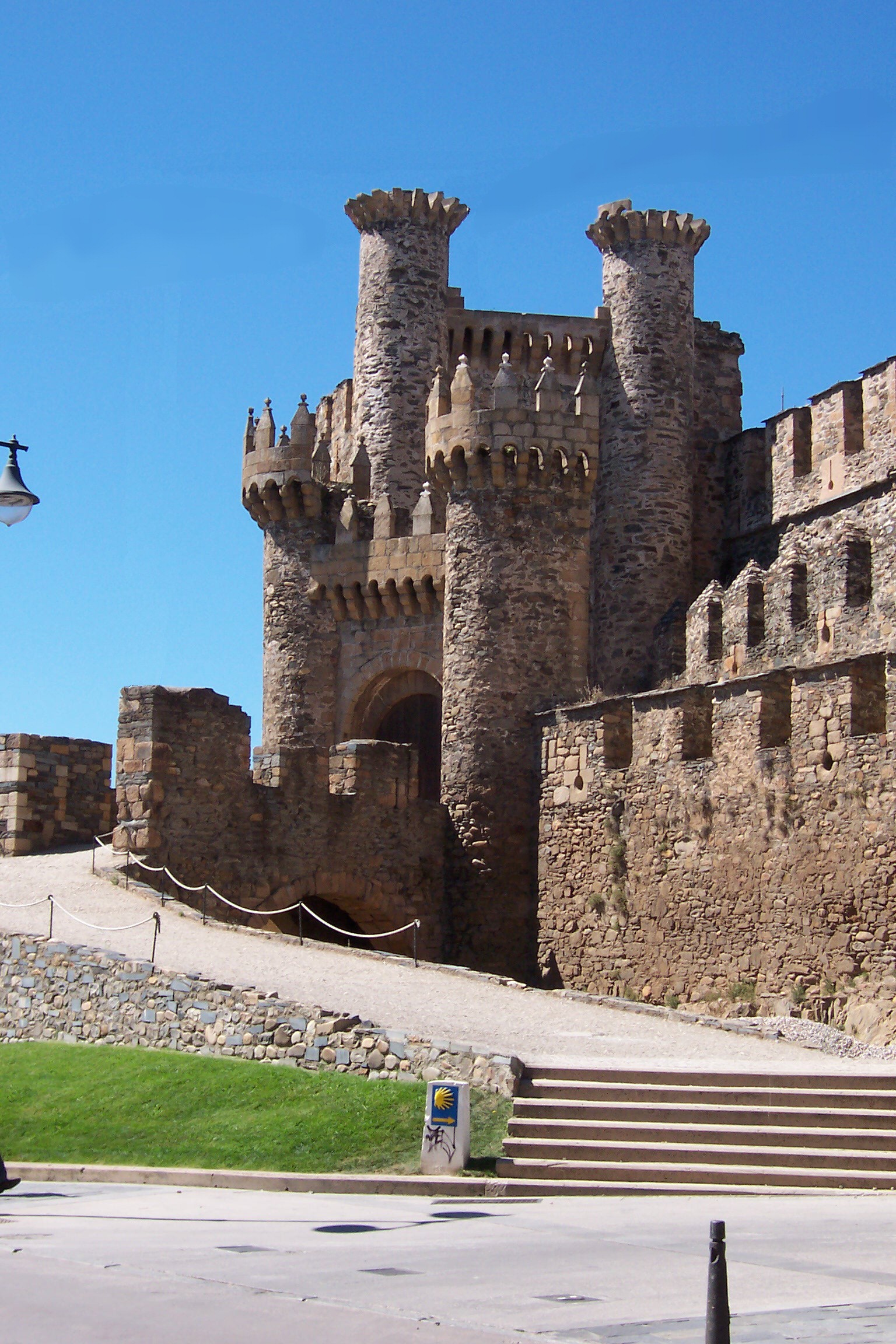
Ponferrada is also very well known by people who are into the Myths of the Templars, because in Ponferrada there stands one of the castles of the Templars.


Castle of the Templars at Ponferrada

The last part of the Camino Paulo has to walk completely alone, conquering his Self again and looking for his Saviour. Finally he arrived at the point were his Master welcomes him and give him back his sword.

[…] “In the small church there was no cross. There on the altar were the relics of the miracle: the chalice and the paten that I had seen during the dance, and a silver reliquary containing the body and blood of Jesus. I once again believed in miracles and in the impossible things that human beings can accomplish in their daily lives.

The mountain peaks seemed to say to me that they were there only as a challenge to humans – and that humans exist only to accept the honor of that challenge. The lamb slipped into one of the pews, and I looked to the front of the chapel. Standing before the altar, smiling – and perhaps a bit relieved – was my Master: with my sword in his hand. I stopped, and he came toward me, passing me by and going outside. I followed him. In front of the chapel, looking up at the dark sky, he unsheathed my sword and told me to grasp its hilt with him. He pointed the blade upward and said the sacred Psalm of those who travel far to achieve victory:

“A thousand fall at your side, and ten thousand to your right,
but you will not be touched.
No evil will befall you, no curse will fall upon your tent;
your angels will be given orders regarding you,
to protect you along your every way.”
I knelt, and as he touched the blade to my shoulders, he said:

“Trample the lion and the serpent, The lion cub and the dragon will make shoes for your feet.”
As he finished saying this, it began to rain. The rain fertilized the earth, and its water would return to the sky after having given birth to a seed, grown a tree, brought a flower into blossom. The storm intensified, and I raised my head, feeling the rain for the first time in my entire journey along the Road to Santiago. I remembered the dry fields, and I was joyful that they were being showered upon that night. I remembered the rocks in Leon, the wheat fields of Navarra, the dryness of Castile, and the vineyards of Rioja that today were drinking the rain that fell in torrents, with all of the force in the skies. I remembered having raised a cross, and I thought that the storm would once again cause it to fall to earth so that another pilgrim could learn about command and obedience. I thought of the waterfall, which now must be even stronger because of the rainfall, and of Foncebadon, where I had left such power to fertilize the soil again. I thought about all of the water I had drunk from so many fountains that were now being replenished. I was worthy of my sword because I knew what to do with it. The Master held out the sword to me, and I grasped it. I looked about for the lamb, but he had disappeared. But that did not matter: the Water of Life fell from the sky and caused the blade of my sword to glisten.” […] (Source: Paulo Coelho’s The Pilgrimage)

Holy Sword

And here ends this Pilgrimage in which Paulo has changed a lot as a person. He has become a totally different person than who he was on the day that he started with his Way of St. James. We had the opportunity to follow within his footsteps and maybe … we all have transformed too.

pilgrims transformation
as buds burst open in spring
flowering cherry trees

(c) Chèvrefeuille

This episode is NOW OPEN for your submissions and will remain open until March 31th 11.59 AM (CET). I will post our next episode, Shido-ji (temple 86), later on today (I will try to be on time).


Thursday, March 27, 2014

Carpe Diem #431, Negoro-ji (temple 82) & Yashima-ji (temple 84)


Dear O-Henro ... Haijin, visitors and travelers,

As you all could have read in the small post of yesterday I have become a granddad (again). Our youngest daughter has given birth to her first born, a baby-boy named Myron. I couldn't post the episode of Negoro-ji and Yashima-ji on time, so I have chosen to do both temples in one post. I hope you don't mind that.
We are almost at the end of our pilgrimages on Shikoku Island and in the Northern region of Spain and then we will enter a new month full of exciting 'modern' kigo (seasonwords) for spring and of course we will have our first week of "Ghost-Writing". All family-members whom I had invited to be 'ghost-writer', have accepted my invitation. So in week 15 (April 7th until April 11th) we will have posts written by (respectively) Jules (April 7th), Managua (April 8th), Ese (April 9th), Belinda (April 10th) and Bjorn (April 11th). I am looking forward to this week and the posts they will write for our Haiku Kai.

Well ... let us go on with our Shikoku Pilgrimage along the 88 temples on the Japanese Island Shikoku. As I wrote above we will visit two temples on this trail today and I hope those temples will inspire you to write nice haiku. This time I have chosen to just give a photo of the temple for your inspiration ... so have fun ...

Negoro-ji (temple 82) devoted to Senju Kannon

a challenge
walking the path to Enlightenment -
poppies bow their head

(c) Chèvrefeuille

And here a photograph of Yashima-ji (temple 84) devoted also to Senju Kannon, the boddhisattva of compassion, as we have seen earlier on our pilgrimage. (The Far Eastern equivalent of the Virgin Mary).

Yashima-ji (temple 84) also devoted to Senju Kannon

full of compassion
she bows her head to Guanyin
the Virgin Mary

(c) Chèvrefeuille

I hope these photos and haiku give you all enough inspiration to write a haiku, senryu, tanka, kyoka or haibun in response on this post. By the way I have tried to write a haiku in response on the birth of my grandson Myron, but I didn't succeed right ... but I will sure share that haiku with you all. Thank you all for the congratulations given in rsponse of the birth of my grandson.
This episode is NOW OPEN for your submissions and will remain open until March 30th 11.59 AM (CET). I wil try to post our new episode, that will be the last Special about The Way of St. James, later on today.