Sunday, April 5, 2015

Carpe Diem #700, Govinda (the bow)


Dear Haijin, visitors and travelers,

Isn't it amazing? This is our 700th episode of our Carpe Diem Haiku Kai, the regular episodes of course. So we have a little celebration ... I have presented you with 700 (regular) episodes in which I challenged you to write an all new haiku inspired on a given prompt. Awesome!

This month we are on a journey to discover the beauty of the Bhagavad Gita and maybe find "peace of mind", as is the central theme this month. Today it's not really a part of the Bhagavad Gita, but more a kind of exchanging thoughts between a few sources. Why? Well ... today our prompt is Govinda (the bow), and it refers to the bow of Arjuna, the Archer, who has the leading role in the Bhagavad Gita.
Maybe you have visited Haiku Shuukan at WP, another part of our Haiku Kai Family. Recently the theme there was "The Way of the Bow", based on a short story by Paulo Coelho. In that short story he describes the path to enlightenment through archery. As the arrow has left the bow ... there is no returning back it will seek its way to the goal. That's how our spiritual growth works ... we are once at a certain point in our lives and then we realize that our life must chance ... this occurs around the age of 20 ...

Maybe you know the novel "Siddhartha" by Hermann Hesse. In that novel Siddhartha and his best friend Govinda are on a journey to discover their path. They were great friends, but after years of searching for the truth their lives depart ... Siddhartha becomes a wealthy merchant and learns "the worldly pleasures" while Govinda is staying at the Buddha's place and becomes a monk. At first Siddhartha is very sad as he and his best friend are split up ... he loses his goal, he had to let go Govinda.

What has this to do with the Bhagavad Gita? All and everything, but also nothing. There is just that name Govinda who hold those different ideas together. There has to be a connection between Hinduism and Buddhism ... the both religions saw the light of life in India and maybe those religions were connected with Christianity, Islam and other religions. All we know is that Hinduism is the oldest religion known. All other religions have grown from Hinduism ... It's just a hypothesis but it's worth thinking it over.

don't hide your light
let it shine bright without regret -
Lotus will bloom again

© Chèvrefeuille


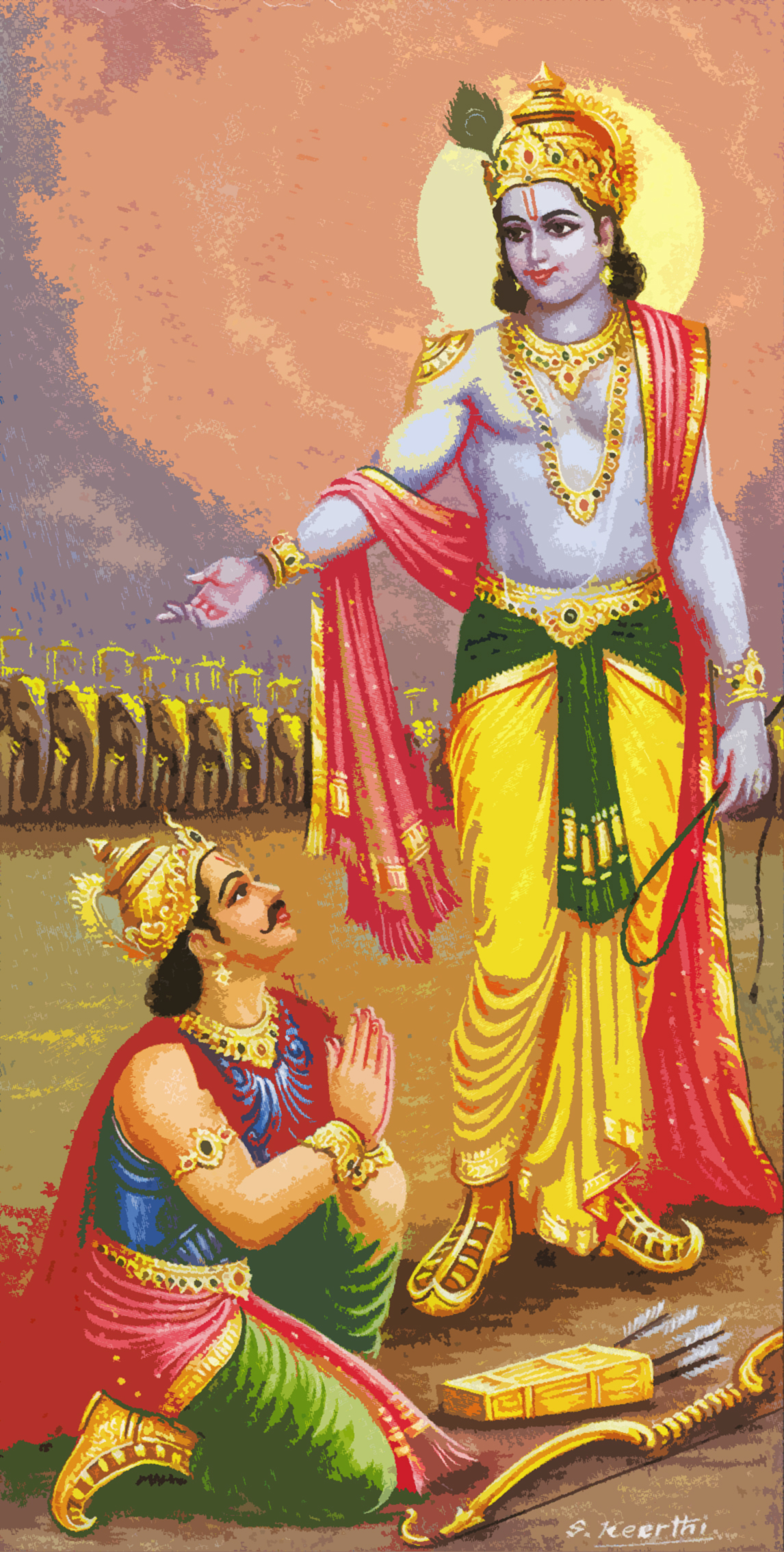
There are similarities in the world religions, there was once the idea of a lot of gods and goddesses, even in the ancient religion of Judaism there was a moment that they thought there were multiple gods ... One way or another it brings us all the ideas for life ... the everlasting battle between good and bad, as we also see in the Bhagavad Gita. There he stands in the middle of two big armies, Arjuna, the Archer. He becomes anxious and let his bow, Govinda, slip from his hands. He doesn't know what to do .... how can he go to battle against an army in which there are friends and family of him?
This is the ultimate inner battle ... and is it a coincidence that that inner battle has been fought by Jesus Christ in the Garden of Gethsemane? No ... it isn't. Maybe you think this is blasphemy, but that's certainly not what I think it is. It's part of the hypothesis that all world religions have grown from Hinduism.

Govinda (the bow), can make the difference. Jesus made the difference by giving his own life to save humankind .... and that's also what is told in the Bhagavad Gita ... Arjuna is the savior of humankind and he is now at that point ... will he choose right? Krishna teaches him about life and death teaches him about Atman, heaven, in which there will be no differences anymore. How wonderful is this idea?

Remember the Tarot month! There was one of the last cards, "The World" in which we see that there will be a New Heaven, a New Jerusalem ... that's the place were we all will come after all ... that New Jerusalem is the same as Atman ...

Credits: Govinda (the bow) slips from Arjuna's hands

This episode wasn't easy to create ... it's triggered by Hamish (see his comment at episode 699) and I thought, no I had to use it for this episode in which we see that Arjuna loses Govinda as he is desperate in the middle of the battle ... Govinda (the bow) cannot be without the hand of the Archer, but also cannot be without the arrow ... the arrow as it has left the bow there is no returning back ... as Arjuna shoots his arrow than the battle will be fought .... at that moment as he looses Govinda (the bow) as is Siddhartha in Hermann Hesse's novel loosing his best friend to the wisdom of Buddha he makes the decision to take another path ... a path that will lead him to salvation ... isn't that what we celebrate today? Easter .....

narcissus bloom
shining their light on our path -
He has risen

(c) Chèvrefeuille

Well .... happy Easter to you all ... and I hope this episode, maybe in a way controversial, but remember this idea exposed here is just a hypothesis. Let this episode inspire you to write an all new haiku ...

This episode is open for your submissions tonight at 7.00 PM (CET) and will remain open until April 8th at noon (CET). I will (try to) publish our new episode, ancestors, later on. For now ... just have fun!


Saturday, April 4, 2015

Carpe Diem #699, depression


Dear Haijin, visitors and travelers,

A few days ago we started our discovery of the Bhagavad Gita and then there were a few other episodes, but today we will continue our discovery of the Bhagavad Gita. As we can recall .... Arjuna stood in the middle of the both armies and had a conversation with Krishna about life and death.
Arjuna becomes sad and depressed as he sees the enemy armies in which his friends, family-members and teachers are gathered. And he becomes anxious ... how can he fight against his best friends and family?

Having thus spoken in the midst of the battlefield, Arjuna, casting away his bow and arrow, sat down on the seat of the chariot with his mind overwhelmed with sorrow.

The Lord takes pity on him and proceeds to enlighten him by various means. He explains to Arjuna the imperishable nature of the Atman, for which there is no past, present and future. The Atman never dies, therefore Arjuna should not grieve. As It transcends the five elements, namely, earth, water, fire, air and ether, It cannot be cut, burnt or dried. It is unchanging and eternal. Everyone experiences conditions like pleasure and pain, heat and cold, due to contact of objects with the senses. The senses carry the sensations through the nerves to the mind. One should be able to withdraw the senses from objects, like the tortoise which withdraws all its limbs within.

eternal circle
lotuses blooming and decaying -
ancient wisdom grows

© Chèvrefeuille


Krishna asserts that only one who has the capacity to be balanced in pleasure and pain alike is fit for immortality. Krishna goes on to tell Arjuna that if he refuses to fight and flees from the battle, people will be justified in condemning such action as unworthy of a warrior.

Having taught Arjuna the immortal nature of the Atman, Lord Krishna turns to the performance of action without expectation of fruit. A man should not concern himself about the fruit of the action, like gain and loss, victory and defeat. These are in the hands of the Lord. He should perform all action with a balanced mind, calmly enduring the pairs of opposites like heat and cold, pleasure and pain, that inevitably manifest during action. Krishna advises Arjuna to fight, free from desire for acquisition of kingdom or preservation of it.

Arjuna is eager to know the characteristics of a man who has a stable mind. Such a person, Krishna tells him, will have no desires at all. Since he is content within, having realized the Self, he is entirely free from desires. The consciousness of the Atman and abandonment of desires are simultaneous experiences. The various qualities of a Sthitaprajna (a stable-minded person) are described by the Lord. He will not be affected by adversity and will have no fear or anger. He will take things as they come, and will not have any likes and dislikes. He will neither hug the world nor hate it. The man of stable mind will have perfect control of the senses. The senses are powerful and draw the mind outwards. One should therefore turn one’s gaze within and realize God who resides in the heart. The Yogi, having achieved a stable mind, remains steadfast even though all sense-objects come to him. He is unmoved and lives a life of eternal peace.

Krishna concludes that the eternal Brahmic state frees one from delusion forever. Even at the end of life, when one departs from this body, one does not lose consciousness of one’s identity with Brahman.

no more delusion
as the Painter finishes His painting -
it is ready


© Chèvrefeuille

As I re-read the above words a kind of joy overwhelms me ... what a joy to know that there will be a time in which we will be free from delusion even at the end of our life as we are leaving our conscious body and become eternal subconsciousness.


Isn't that what we explored during our Tarot month? This scene above could be easily placed in the Great Arcana's Tower card ... in which we have seen that we cannot become as God, but we are already God. Maybe you remember the Tower card ... in which the sky was filled with "yods" the only Hebrew sign that is placed in all words of the Holy Scripture .... therefore we can say God is everywhere around us, in us accompanying us through our whole life.
At the end of our life we may enter the Holy City, becoming Brahman ... and so there is a link between the great religions ... there is a common meaning in all the holy scriptures on Earth and beyond.

Arjuna overcomes his depression as he hears the words of Krishna and his transformation has started.


old pond
lotuses start blooming, growing to the light
water circles


© Chèvrefeuille

This episode is open for your submissions tonight at 7.00 PM (CET) and will remain open until April 7th at noon (CET). I will try to publish our new episode, Gandiva (the bow), later on. For now ... I hope this episode will inspire you to compose an all new haiku.

!! I have published our new Carpe Diem Haiku Kai prompt list already. You can find it in the menu !!

Carpe Diem Sparkling Stars # 21, Buson's "I came to the cherry blossoms"


Dear Haijin, visitors and travelers,

What a joy ... my Sakura has started to bloom, a little bit later then last year, but still it's a beauty. As I told you earlier I was a bit anxious that the fragile cherry blossoms would be scattered through the first tough spring storm here in The Netherlands. And as you all know I am very proud on my Sakura ... so I have chosen a Sparkling Star about cherry blossoms composed by Buson. Buson, one of the four greatest haiku poets, was also a haiga artist as you have seen in one of the earlier post this week. However ... Basho ... stays my master, but I also learn a lot of Buson lately. He (Buson) has an eye for beauty in nature and I think that in this haiku which I have chosen ... he paints with words.

hana ni kite hana ni ineburu itoma kana

I came to the cherry blossoms;
I slept beneath them;
this was my leisure


© Yosa Buson

When we see that cherry blossoms are something to sleep under, or dance under, we have attained a state beyond that of the average artist or poet. Beauty and significance are to be imbided without strain or affectation. A life of art, like that of goodness, is to be lived as the normal, the ordinary thing, without letting the right hand know or care about what the left hand does. All aesthetic and ethical pleasure must be spontaneous, without meaning or gain, just like the fish in the water and the bird in the air.

Sakura in bloom © Chèvrefeuille

The above photo I made early this morning, the sun started to become a bit stronger, but was still hidden behind a thin veil of clouds, but the color of the leaves and those fragile cherry blossoms made me very happy. My Sakura has bloomed ...

I love to get back to the haiku by Buson, because there are a few things which are rather strange ... First Buson IS part of the haiku, and that's not according to the classical haiku rules, because one of the major rules is that haiku is free of persona, but Buson places himself in his haiku. Why? I think he felt really part of the scene he gives an impression of in his haiku. Then there is the past tense, he places his haiku in the past and that also is a violation of the classical haiku rules, but on the other hand ... Buson remembered the scene as being wonderful ... I think this haiku is not the original haiku but a re-done haiku far after the time happening. Makes that his haiku a "bad" haiku? I think not ... I even think ... bringing himself in the haiku and placing the haiku in the past makes this haiku even stronger ... a wonderful memory ... and I am very certain that Buson has turned this haiku into a wonderful haiga ... after all .... he was a haiga master.

The task for you, my dear Haijin, visitors and travelers, is to compose another haiku with cherry blossom as theme (my favorite theme) following the classical rules as there are:

1. 5-7-5 syllables
2. a kigo (in this particular haiku) cherry blossom (a spring kigo)
3. a kireji (a cutting word, in Western languages mostly interpunction)
4. interchangeable first and third line
5. if possible, a deeper spiritual meaning

More about these classical rules you can find in Carpe Diem's Haiku Writing Techniques e-book (chapter 10), which you can find in the menu above.

As you all know ... I am not such a fan of the classical way of writing/composing haiku, but I had to try and this is what I accomplished:

finally dreams become true
just one peaceful spring night -
blossoms of cherry bloom


© Chèvrefeuille

This episode of our Sparkling Stars is open for your submissions today at noon (CET) and it will remain open until next Saturday April 11th at noon (CET).


Friday, April 3, 2015

Carpe Diem Time Machine #7, Ancient Road


Dear Haijin, visitors and travelers,

It's time again for our Time Machine trip back into the history of Carpe Diem Haiku Kai. As you all know we have every month a featured haiku poet and those Carpe Diem Specials I started already from the start of Carpe Diem Haiku Kai. At the start of our weblog it was called "Carpe Diem", but later it became Carpe Diem Haiku Kai.

Today I love to take you back to December 2012. In that month our featured haiku poet was Yosa Buson, one of the four greatest haiku-masters (next to Basho, Issa and Shiki) of haiku history. Buson (1716-1783) was also a great Haiga painter and has several wonderful paintings left behind as his heritage.
Credits: Haiga by Yosa Buson
He was also the illustrator of the first edition of Basho's "Oku no Hosomichi" (The Small Road Into The Deep North) here after I have a part of that illustrated edition imaged.
Credits: First illustrated edition of Basho's "Oku No Hosomichi" by Buson.
And of course there was Buson the haiku poet who has written/composed wonderful haiku. His haiku are strong and great ... you even can see that the haiku are written by a painter ... Buson's haiku are little paintings with words. Here is (again) the haiku from that episode to which this Time Machine episode is referring.

furumichito kikeba yukashiki yukino shita

"An ancient road," they say
How charming
Though beneath this snow.


© Yosa Buson (1782)

As you can see at the year ... the possibility that this haiku was one of his last haiku written is very sure.

What is the idea behind this haiku? Let us look at it closer and maybe we can determine Buson's thoughts ... a challenging idea ...

"an ancient road", they say" ... which ancient road is meant here? It's possible the road between Edo and the new capital. Than the idea turns towards the virgin snow, and than the "ancient road" becomes in an eye blink a "new road", Buson is charmed by the beauty of the fresh snow.
Of course I wasn't there, but this could be a possible explanation of the haiku.
Logo Special feature "Carpe Diem's Oku no Hosomichi (September 2013)
Ok ... as you all know we will go on the trail with Matsuo Basho next month and in our rich history I also have had a special feature about the "Oku no Hosomichi" (see above logo) in that special feature we followed Basho's journey and as is the "theme" of this Time Machine episode "ancient road" I have a nice haiku which I composed for the start of that above mentioned special feature to share here with you again:

following his trail
on a journey through the world
to find ourselves


© Chèvrefeuille
 
And there were more haiku inspired on this "ancient road" and here are a few to inspire you ...
on a journey
seeking for ancient knowledge
deep inside myself


© Chèvrefeuille


seeking the path
walking the 'Narrow Road'
in deep silence


© Chèvrefeuille
I think this has become a wonderful Time Machine episode and it has made me even more grateful ... because I once initiated this weblog and dreamed that it would become a success ... and ... now look Carpe Diem Haiku Kai is still here and it has become a great, loving family of haiku poets. Thank you all ...

This episode is open for your submissions tonight at 7.00 PM (CET) and will remain open until April 6th at noon (CET). I will try to publish our next episode, depression, later on.

Carpe Diem Tan Renga Challenge #79, Ese's "through the darkest hour"


Dear Haijin, visitors and travelers,

It is Friday again and so it is time again for a new Tan Renga Challenge here at our Haiku Kai. Every Friday (mostly) I have such a challenge and last week we had a nice classical haiku Shoha and this week I have a wonderful haiku by one of our Haiku Family members ... Ese of Ese's Voice.

The goal of this Tan Renga challenge is to continue or complete a Tan Renga, a two chained haiku poem, which is started by one of our classical haiku-poets or a non-classical haiku poet as is today.

through the darkest hour
every tree top in the forest
adorned with a star


© Ese

Ese wrote this haiku in response on "Starry Night" a painting by Van Gogh which we had for prompt in February 2015.
And now it's the goal to complete this Tan Renga with a two-lined stanza of 7-7 syllables, however there is no need to use that strict syllables count.


Here is my attempt to complete this Tan Renga

through the darkest hour
every tree top in the forest
adorned with a star
                 (Ese)

new years celebrations
lightshow against the dark sky
           (Chèvrefeuille)


Well I hope you all did like this episode of our Tan Renga Challenge and I hope it will inspire you all to continue or to complete the Tan Ranga started by Ese. Have fun!

This episode is open for your submissions today at noon (CET) and will remain open until next Friday April 10th at noon (CET).


Thursday, April 2, 2015

Carpe Diem Special #140, Kala Ramesh's "morning prayers"


Dear Haijin, visitors and travelers,

What a joy to present our first haiku by our featured haiku poetess of this month Kala Ramesh (you can find some more background on her above in the promptlist for April). Kala is an Indian poetess, musician and artist who writes/composes haiku since 2005, so in a way she is a young haiku poet, but she has already written wonderful haiku and has been a co-publisher with haiku as her task of an Indian publisher.

Recently I discovered that Kala and I have something in common. First of all we both like haiku, but secondly we were published in the same world wide anthology "Spasms of Light" of Wonder Haiku Worlds.
Kala Ramesh
And of course there was Jane Reichhold who settled the contact between Kala and me. I hope this month we will have wonderful haiku to share by Kala Ramesh and I hope to bring you all some more about Kala Ramesh and a few projects she is working at.

Well ... that was the introduction to this first CD-Special of April and now it's time for Kala Ramesh's  first haiku for this month:

morning prayers
the rising sun between
my hands


© Kala Ramesh


Credits: Praying Hands
A gorgeous haiku I think and very strong in tune with our theme for this month "peace of mind" and in a way it also refers to our prompt of yesterday ... the sun is seen as a strong healer and in the Bhagavad Gita we will see that healing too ...

For those new here at Carpe Diem Haiku Kai I will give the goal for these CD-Specials. The goal is to write/compose an all new haiku inspired on the given haiku and in the same sense, tone and spirit as the given verse/haiku.

Here is my attempt:

midsummer night
in the light of the full moon
a young woman dancing


© Chèvrefeuille

And another nice response I think, but ... that's not to me to say that ...
the moon is rising
silvery waves resonate
in tune with my heart
© Chèvrefeuille

In my country we have a natural phenomenon that we call (in Dutch) 'het lichten der zee' or in English 'phosphoresce sea'. When this occurs, mostly with full moon, the sea looks like silver and the waves have a silvery glow. It's a wonderful sight. This phenomenon occurs because little algae called dinoflagelate are reflecting the light of the moon. (Look at this wonderful phenomenon)
 
I have seen this often and I remember that it was a magnificent and mysterious sight almost hypnotizing. I sat down on the beach and started meditating. The waves rolling to and fro the beach gave a deep, spiritual, feeling. When my meditation became deeper I realized that the silvery waves resonated with my heartbeat in the same way. It felt great and there on that beach meditating and hypnotized by the silvery waves in the bright moonlight I became all in one with nature. I felt great and was in a deeper, spiritual, mood than I ever had been. Embraced by the Universe laying down in the arms of Mother Earth. I felt save and happy sitting there with only the moon, the silvery waves, the sound of the sea and my heartbeat.

This episode is open for your submissions tonight at 7.00 PM (CET) and will remain open until April 5th at noon (CET). I will try to post our next episode, another nice Time Machine episode in which we will revisit a prompt from our rich CDHK history, later on.

Wednesday, April 1, 2015

Carpe Diem #698, Chariot


Dear Haijin, visitors and travelers,

Welcome at a new episode of Carpe Diem Haiku Kai. This month I have given the theme "Peace of Mind" and it's all about the Bhagavad Gita, that wonderful part of the Mahabharata, in which Arjuna and Krishna are having a conversation about life and death before going into battle.

In the Bhagavad Gita this conversation is given form by verses (as e.g. in the Bible or the Qu'ran). Our first prompt chariot is distilled from the start of the Bhagavad Gita. Arjuna (the Archer) drives his chariot in between the two armies to start the battle. He asks his charioteer (Krishna) why he has to go into battle with the enemy armies in which he (Arjuna) sees relatives, friends and so on. Than the conversation starts:
21-22 In the middle of the two armies, place my chariot, O Krishna, so that I may behold those who stand here, desirous to fight, and know with whom I must fight when the battle begins.
23. For I desire to observe those who are assembled here to fight, wishing to please in battle Duryodhana, the evil-minded.
24. Being thus addressed by Arjuna, Lord Krishna, having stationed that best of chariots, O Dhritarashtra, in the midst of the two armies,
25. In front of Bhishma and Drona and all the rulers of the earth, Krishna said: “O Arjuna, beholdnow all these Kurus gathered together!”
26. Then Arjuna beheld there stationed, grandfathers and fathers, teachers, maternal uncles, brothers, sons, grandsons and friends, too.
27. (He saw) fathers-in-law and friends also in both armies. The son of Kunti—Arjuna—seeing all these kinsmen standing arrayed, spoke thus sorrowfully, filled with deep pity.
28. Arjuna said: "Seeing these, my kinsmen, O Krishna, arrayed, eager to fight,
29. My limbs fail and my mouth is parched up, my body quivers and my hairs stand on end!
30. The (bow) “Gandiva” slips from my hand and my skin burns all over; I am unable even to stand, my mind is reeling, as it were."

Credits: Arjuna drives his chariot between the armies
These are the first verses of the Bhagavad Gita and as you can read in verses 21 and 22 Arjuna asks Krishna to ride his chariot into the middle of the two armies. 

As I was preparing this episode I thought immediately at another episode about Chariot ... maybe you can remember that too ... it was in the Tarot-month (May 2013) and I have decided to re-produce a haiku from that episode here: 

divine guidance
awaiting before going to battle -
the charioteer
© Chèvrefeuille (2013)

Isn't it incredible to see how this haiku fits this new episode in which we started to discover the Bhagavad Gita? Will there be more similarities this month between the Tarot and the Bhagavad Gita? We will see ....

This episode is open for your submissions tonight at 7.00 PM (CET) and will remain open until April 3rd at noon (CET). I will (try to) post our next episode, our first special with a haiku written by Kala Ramesh, our featured haiku-poetess this month, later on. For now ... be inspired ... and remember this prompt is just for your inspiration and there is not an obligation to use the Bhagavad Gita in your submissions. Feel free ... let the prompt, chariot, inspire you ... let your muses speak to you.