Friday, May 29, 2015

Carpe Diem Tan Renga Challenge #87, Basho's "for the Star Festival"


Dear Haijin, visitors and travelers,

For this week's Tan Renga Challenge I have chosen an early haiku written by Basho. At that time he was 22 years of age and just starting to write haiku. This haiku he wrote in the autumn of 1666 and I think it's a nice one, but there is some need to tell you something first about this haiku.

On the seventh day of the seventh month, now celebrated on July 7, is Tanabata ("Star Festival"). This is the night once a year when the crow herder, the star Altair, crosses the Milky Way on a bridge of magpie wings to meet the weaver-girl, Vega, for a night of celestial love making. On a summer night, considered by the Japanese as the beginning of autumn, in this hemisphere, these are the two brightest stars seen directly overhead. If it rains the lovers cannot meet. Traditionally, on this evening people gather for outdoor picnics. Children of all ages make  wishes by writing them on strips of paper to be tied on bamboo bushes. The word uchuten is a compound word made by Basho incorporating "rain in the middle of heaven" and "ecstasy."

Credits: Tanabata Festival (July 7th)
Tanabata no awanu kokoro ya uchuten

for the Star Festival
even when hearts cannot meet
rainy-rapture

© Basho (Tr. Jane Reichhold)

A wonderful Festival and a wonderful haiku to start our Tan Renga Challenge (TRC) with this week.

For those who are new at Carpe Diem Haiku Kai I will explain the "task" for this TRC. A Tan Renga is a short chained verse written by two poets. It looks similar with the Tanka, but the Tanka is written by one poet.
The Tan Renga has two stanza, the first the hokku, looks like a haiku following the sequence short-long-short line. The second stanza has two lines with approximately 7 syllables per line. This second stanza you have to write by associating on images of the first stanza. While doing that your second stanza makes the Tan Renga complete or continues the scene in the first stanza.

Here is my attempt:

for the Star Festival
even when hearts cannot meet
rainy-rapture                                  (Basho)

after a while the clouds move
finally the lovers can meet each other                (Chèvrefeuille)

Ah ... I like this little love story .... what a joy that must be to find your soulmate and become one with him/her.

This Tan Renga Challenge is NOW OPEN for your submissions and will remain open until next Friday June 5th at noon (CET). Have fun!

Thursday, May 28, 2015

Carpe Diem #744 a river breeze


Dear Haijin, visitors and travelers,

After his "Narrow Road" Basho stayed on traveling through his world, ancient Japan. In the summer of 1690 he visited Kyoto (nowadays Tokyo) and he wrote our haiku for today, a river breeze" on the river bank at Shijo at Kyoto. It's assumed that there is a picture of Basho wearing a light persimmon robe. That persimmon robe is the theme of this haiku.

In some of Basho's haiku he refers to himself as part of the scene or looks to the scene from a distance. Not very common for haiku poets. It isn't done to be part of your own haiku as haiku poet, but rules are there to be once read and than to forget them immediately.
In the following haiku he does both. He is part of the scene, but is also watching it from a distance. I think it's a great way to write haiku (unless it wasn't common).
This "not being part of your own haiku" is still in our times one of the rules. Rules? Basho once said: "Know the rules of writing haiku and forget them immediately". Well ... that's my way to write haiku. So I 'forgot' the rules of the classical haiku and embraced the rules of the Kanshicho style in which Basho wrote his haiku between 1683 and 1685. In that style the syllable count is different and less important. But as Basho said: "Forget the rules immediately". Well I can say "forgetting the rules feels good and makes my mind free". With that thought I have written and write all my haiku.

kawa kaze ya   usu gaki ki taru   yu suzumi

a river breeze
the one wearing a light persimmon robe
enjoying the coolness

© Basho (Tr. jane Reichhold)

With this haiku came, as was common use in Basho's time, a preface to introduce the haiku moment. Such a preface however can pollute the scene for the reader, who has maybe another scene in his/her mind while reading the haiku. As I look at myself than I am not a proponent of such introductory prefaces because I love to "make my own visual" of the haiku. Both, the poet and the reader of the poem are the heart and soul of the poem, together they make the haiku, but that's just my opinion.

Credits: Formal long coat (modern times)

"From the beginning to the middle of June, a special platform is set up right on the river bank at Shijo at Kyoto, and people enjoy drinking and eating all night. Women tie their sashes properly, and men wear their formal long coats. I see even the apprentices of a cooper and the blacksmith. They seem to have too much leisure time, singing and making noise. This is probably a scene that can only be seen in the capital".

It's a wonderful haiku and there is enough inspiration hidden in it to write an all new haiku as is our goal ...

This is my attempt:

hot summer day
lying naked in the sun
no need for coolness


© Chèvrefeuille


hot summer day
f
orest bathing in the nude
enjoying the coolness

© Chèvrefeuille
This episode is open for your submissions tonight at 7.00 PM (CET) and will remain open until May 31st at noon (CET). I will try to publish our new episode, moonrise, later on.


Wednesday, May 27, 2015

Carpe Diem #743 from all directions


Dear Haijin, visitors and travelers,

We have just to go a few days on the trail with Basho and than we will close this wonderful CDHK-month. I have enjoyed this month a lot and I hope you all did enjoy it too. Today our haiku by Basho is titled from all directions and that brought a few things in mind.
First our Carpe Diem Haiku Kai Family has members from all directions and that makes me happy. Second this haiku title brought another idea in mind. A more sad idea. From all directions, everywere on Earth there are issues to resolve not at least peace. Peace right now is further away than we ever could imagine, but what makes me sad the most is the following. Once humankind was proud on its history, but nowadays our history is under attack .... not so long ago Nimrud and Hattra were destroyed and now maybe Palmyra is the next piece of history to be destroyed.
Of course this has nothing to do with our Haiku Kai, but sometimes I just have to share this kind of things ... and I hope you don't mind ....

Credits: Palmyra, and ancient Roman city in Syria

Back to our haiku for today from all directions. This haiku was a greeting verse for Hamada Chinseki, a physician, at his home, Sharaku Do, which had majestic views of Lake Biwa and its surroundings. There is a wordplay on nio, which can mean "a grebe" (Podiceps ruficollis) or "a plentiful water bird on the lake". It is also an abbreviation for the lake.

shiho yori hana fuki rete nio no nami

from all directions
blossoms blow into
waves of Lake Lute


© Basho (Tr. Jane Reichhold)

Lake Biwa is a very well known fresh water lake in the Northeastern region of Honshu (the Southern Island of Japan) and Basho has written a lot of haiku with Lake Biwa as theme. Here are a few examples:

open the lock
let the moon shine in -
Floating Temple


© Basho (Tr. David Landis Barnhill)

The "Floating Temple" (or Ukimi Temple) is located on Lake Biwa by Katada, and is reached by boat or bridge.

Mii Temple,
I'd love to knock on it's gate:
tonight's moon


© Basho (Tr. David Landis Barnhill)

Basho held a moon-viewing party at Gichuji Temple, a few miles from Mii Temple on the souther shore of Lake Biwa. Basho draws on lines from a Chinese verse by Jia Dao: "Birds sleep in trees by the pond. Under the moon, a monk knocks on the gate".

 Credits: Shinto Shrine on Lake Biwa
Credits: Shinto Shrine on Lake Biwa
All wonderful haiku by Basho about Lake Biwa .... imagine that this lake would be destroyed? Than we only had the inheritance of Basho to "see" how beautiful Lake Biwa was.

full moon
reflecting her beauty in the water
of Lake Biwa

© Chèvrefeuille

Another one a baransu styled haiku:

moonlight reflects
spring breeze scatters her beauty
I bow and pray

© Chèvrefeuille

Well .... I hope you did like this episode notwithstanding my shared thoughts about destroying history. It just had to be said ...

This episode is open for your submissions tonight at 7.00 PM (CET) and will remain open until May 30th at noon (CET). I will (try to) publish our next episode, a river breeze, later on. For now ... have fun, be inspired and share your haiku with us all.

Carpe Diem Special #148a, Kikaku's "above the sea"


Dear haijin, visitors and travelers,

Yesterday (May 27th) I had planned a CD-Special, but through lack of time I couldn't write that episode, so I do that now.
Our CD-Specials this month are all haiku written by disciples of Basho and today I have chosen a haiku by Kikaku (1661-1707), one of Basho's closest friends and students. Kikaku has almost the same attraction to the beauty of nature as Basho had and he (Kikaku) has written wonderful haiku. Later in his life Kikaku fell in love with the city and his haiku changed dramatically, but were all beauties. Here are two haiku written by Kikaku to inspire you all.

this wooden gate
shuts me out for the night
winter moon

above the sea
a rainbow, erased by
a flock of swallows


© Kikaku (Tr. Michael K. Bourdaghs)

Both are really beautiful in my opinion and that first one comes close to the beauty of the haiku by the master, Basho, himself. In our regular episode for today, from all directions, we also see a haiku with "gate" in it, so I think that Basho was in love with the city too, but that's just a guess.

finally home
I shut the gate of my garden
ah! the Honeysuckle


© Chèvrefeuille

Honeysuckle (my pseudonym)
This CD-Special is NOW OPEN for your submissions and will remain open until May 30th at noon (CET). Have fun!

Tuesday, May 26, 2015

Carpe Diem #742 under the trees (an example of the karumi-style)


Dear Haijin, visitors and travelers,

This wonderful month is running to an end. We have seen a lot of beauty in Basho's haiku and through his haiku we imagined that we were in ancient Japan. After his "Narrow Road" Basho undertook several short journeys to promote his "karumi-style" haiku. One of those "karumi-style" haiku is the prompt for today, but before I introduce that haiku the following.

I love to remind you at our new Kukai "summertime", submission is open until June 15th and I love to ask you if you would like to be our substitute co-host for next month. I will take a weekend off on June19th, 20th and 21st. Do you like to experience what it is to be host at Carpe Diem Haiku Kai than please let me know (see for details our new prompt-list for June which I have published today, you can find it in the menu above).

Matsuo Basho (1644-1694)

Ok ... back to our haiku for today. Today I have a nice haiku written by Basho in his "karumi-style". It was Basho's belief that a haiku without a verb is "lighter" (karumi means lightness). It is true that the verb often carries with it great emotion. Without it, the poem is more matter of fact and detached. This poem for today is an example of Basho's idea karumi and it uses the associative technique. Both the blossoms and the soup and pickles are under the trees.

ki no moto ni shiru mo namasu mo sakura kana

under the trees

soup and pickles
cherry blossoms

© Basho (Tr. Jane Reichhold)

Association, as e.g in the baransu-haiku is a method of linking as in the thought "how different things relate or come together". The Zen-aspect of association is called "oneness" - showing how everything is part of everything else. One association that has been used so often that it has become a cliché is the Japanese association of dew and tears.

For example:

wakaba shite om me no shizuku nuguwa baya

y
oung leaves
I would like to wipe away
tears in your eyes


© Basho (Tr. Jane Reichhold)

One of Basho's major objectives was to find new and apt associations that made the reader rethink reality and the connectedness within. Association is very important in Basho's work, he used it very often.

Karumi is a concept that Basho discovered late in life. His belief in this method of writing was so strong it compelled him to take trips while in ill health in order to bring the concept to a wider audience. Several students abandoned Basho their dislike of the method, and others, even though they said they believed in it, found it very hard to define and emulate. Looking back, it seems Basho was trying to write poetry that was less emotional. Basho seems to have believed that it is the verb that carries the emotional baggage of a poem. The poems he considered to exemplify the concept of karumi best are the ones with few or no verbs.
In our times this technique of writing haiku without a verb produces what is pejeratively called "grocery list"-haiku. The above haiku (under the trees) displays karumi in the best way.

Here are a few other "karumi-style" haiku:

was it a bush warbler
poop on the rice cake
on the veranda's edge


© Basho (Tr. Jane Reichhold)

glass noodles
few slices of fish
plum blossoms


© Basho (Tr. Jane Reichhold)

Credits: Hydrangea

And a last one, also one of his "karumi-style" haiku:

hydrangea
a bush is the little garden
of a detached room


© Basho (Tr. Jane Reichhold)

More about the concept of "karumi" you can find in our e-book "Carpe Diem Haiku Writing Techniques" (chapter 8)


Here is the haiku which I used as an example in our Haiku Writing Techniques series:
slowly a snail seeks
his path between Cherry blossoms
reaches for the sky


© Chèvrefeuille
This episode is open for your submissions tonight at 7.00 PM (CET) and will remain open until May 29th at noon (CET). I will (try to) publish our next episode, from all directions, later on.

Monday, May 25, 2015

Carpe Diem #741 wrapped in a straw mat


Dear Haijin, visitors and travelers,

Today we are continuing to follow Basho. Yesterday in our "a clam" episode we finished our "Narrow Road", but Basho didn't stop with his journeys after "Narrow Road". After his "Narrow Road" he made several short journeys to several places and today our haiku wrapped in a straw mat he wrote somewhere in the near of Kyoto.

To create this episode I used a post from my archives, this post was published in 2012 at www.wonderhaikuworlds.com

In the old Japanese culture, and maybe even now, the year had five seasons. Next to spring, summer, autumn and winter they had the New Year season (this was the last week of the old year and the first week of the new year). This of course was when they used the lunar calendar, which is more bound to nature.
In the Western world we used the lunar calendar a long time ago. When we look at the lunar calendar one year has thirteen months instead of twelve as we now use. For example autumn in the lunar calendar starts in august instead of September. So when we talk about the lunar calendar New Year starts on February the first.
According to the lunar calendar 2012, New Year starts on January 9th. According to this, I can place the next haiku by Basho at the beginning of February, halfway our winter, because as I wrote earlier in this episode we have to go to a month later. So this haiku could be written in February.
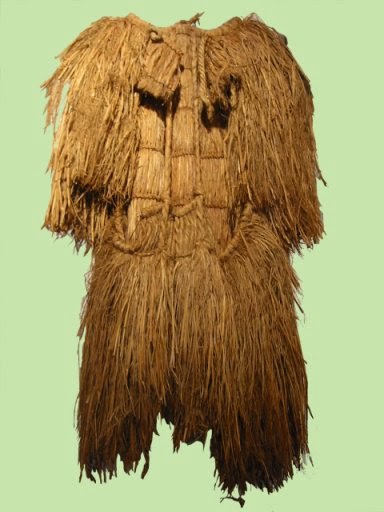
Straw raincoat (ancient Japan)
komo wo ki te   tare bito imasu   hana no haru

wrapped in a straw mat
who can this great one be?
flowers of spring


© Basho (Tr. Jane Reichhold)
With this haiku came a preface: “Welcoming the New Year near Kyoto”. In winter plants and trees are wrapped in mats of woven straw to protect them from freezing. People also wore straw raincoats so it seemed that a person was wrapped in the mat. This is an example of the riddle technique, because it is the tree that is wrapped but it is done for the protection of the flowers which have no physical shape at this time. In our time we also try to protect plants and trees from freezing by 'making the garden ready for winter'.


winter garden
colorless and ugly -
spring flowers


© Chèvrefeuille

The riddle is probably one of the very oldest poetical techniques. It has been guessed that early spiritual knowledge was secretly preserved and passed along through riddles. Because poetry, as it is today, is the commercialization of religious prayers, incantations, and knowledge, it is no surprise that riddles still form a serious part of poetry's transmission of ideas.The 'trick' is to state the riddle in as puzzling terms as possible. What can one say that the reader cannot figure out the answer? The more intriguing the 'set-up' and the bigger surprise the answer is, the better the haiku seems to work. As in anything, you can overextend the joke and lose the reader completely. The answer has to make sense to work and it should be realistic. Here is a case against desk haiku. If one has seen plastic bags caught on cacti, it is simple and safe to come to the conclusion I did. If I had never seen such an incident, it could be it only happened in my imagination and in that scary territory one can lose a reader. So keep it true, keep it simple and keep it accurate and make it weird.

Oh, the old masters favorite trick with riddles was the one of: is that a flower falling or is it a butterfly? or is that snow on the plum or blossoms and the all-time favorite – am I a butterfly dreaming I am a man or a man dreaming I am a butterfly. Again, if you wish to experiment (the ku may or may not be a keeper) you can ask yourself the question: if I saw snow on a branch, what else could it be? Or seeing a butterfly going by you ask yourself what else besides a butterfly could that be?
One famous haiku with this "riddle technique" I had to share here with you all. I think you all will know this haiku by Arakida Moritake (1473-1549):

A fallen blossom
Returning to the bough, I thought --
But no, a butterfly.


© Moritake 

 This episode is open for your submissions tonight at 7.00 PM (CET) and will remain open until May 28th at noon (CET). I will try to publish our next episode, under the tree, later on.


Sunday, May 24, 2015

Carpe Diem #740 a clam


Dear Haijin, visitors and travelers,

It's my pleasure to bring another wonderful episode of Carpe Diem's On The Trail With Basho in which we are following Basho in his footsteps. Today's episode a clam is about the last haiku in his Oku no Hosomichi and I love this haiku a lot.


hamaguri no   futami ni wakare   yuku aki zo
a clam
torn from its shell
departing autumn


© Basho (Tr. Jane Reichhold)


This is the last verse in Basho's 'Oku no Hosomichi' 'The Narrow Road to the Far North'. Because there are several word plays at work here, the Japanese maintain that there is no way for the poem to be rendered into another language. So here goes: hama (beach); hamaguri (a clam) however 'guri' is also (a chestnut) or (a pebble). And that is only the first line! 'Futami' (place name of the port where the famous Wedded Rocks (two large rocks considered to 'married' which are considered to be sacred) are such an attraction) is made up of the words 'futa' (lid, cover, shell) and 'mu' (body, meat, fruit, nut, berry, seed, substance, contents). The word 'wakare' can be either (to part or to split) or (to leave). Added to the last line (departing autumn) 'wakare' can mean either that it is autumn which is leaving or a person who is departing. In Ogaki, Basho was met by many of his disciples, including Sora who rejoined him, for the end of the trip back to Tokyo. This verse, and the second one in 'Oku no Hosomichi' are considered the 'book-ends' of the work with partings of Spring and Autumn.
Awesome! Isn't it! This haiku is a masterpiece.

Wedded Rocks
I love to write a haiku with the same words, but with the other meaning. That will be the challenge for this episode of Carpe Diem On the Trail with Basho. Of course I have to try it myself.

a pebble-stone
taken from the Wedded Rocks
a farewell gift


autumn has gone
the only thing that remains
a chestnut


a jackstone
broken of the Married Rocks
a farewell gift


Wedded Rocks (at sunset)
a chestnut
fallen into the grass
departing autumn


on the seashore
the shell of a hermit crab
abandoned


© Chèvrefeuille

Well ... it wasn't easy, but I think I did well. Are these my masterpieces? Or in Basho's Spirit? I don't know. You, my dear readers, may tell me.

This episode is open for your submissions tonight at 7.00 PM (CET) and will remain open until May 27th at noon (CET). I will try to publish our next episode, wrapped in a straw mat, later on.