Showing posts with label Tale of Genji. Show all posts

Thursday, June 15, 2017

Carpe Diem Time Travel #2 The Tale of Genji


!! Open for your submissions next Sunday June 18th at 7:00 PM (CET) !!

Dear Haijin, visitors and travelers,

Welcome at a new episode of our "Time Travel" feature. This feature I have created especially for our "weekend-meditation" and its goal is to create new haiku, tanka or other Japanese poetry form inspired on poems from ancient times. For example: waka taken from the Man'yoshu, as we did in the first episode of this new feature.

This episode I love to introduce to you a well known Japanese novel from the 11th century, The Tale of Genji. And I will share a few poems from this Tale with you to inspire you. Let me (with help from Mark Cartwright) tell you a little bit more about this ancient Japanese novel.

Tale of Genji (by Mark Cartwright); published on 10 April 2017 at www.ancient.eu 

The 'Tale of the Genji' or Genji Monogatari, written in the 11th century CE by Murasaki Shikibu, a court lady, is Japan's oldest novel and possibly the first novel in world literature. The classic of Japanese literature, the work describes the life and loves of Prince Genji and is noted for its rich characterization and vivid descriptions of life in the Japanese imperial court. The work famously reproduces the line 'the sadness of things' over 1,000 times and has been tremendously influential on Japanese literature and thinking ever since it was written. The 'Tale of Genji' continues to be retranslated into modern Japanese on a regular basis so that its grip on the nation's imagination shows no sign of loosening.

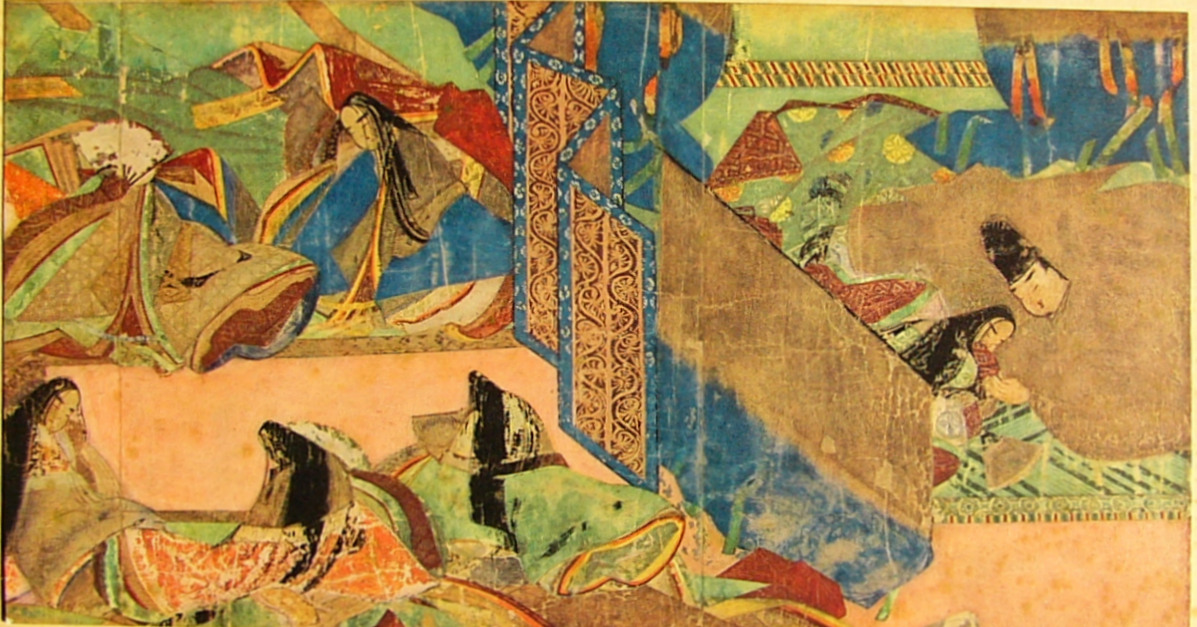
Hand painted illustration from the Tale of Genji

Murasaki Shikibu

The work's author is considered to be a lady of the imperial court by the name of Murasaki Shikibu who wrote it over several years and completed it around 1020 CE during the Heian period (794-1185 CE). Murasaki is also known as To no Shikibu. Murasaki was a nickname and shikibu means 'secretariat,' which was the role of her father as in ancient Japan it was common to call a daughter by her father's position. She was a member of the Fujiwara clan. Her birth is accepted as around 973 CE and her death after 1013 CE, the date of the last mention of her in court documents. Details of her life are sketchy except that her father was Fujiwara no Tametoki, a provincial governor, and that she married a fellow Fujiwara clan member, one Fujiwara no Nobutaka, with whom she had one daughter, Daini no Sammi. Murasaki's husband died in 1001 CE, and she then became a lady-in-waiting (nyobo) to Empress Akiko (aka Shoshi) where she displayed great talent in the arts, particularly calligraphy, the harp (koto), painting, and poetry. Besides the novel, other surviving works by Murasaki include poems and her diary.

The novel describes life in the Japanese Imperial Court. Its etiquette & intrigues & above all the central character of Prince Genji. (Genji Monogatari)

The Japanese title Genji Monogatari may be translated as 'The Tale of Prince Genji.' It consists of 54 chapters and 750,000 words, although the final 13 chapters are regarded as a later addition by a minority of scholars principally because the story then no longer concerns Genji but his son Kaoru and takes on a darker tone. Neither do scholars entirely agree on the order of the chapters as many seem like later insertions by the author and several are parallel chapters or narabi where events occur not after but contemporary with the events described in earlier 'ordinary' chapters (hon no maki).

The novel describes life in the Japanese imperial court, its etiquette and intrigues, and, above all, the central character of Prince Genji who is the perfect gentleman in looks and deed. Genji's relations, love affairs, and transition from youth to middle age are all captured by Murasaki's astute writing which combines romanticism and realism in equal measure to capture a timeless treatment of human relations and the general impermanence of all things.

Scene from The Tale of Genji (Brooklyn Museum)

In her own words Murasaki describes this discovery:

"But I have a theory of my own about what this art of the novel is...it happens because the storyteller's own experience of men and things, whether for good or ill - not only what he has passed through himself, but even events which he has only witnessed or been told of - has moved him to an emotion so passionate that he can no longer keep it shut up in his heart. Again and again something in his own life or that around him will seem to the writer so important that he cannot bear to let it pass into oblivion". (Mason, 96)

Murasaki Shikibu (978-1014) is seen as the inventor of the "Psychological Novel", as she shows in her Tale of Genji.

Murasaki Shikibu (978-1014)
Now we know a little bit about the background of The Tale of Genji and now we are looking to a few poems from this wonderful ancient Japanese novel.

In The Tale of Genji we see very often two characters speaking with each other through poems, so maybe we can say that The Tale of Genji was the first kind of Tan Renga. In the examples I will show you that.

This first poem is a stand alone poem:

since my departure for this dark journey,
makes you so sad and lonely,
fain would I stay though weak and weary,
and live for your sake only!


And here is a beautiful example of a "poem-conversation":

fain would one weep the whole night long,
as weeps the Sudu-Mushi's* song,
who chants her melancholy lay,
till night and darkness pass away


(the "answer"):

to the heath where the Sudu-Mushi sings,
from beyond the clouds one comes from on high
and more dews on the grass around she flings,
and adds her own, to the night wind's sigh.


* Sudu-Mushi are a kind of insects which sing in herbage grass especially in autumn evenings

Scene from The Tale of Genji
Another example of a "poem-conversation":

when on my fingers, I must say
I count the hours I spent with thee,
is this, and this alone, I pray
the only pang you've caused on me?
you are now quits with me


(the "answer"):

from me, who long bore grievous harms,
from that cold hand and wandering heart,
you now withdraw your sheltering arms,
and coolly tell me, we must part


Chrysanthemum (woodblock print)
A last example of what I have called here a "poem-conversation":

even this spot, so far to view
with moon, and Koto's gentle strain,
could make no other lover true,
as me, thy fond, thy only swain
one turn more!
stay not your hand when one is near,
who so ardently longs to hear you


(the "answer"):

sorry I am my voice to low
to match the flute's far sweeter sound,
which mingles with the winds that blow
the autumn leaves upon the ground


All wonderfully crafted poems in which we can sense the love between the characters. Strong emotions hidden in their words. The Tale of Genji, a psychological love story.

Cicada (woodblock print)

Here is the "poem-conversation" to work with. Let this "poem-conversation" inspire you to create haiku, tanka or other Japanese poetry form in which you try to catch the strong emotions hidden in the Tale of Genji.

where the cicada casts her shell
in the shadows of the tree,
there is one whom I love well
though her heart is cold to me


(the "answer"):

amidst dark shadows of the tree,
cicada's wing with dew is wet,
so in mine eyes unknown to thee,
spring sweet tears of fond regret


An awesome "poem-conversation" to work with I think. So I have given it a try with this tanka:

weeping willow
hides her red-stained eyes
behind broken roses
trampled with the foot he cherished
even kissed that last night


© Chèvrefeuille

Well ... sorry for this long episode, but I was on a roll. I hope you do not mind. This "weekend-meditation" is open for your submissions next Sunday June 18th at 7:00 PM (CET) and will remain open until June 23rd at noon (CET). I will try to publish our new episode, the first of our Theme Week about Milarepa, the renown poet and yogi from Tibet, later on. Have a great weekend ... be inspired and enjoy creating your haiku, tanka or other Japanese poetry form.

PS. You can find a pdf filed version of "The Tale of Genji" HERE


Thursday, November 24, 2016

Carpe Diem Tanka Splendor 25th Teika's 9th Tanka Writing Technique "Exquisite Detail" (prompt: charcoal)


!! I have replaced the e-books of CDHK to our Carpe Diem Library and I created a new page for our own E-zine Souchou!!

Dear Haijin, visitors and travelers,

Welcome at a new episode of Carpe Diem Tanka Splendor. This month our main goal is to improve our tanka writing skills through the Ten Tanka Writing Techniques by Teika. Today I will introduce to you Teika's 9th Tanka Writing Technique "Exquisite Detail" and I will try to create a tanka with it prompted "charcoal".

Let me first take you back in time to the century in which the tanka was known as waka. In ancient times, it was a custom between two writers to exchange waka instead of letters in prose. In particular, it was common between lovers. Reflecting this custom, five of the twenty volumes of the Kokin Wakashū gathered waka for love. In the Heian period the lovers would exchange waka in the morning when lovers met at the woman's home. The exchanged waka were called Kinuginu, because it was thought the man wanted to stay with his lover and when the sun rose he had almost no time to put on his clothes on which he had lain instead of a mattress (it being the custom in those days). Works of this period, The Pillow Book and The Tale of Genji provide us with such examples in the life of aristocrats. Murasaki Shikibu uses 795 waka in her The Tale of Genji as waka her characters made in the story. Some of these are her own, although most are taken from existing sources. Shortly, making and reciting waka became a part of aristocratic culture. They recited a part of appropriate waka freely to imply something on an occasion.

Illustration from the Tale of Genji (woodblock print)

Much like with tea, there were a number of rituals and events surrounding the composition, presentation, and judgment of waka. There were two types of waka party that produced occasional poetry: Utakai and Uta-awase. Utakai was a party in which all participants wrote a waka and recited them. Utakai derived from Shikai, Kanshi party and was held in occasion people gathered like seasonal party for the New Year, some celebrations for a newborn baby, a birthday, or a newly built house. Utaawase was a contest in two teams. Themes were determined and a chosen poet from each team wrote a waka for a given theme. The judge appointed a winner for each theme and gave points to the winning team. The team which received the largest sum was the winner. The first recorded Utaawase was held in around 885. At first, Utaawase was playful and mere entertainment, but as the poetic tradition deepened and grew, it turned into a serious aesthetic contest, with considerably more formality. (source:wikipedia)

Okay back to our episode.

Exquisite detail - komayaka naru tei

This style is indicated by exact and precise details with often complex imagery. In Teika's anthology of tanka styles he has 29 examples. One of which is one from the Kokinshū, #4:193, written by Ōno Chisato (890-905):

tsuki mireba / chiji ni mono koso / kanashikere / waga ni hitiostu no / /aki ni wa aranedo

gazing at the moon
a thousand sad things
overcome me
not only I feel this
in autumn alone


This "exquisite detail" technique we can imagine quit well I think, because we are all haiku poets and are proud on the details we can use in our haiku. For example think about the haiku by Basho on "shepherd's purse", which we have seen here earlier:

if you look closely
a sheperd's purse flowering
underneath the hedge


© Basho


I have tried to create a tanka with "charcoal" and with the use of this "exquisite detail" technique. I don't know if it has become a good one.

in the meadow
peeling the leaves of daisies,
does she loves me?
dreaming In front of the fireplace
I look into the charcoal

© Chèvrefeuille

This episode is open for your submissions tonight at 7.00 PM (CET) and will remain open until November 29th at noon (CET). I will try to publish our new episode, meditation, later on.


Monday, October 10, 2016

Carpe Diem Special (2nd guest) Kala Ramesh #2 "tangled thoughts . . ." (tanka)


Dear Haijin, visitors and travelers,

Welcome at the second Carpe Diem Special by Kala Ramesh. In the first CD-Special by Kala I shared haiku written by her with you all, today I love to share a few tanka by Kala with you.
Kala is not only a gifted haiku poetess, but she also writes beautiful tanka in a very nice and personal way. Her tanka are mostly a reflection of daily happenings like for example "children trying to stretch their playing time before going to bed".

As you all know I am not such a great tanka poet, but I love the form. Let me tell you first a little bit more about tanka, for those visiting here who not know about tanka.
Tanka is, like haiku, an ancient Japanese poetry form and it derived from the waka and maybe partially from renga . Maybe you have heard from tanka and waka or maybe you are familiar with "The Tale of Genji" (a wonderful classical piece of literature in which the poetess used waka).


Scenes from "The Tale of Genji"

Back in 2013 I once created a Carpe Diem Distillation episode about "The Tale of Genji" and I love to share here the waka which I presented there again:

mishi hito no
keburi o kumo to
nagamureba
yuube no sora mo
mutsumashiki ka na

the evening sky itself
becomes something to cherish
when I gaze at it,
seeing in one of the clouds
the smoke from her funeral pyre

© Murasaki Shikibu (11th century)

weeping willow

Here at CDHK we have seen several posts in which I shared waka by classical poets/esses, maybe you can remember this one too. It's a waka by Saigyo and it was the inspiration for a well known haiku by Matsuo Basho (1644-1694):

along the way
where water is running
in the willow shade
I have stopped to rest
for a little while


© Saigyo (12th century)

And this is the haiku which Basho wrote after reading this waka by Saigyo:

one patch of a rice field
when it was planted I left
the willow tree
© Basho (Tr. Jane Reichhold)
Waka ... an ancient but beautiful poetry form from which the Tanka derived. Tanka is a short poem with five lines following the syllables count 5-7-5-7-7 (or in Japanese sounds, onji) and mostly the first part (say the "haiku" part) brings up a scene, but by putting the second part (say the "response" part) towards it that scene changes. The "pivot" of the tanka is the third line mostly. Tanka is a nice form to work with and as you know next month November 2016 we will have a Tanka month here at Carpe Diem Haiku Kai created around "Teika's Ten Tanka Writing Techniques".
Kala Ramesh
Okay ... back to Kala Ramesh, our 2nd guest this celebration month. Last week we had the first special by Kala with haiku and today I love to share a few of her tanka.
an evening
of tangled thoughts . . .
through branches
even this rugged moon
looks tattered at the edges
© Kala Ramesh
These tanka are in my opinion really nice, but I don't know if I am capable to say such a thing because I am not such a good tanka poet. Of course I tried to create a new haiku or tanka in response on this CD Special by Kala Ramesh:
the days shorten
the colorful leaves
Ah! what a sight
mysterious moon
behind thin clouds
leaves falling
tears fall
this autumn day
has gone by
such sadness
without the full moon
© Chèvrefeuille
This episode is NOW OPEN for your submissions and will remain open until October 14th at noon (CET). I will try to publish our new episode, knitting wool, later on. For now .... have fun!


Thursday, September 19, 2013

Carpe Diem #302, Nowaki (windstorm, field dividing wind)


Dear Haijin, visitors and travelers,

Last night we had a very clear night and I could gaze at the Harvest Moon for a long time, it was hypnotizing and I dreamed away to ancient Japan, the land of the rising sun, but also of the Nowaki (windstorm or field dividing wind, typhoon) and wandered through this ancient Japan as a companion of Basho on his way to the Deep North. It was awesome. Basho and I took shelter for a strong field dividing wind in an old barn and wrote a Renga together ... for a little while I was in the shadow of the master. As clouds covered the harvest moon I came back on my feet and shook my head. "It was just a dream", I thought.

Today we share haiku on Nowaki. Nowaki or field-dividing wind is a kind of wind that occurs on a regular base between the 210th and 220th day after the starting of spring (Risshuu). It's a typhoon-like strong autumn gale, but only the wind and not the rain (as with a typhoon).
People living in the rice fields of Western Japan, have seen this "parting of the fields" quite often after the autumn typhoons. It hurts them  to see the ripe ears of rice hang down on the ground to the right and left of a swath of flattened stems.


Nowaki is also a short Japanese novel by Natsume Sōseki (1867-1916). Written in 1907, the novel was published in the magazine Hototogisu (the magazine founded by Shiki) in January. The year 1907 was a turning point in the author’s life when he left his Tokyo University teaching position to write full-time for the daily Asahi Shimbun (a Japanese newspaper).

Nowaki is about three men, all of whom are writers. Two of the younger men, the tubercular Takayanagi and the dandy Nakano, were close in their student days, and are now recent university graduates making their way in the world. The older man of the three is known as Dōya-sensei (Master Dōya), once a teacher in the provinces who was forced to leave his post by villagers and students angered over his disrespectful attitude toward wealth and authority, now pursuing in Tokyo a career as editor and writer, barely eking out a livelihood, much to his wife’s consternation. Magazine editor by day, he longs to finish and publish his more serious writing, "Essay on Character." By sheer coincidence, the three lives come together over the sum of one hundred yen (about a month’s salary at the time): Nakano’s gift to Takayanagi to convalesce at a seaside hot springs, Dōya-sensei’s debts which are paid off with the purchase of his manuscript, and Takayangi’s act of self-sacrifice and redemption.


In the "Tale of Genji" in chapter 28 a Nowaki occurs. This chapter is called "The Typhoon" and I love to share a piece of that chapter here with you.


[...] “An irritable, impatient sort of wind,” he said. “You must close your shutters. There are men about and you are very visible.”
Yūgiri looked back. Smiling at Murasaki, Genji was so young and handsome that Yūgiri found it hard to believe he was looking at his own father. Murasaki too was at her best. Nowhere could there be a nearer approach to perfection than the two of them, thought Yūgiri, with a stabbing thrill of pleasure. The wind had blown open the shutters along the gallery to make him feel rather exposed. He withdrew. Then, going up to the veranda, he coughed as if to announce that he had just arrived.
“See,” said Genji, pointing to the open door. “You have been quite naked.”
Nothing of the sort had been permitted through all the years. Winds can move boulders and they had reduced the careful order to disarray, and so permitted the remarkable pleasure that had just been Yūgiri’s.
Some men had come up to see what repairs were needed. “We are in for a real storm,” they said. “It’s blowing from the northeast and you aren’t getting the worst of it here. The stables and the angling pavilion could blow away any minute.”
“And where are you on your way from?” Genji asked Yūgiri.
“I was at Grandmother’s, but with all the talk of the storm I was worried about you. But they’re worse off at Sanjō than you are here. The roar of the wind had Grandmother trembling like a child. I think perhaps if you don’t mind I’ll go back.”
“Do, please. It doesn’t seem fair that people should be more childish as they get older, but it is what we all have to look forward to.”
He gave his son a message for the old lady: “It is a frightful storm, but I am sure that Yūgiri is taking good care of you.”
Though the winds were fierce all the way to Sanjō, Yūgiri’s sense of duty prevailed. He looked in on his father and his grandmother every day except when the court was in retreat. His route, even when public affairs and festivals were keeping him very busy, was from his own rooms to his father’s and so to Sanjō and the palace. Today he was even more dutiful, hurrying around under black skies as if trying to keep ahead of the wind.
His grandmother was delighted. “In all my long years I don’t think I have ever seen a worse storm.” She was trembling violently.
Great branches were rent from trees with terrifying explosions. Tiles were flying through the air in such numbers that the roofs must at any moment be stripped bare.
“It was very brave of you.”
Yūgiri had been her chief comfort since her husband’s death. Little was left for her of his glory. Though one could not have said that the world had forgotten her, it does change and move on. She felt closer to Yūgiri than to her son, Tō no Chūjō.
Yūgiri was jumpy and fretful as he sat listening to the howl of the wind. That glimpse of Murasaki had driven away the image that was so much with him. He tried to think of other things. This would not do, indeed it was rather terrible. But the same image was back again a moment after he had driven it away. There could have been few examples in the past of such beauty, nor were there likely to be many in the future. He thought of the lady of the orange blossoms. It was sad for her, but comparison was not possible. How admirable it had been of Genji not to discard so ill-favored a lady! Yūgiri was a very staid and sober young man who did not permit himself wanton thoughts, but he went on thinking wistfully of the years it would add to a man’s life to be with such beauty day and night.
The storm quieted toward dawn, though there were still intermittent showers. Reports came that several of the outbuildings at Rokujō had collapsed. Yūgiri was worried about the lady of the orange blossoms. The Rokujō grounds were vast and the buildings grand, and Genji’s southeast quarter would without question have been well guarded. Less well guarded, the lady of the orange blossoms must have had a perilous time in her northeast quarter. He set off for Rokujō before it was yet full daylight. The wind was still strong enough to drive a chilly rain through the carriage openings. Under unsettled skies, he felt very unsettled himself, as if his spirit had flown off with the winds. Another source of disquiet had been added to what had seemed sufficient disquiet already, and it was of a strange and terrible kind, pointing the way to insanity. [...]


Nowaki drawing from the "Tale of Genji"

What an awesome story this is and a joy to read it. I wonder ... maybe after our column-series about Oku no Hosomichi I can do a column series about the "Tale of Genji". I will keep that idea in my thoughts.

field dividing wind
ruins the grain harvest -
no bread today

coming from the west
dark clouds pack together
first autumn storm

first autumn storm
colorful leaves dancing through the street
branches broken

branches broken
big trees unrooted and thrown away -
a strong western wind

Not such a strong set of haiku, but the intense feeling of Nowaki makes it all better. I like those strong autumn winds and I hope you do to. Have fun, be inspired and share your haiku on Nowaki with us.
This prompt will stay on 'till September 21th 11.59 AM (CET) and I will post our next Special episode, a haiku by our featured haiku poet O. Mabson Southard, later on today around 7.00 PM (CET).
!! Nowaki is open for your submissions at 7.00 PM (CET) !!


Wednesday, September 18, 2013

Carpe Diem's Oku no Hosomichi Station #2, Departure


Dear Haijin, visitors and travelers,

We are on our way to the Deep North and today we depart together with Basho and his companion Sora with the boat to Senju. This station has strong lines with a classical Japanese novel which was written in the 11th century. That novel is "The Tale of Genji".

The Tale of Genji (源氏物語 Genji Monogatari?) is a classic work of Japanese literature written by the Japanese noblewoman and lady-in-waiting Murasaki Shikibu in the early years of the 11th century, around the peak of the Heian period. It is sometimes called the world's first novel, the first modern novel, the first psychological novel or the first novel still to be considered a classic. Notably, the novel also illustrates a unique depiction of the livelihoods of high courtiers during the Heian period. While universally considered a masterpiece, its precise classification and influence in both Western and Eastern canon has been a matter of debate.


The first classic roll of the Tale of Genji

As I told you earlier this week the classical haiku poets, also Basho, leant sometimes lines from the classical literature or poetry. In his Narrow Road to the Deep North Basho used several classical sources of literature and poetry. This second station has strong influences from the Tale of Genji. Let us go on our way and look what this second station will bring us.

Basho departed on May 16th in the western calendar. So hestarted his journey to the Deep North in late spring as the cherry trees are in full bloom. However in his journal, the departing was in March. The day before his close friends gave a goodbye party and they certain wrote a renga together to give Basho something to read while on his way. They also gave him goodbye presents to give him strength.
As he departs he is accompanied by his friends who would keep him company for the first few miles. His friends take a last farewell and left him and his travel companion Sora at Senju. 


Credits: Senju (Woodblock by Katsushika Hokusai (1760-1849)
It's there that Basho starts to be desperate as he thinks of the 2400 km ahead of him. His eyes fill with tears and blurrs his vision. He writes his first haiku on this journey there in Senju.
This station in his journey has several pointers towards other classical Japanese poetry. For example were Basho talks about the cherry blossoms he thought at a poem by Saigyo Hashi (1118-1190).


having seen them long
I hold the flowers so dear
that when they scatter
I find it all the more sad
to bid them my last farewell


And the haiku he wrote in this first station has a touch of "The Tale of Genji". And as he writes about the moon, the waning moon, he refers to the "broom tree" chapter of "The Tale of Genji".
The poem from "The Tale of Genji" he refers to is the following:


even this spot, so fair to view
with moon, and Koto's gentle strain,
could make no other lover true,
as me, thy fond, thy only swain


A wonderful poem with a strong sacred or secret love in it. I imagine the scenery of this poem. A tranquil garden, the full moon in the sky, cherry blossoms in full bloom, the sweet song of the Nightingale and then the sweet sound of the Koto. A scenery overwhelming with true love.


Credits: Japanese Garden

This scenery is quit what we see in the scene of sation 2 of "The Narrow Road to the Deep North". It's March (following the ancient lunar calendar), every spring, the cherry trees in full bloom, the sound of the water around the boat Basho took to Senju, and the strong love of his companions towards him.

As Basho says farewell to his friends in Senju he has tears in his eyes, a strong sadness, a strong emotion which we can read back in the haiku which he wrote at his departure:

the passing spring
birds mourn, fishes weep
with tearful eyes


A strong farewell verse, could be even a Jisei (death poem) this emotional haiku in which Basho says: "I am part of nature and nature feels my pain and sadness". Here we see another Zen-Buddhistic base ... Oneness ... Humans are not only the keepers of nature, but they are also part of nature. This is also one of the base-rules of haiku. Haiku is sometimes called "Nature's Poetry" because haiku is about nature and the role of humans in nature. The poet isn't only the poet, but he/she is also part of the haiku, part of nature.
Another strong Zen-Buddhistic feeling described in our first episode of "Oku no Hosomichi". Selflessness. Basho sold his house, his material life, and in this second station he 'sells' his immaterial life by saying farewell to his friends. Now he is really alone and only in the companionship of Sora, a loyal disciple of Basho. Both are on their way to Enlightment and they will walk together, on straw sandals, cane in hand, their belongings tight upon their back ... a journey of 2400 km ... on foot.


farewell verse
as I depart from the train station -
forget me not


(C) Chèvrefeuille (your host)


Credits: First page of Basho's "Narrow Road to the Deep North" (Dutch page)

Hereafter I will reproduce the text of this second Station of "The Narrow Road to the Deep North".

Station 2 - Departure

It was early on the morning of March the twenty-seventh that I took to the road. There was darkness lingering in the sky, and the moon was still visible, though gradually thinning away. The faint shadow of Mount Fuji and the cherry blossoms of Ueno and Yanaka were bidding me a last farewell. My friends had got together the night before, and they all came with me on the boat to keep me company for the first few miles. When we got off the boat at Senju, however, the thought of three thousand miles before me suddenly filled my heart, and neither the houses of the town nor the faces of my friends could be seen by my tearful eyes except as a vision.

the passing spring
birds mourn, Fishes weep
with tearful eyes
.


With this poem to commemorate my departure, I walked forth on my journey, but lingering thoughts made my steps heavy. My friends stood in a line and waved good-bye as long as they could see my back.

Well I hope you enjoyed the read and next week we will go on together with Basho and Sora on our way to the Deep North.

Namaste

Sunday, September 15, 2013

Carpe Diem's Distillation #2, A poem by Genji, from the wellknown Japanese novel "The Tale of Genji"


Dear Haijin, visitors and travelers,

I love to publish our second episode of  "Carpe Diem's Distillation", the feature in which I challenge you to write a haiku distilled from another poem. Today I have a nice poem by Genji (12th century) to distil your haiku from. With this feature we are following in the footsteps of the ancient haiku poets, who were using on a regular base classical literature and poetry for theit own haiku. So it's also a way to go back to the roots of haiku, as the other feature I started last week. "The Tale of Genji", is one of the oldest novels of Japan and this "Tale" has inspired several other poets including Matsuo Basho as we will see in the second episode of Carpe Diem's Oku no Hosomichi.

Credits: Scenes from "The Tale of Genji"

The poem is from Chapter 4, "Yuugao". Prince Genji has a brief love affair with a young girl, called Yuugao. But there is another lady, deeply in love with Genji, who hates Yuugao so much that she dies. Yes, at that time people believed that hatred can kill people!

After the funeral of Yuugao, Genji is looking at the smoke from the pyre, and recites this poem:

mishi hito no
keburi o kumo to
nagamureba
yuube no sora mo
mutsumashiki ka na

The evening sky itself
becomes something to cherish
when I gaze at it,
seeing in one of the clouds
the smoke from her funeral pyre


It is important to know that Yuugao's name means "Evening Faces." Therefore, Genji's reference to "being deeply intimate with the evening sky" refers to the love he shared with Yuugao.

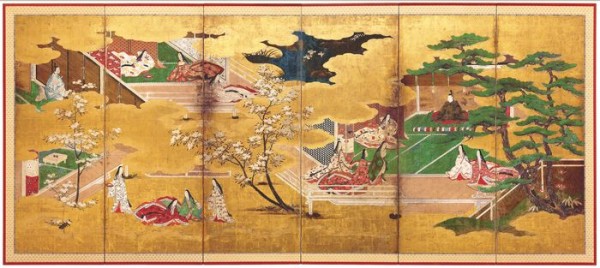
Credits: Japanese screen, "The Tale of Genji"

It's a though challenge this time I think, but a good challenge is always welcome isn't it?

My attempt to 'distil' a haiku from this poem (by the way: a lot of the poems in the "Tale of Genji" are in a Tanka-like way written.):


her spirit departs
with the dying of her pyre -
smoke rises to the sky


Awesome .... I succeeded I think to 'distil' a wonderful haiku from the poem I gave for inspiration. Now it's your turn ...

This episode of Carpe Diem's Distillation will stay on 'till September 29th 11.59 AM (CET) and I will try to post the next episode of CD's Distillation later on that day. For now ... have fun, be inspired, pick up the challenge and share your haiku with us all here at Carpe Diem. This episode of CD's Distillation is open for your submissions.


Namaste