Thursday, June 15, 2017

Carpe Diem Time Travel #2 The Tale of Genji


!! Open for your submissions next Sunday June 18th at 7:00 PM (CET) !!

Dear Haijin, visitors and travelers,

Welcome at a new episode of our "Time Travel" feature. This feature I have created especially for our "weekend-meditation" and its goal is to create new haiku, tanka or other Japanese poetry form inspired on poems from ancient times. For example: waka taken from the Man'yoshu, as we did in the first episode of this new feature.

This episode I love to introduce to you a well known Japanese novel from the 11th century, The Tale of Genji. And I will share a few poems from this Tale with you to inspire you. Let me (with help from Mark Cartwright) tell you a little bit more about this ancient Japanese novel.

Tale of Genji (by Mark Cartwright); published on 10 April 2017 at www.ancient.eu 

The 'Tale of the Genji' or Genji Monogatari, written in the 11th century CE by Murasaki Shikibu, a court lady, is Japan's oldest novel and possibly the first novel in world literature. The classic of Japanese literature, the work describes the life and loves of Prince Genji and is noted for its rich characterization and vivid descriptions of life in the Japanese imperial court. The work famously reproduces the line 'the sadness of things' over 1,000 times and has been tremendously influential on Japanese literature and thinking ever since it was written. The 'Tale of Genji' continues to be retranslated into modern Japanese on a regular basis so that its grip on the nation's imagination shows no sign of loosening.

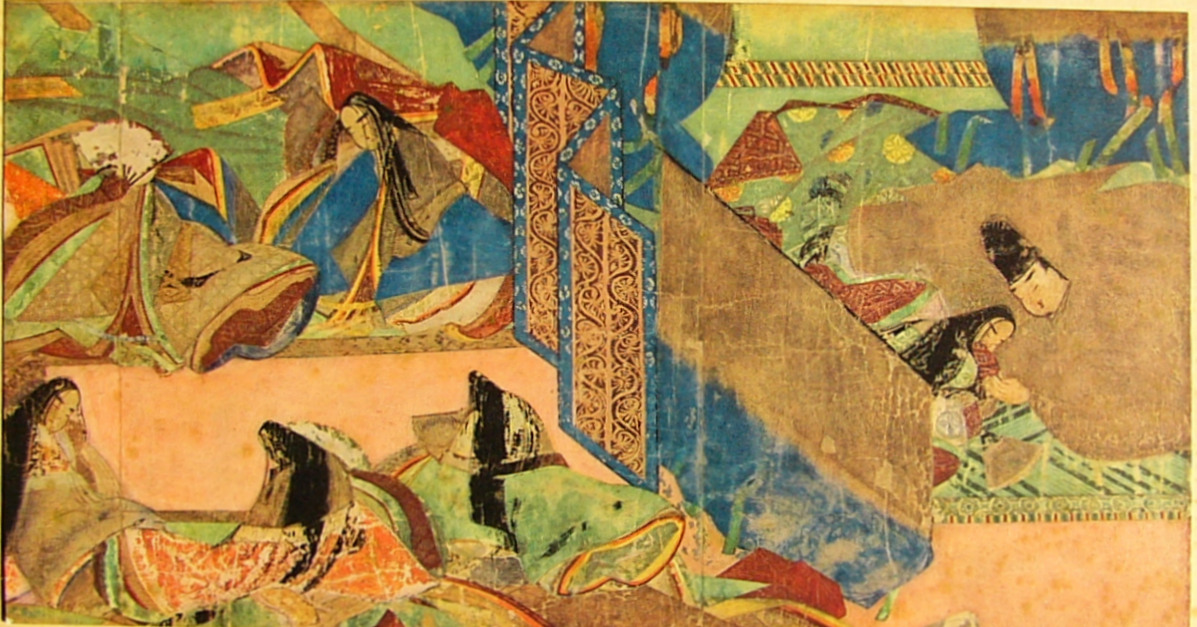
Hand painted illustration from the Tale of Genji

Murasaki Shikibu

The work's author is considered to be a lady of the imperial court by the name of Murasaki Shikibu who wrote it over several years and completed it around 1020 CE during the Heian period (794-1185 CE). Murasaki is also known as To no Shikibu. Murasaki was a nickname and shikibu means 'secretariat,' which was the role of her father as in ancient Japan it was common to call a daughter by her father's position. She was a member of the Fujiwara clan. Her birth is accepted as around 973 CE and her death after 1013 CE, the date of the last mention of her in court documents. Details of her life are sketchy except that her father was Fujiwara no Tametoki, a provincial governor, and that she married a fellow Fujiwara clan member, one Fujiwara no Nobutaka, with whom she had one daughter, Daini no Sammi. Murasaki's husband died in 1001 CE, and she then became a lady-in-waiting (nyobo) to Empress Akiko (aka Shoshi) where she displayed great talent in the arts, particularly calligraphy, the harp (koto), painting, and poetry. Besides the novel, other surviving works by Murasaki include poems and her diary.

The novel describes life in the Japanese Imperial Court. Its etiquette & intrigues & above all the central character of Prince Genji. (Genji Monogatari)

The Japanese title Genji Monogatari may be translated as 'The Tale of Prince Genji.' It consists of 54 chapters and 750,000 words, although the final 13 chapters are regarded as a later addition by a minority of scholars principally because the story then no longer concerns Genji but his son Kaoru and takes on a darker tone. Neither do scholars entirely agree on the order of the chapters as many seem like later insertions by the author and several are parallel chapters or narabi where events occur not after but contemporary with the events described in earlier 'ordinary' chapters (hon no maki).

The novel describes life in the Japanese imperial court, its etiquette and intrigues, and, above all, the central character of Prince Genji who is the perfect gentleman in looks and deed. Genji's relations, love affairs, and transition from youth to middle age are all captured by Murasaki's astute writing which combines romanticism and realism in equal measure to capture a timeless treatment of human relations and the general impermanence of all things.

Scene from The Tale of Genji (Brooklyn Museum)

In her own words Murasaki describes this discovery:

"But I have a theory of my own about what this art of the novel is...it happens because the storyteller's own experience of men and things, whether for good or ill - not only what he has passed through himself, but even events which he has only witnessed or been told of - has moved him to an emotion so passionate that he can no longer keep it shut up in his heart. Again and again something in his own life or that around him will seem to the writer so important that he cannot bear to let it pass into oblivion". (Mason, 96)

Murasaki Shikibu (978-1014) is seen as the inventor of the "Psychological Novel", as she shows in her Tale of Genji.

Murasaki Shikibu (978-1014)
Now we know a little bit about the background of The Tale of Genji and now we are looking to a few poems from this wonderful ancient Japanese novel.

In The Tale of Genji we see very often two characters speaking with each other through poems, so maybe we can say that The Tale of Genji was the first kind of Tan Renga. In the examples I will show you that.

This first poem is a stand alone poem:

since my departure for this dark journey,
makes you so sad and lonely,
fain would I stay though weak and weary,
and live for your sake only!


And here is a beautiful example of a "poem-conversation":

fain would one weep the whole night long,
as weeps the Sudu-Mushi's* song,
who chants her melancholy lay,
till night and darkness pass away


(the "answer"):

to the heath where the Sudu-Mushi sings,
from beyond the clouds one comes from on high
and more dews on the grass around she flings,
and adds her own, to the night wind's sigh.


* Sudu-Mushi are a kind of insects which sing in herbage grass especially in autumn evenings

Scene from The Tale of Genji
Another example of a "poem-conversation":

when on my fingers, I must say
I count the hours I spent with thee,
is this, and this alone, I pray
the only pang you've caused on me?
you are now quits with me


(the "answer"):

from me, who long bore grievous harms,
from that cold hand and wandering heart,
you now withdraw your sheltering arms,
and coolly tell me, we must part


Chrysanthemum (woodblock print)
A last example of what I have called here a "poem-conversation":

even this spot, so far to view
with moon, and Koto's gentle strain,
could make no other lover true,
as me, thy fond, thy only swain
one turn more!
stay not your hand when one is near,
who so ardently longs to hear you


(the "answer"):

sorry I am my voice to low
to match the flute's far sweeter sound,
which mingles with the winds that blow
the autumn leaves upon the ground


All wonderfully crafted poems in which we can sense the love between the characters. Strong emotions hidden in their words. The Tale of Genji, a psychological love story.

Cicada (woodblock print)

Here is the "poem-conversation" to work with. Let this "poem-conversation" inspire you to create haiku, tanka or other Japanese poetry form in which you try to catch the strong emotions hidden in the Tale of Genji.

where the cicada casts her shell
in the shadows of the tree,
there is one whom I love well
though her heart is cold to me


(the "answer"):

amidst dark shadows of the tree,
cicada's wing with dew is wet,
so in mine eyes unknown to thee,
spring sweet tears of fond regret


An awesome "poem-conversation" to work with I think. So I have given it a try with this tanka:

weeping willow
hides her red-stained eyes
behind broken roses
trampled with the foot he cherished
even kissed that last night


© Chèvrefeuille

Well ... sorry for this long episode, but I was on a roll. I hope you do not mind. This "weekend-meditation" is open for your submissions next Sunday June 18th at 7:00 PM (CET) and will remain open until June 23rd at noon (CET). I will try to publish our new episode, the first of our Theme Week about Milarepa, the renown poet and yogi from Tibet, later on. Have a great weekend ... be inspired and enjoy creating your haiku, tanka or other Japanese poetry form.

PS. You can find a pdf filed version of "The Tale of Genji" HERE


Wednesday, June 14, 2017

Carpe Diem Extra June 14th 2017 A New Exclusive CDHK E-Book creation


Dear Haijin, visitors and travelers,

Next month July 2017 it is one year after the death of Jane Reichhold, as you all maybe know she ended her own life on July 28th 2016. It was a shock to the whole haiku and tanka world and also for us here at CDHK.
I have created several episodes in honor of and in tribute to Jane Reichhold and I have decided to create an all new CDHK E-book in honor of her ... the Queen of Haiku and Tanka. In this new CDHK E-book I will gather a selection of the posts dedicated to Jane Reichhold. I love to ask your permission to use your responses on these posts. I know we have a permission policy (at the foot of our Haiku Kai you can read that policy), but in this case I love to ask your permission to use your work, because of your connection with Jane Reichhold, maybe you love to keep them for yourselves, and of course I respect that.

Jane Reichhold (1937-2016)

However I have made one exception. The haiku which were submitted for the Tribute to Jane Kukai I will include in this new exclusive CDHK E-book which I have titled "I Think Of Days Gone".

Please let me know if you are okay with using your haiku, tanka or other Japanese poetry form submitted for posts by and about Jane Reichhold.

You can email to our emailaddress: carpediemhaikukai@gmail.com Please write in the subject line Tribute to Jane E-book.

Namasté,

Chèvrefeuille, your host

PS. I have highlighted the tribute to Jane written by Jen. You can find it at the left side of our Kai.
PPS. As you maybe have noticed I have removed two links to our exclusive e-books. You can find them now in our Library.

Carpe Diem #1207 Non-Resistance


Dear Haijin, visitors and travelers,

Welcome at a new episode of our journey through magical and spiritual Tibet. Today I love to look closer to the character of the Tibetan people. Somewhere in the early fifties of the last century China annexated Tibet. The Tibetans until than didn't had a well trained army, only a small group of strong monks and some foreigners were at hand to defend the country.
The Tibetans aren't a violent race, they all are very loving and spiritual beings so China could annexate the country without any resistance. Since than the Tibetans show their thoughts about China without anger, but from out of a kind of spiritual unconditional love ... non-resistance is their power.

The Dalai Lama, like Ghandi, is a leader who shows His thoughts on the annexation of His country by the Chinese, from a non-resistance, non violent idea. Through His travels all around the globe and His temporary place to live in Nepal, He shows how strong His people are.
Several days ago I told you about the Tibetan smile ... that smile is a stronger weapon than any other weapon. Non-resistance is a stronger weapon than any other weapon.

The Beauty of Tibet
This is not a political weblog, but I love to share my thoughts about this annexation of Tibet by the Chinese. Tibet is one of the most beautiful countries on Earth, the strong spiritual way of living in Tibet makes that this country deserves to be a country again with its own spiritual leader, with its own spiritual government. The Chinese overruled this beautiful country because they couldn't handle that Tibet was a rich and spiritual country. The Chinese saw this small country (compared with China) as a threat for their own communistic policy. As we look at China nowadays than there is no need to see Tibet as a threat for their wealth, because China is one of the fastest growing economies. There is no longer need to have Tibet ... they have to give Tibet back their sovereignty ... they have to give Tibet back to their rightful owners ... the Tibetan people.

Sorry for this small piece of text about my thoughts on the case of Tibet and China, I just had to write it, share it with you all.

flowers in their hair
the Tibetan people proud and strong
conquering with a smile

© Chèvrefeuille

This episode is open for your submissions tonight at 7:00 PM (CET) and will remain open until June 19th at noon (CET). I will try to post our new "weekend-meditation", a new Time Travel episode, later on. For now .... have fun and be inspired.


Tuesday, June 13, 2017

Carpe Diem #1206 Yoga (especially Tibetan 5 rites Yoga)


Dear Haijin, visitors and travelers,

Welcome at a new episode of our Haiku Kai. This month we are on a virtual journey through Tibet. That wonderful spiritual country in the Himalayans, Recently Hamish pointed it me to the Tibetan Yoga of the five (5) rites, a very strong and powerful way of Yoga in which you can revive yourself to the max. There are even some great results of rejuvenation told. I love to introduce to you this beautiful kind of Yoga.

Tibetan Yoga, the Five Rites
Tibetan Yoga comprises of 5 simple, yet dynamic yogic exercises called 5 Tibetan Rites, meditation, praanayam and positive thinking.
The Five Tibetan Rites is a yoga routine based on a ritual of exercises done by the Tibetan Lamas, which helped them to live very long and healthy life and to stay ever young. (They were developed over centuries in the monasteries of Tibet. In 1930 a retired British army officer, who learnt these from the Lamas, brought them to the west). They are now practiced around the world and are said to prevent aging. The entire routine can be completed in less than 20 minutes. An important part of the Tibetan exercises is a conscious synchronization of breathing while performing physical activity.
They balance the 7 chakras & regulate the hormonal output. They effect our digestive system, cardio vascular system, nervous system and respiratory system.

These low profile yogic secrets of the Lamas will unearth all the energies and an awesome power lying dormant within you, aligning it with the cosmic energy to give you the best of both mind & body.
Meditation
History of Tibetan Yoga
Tibetan Yoga is the union of mind, body and spirit, & is based on Buddhism. The Godly Tibetan Lamas believe in living each moment to the fullest, i.e. to be consciously and totally present in every moment. These Lamas lived for 100 years and more but looked & felt like they were 50 years old. Their secret of eternal youth & vitality was a set of 5 simple yogic exercises called the ‘5 Rites' which were developed over centuries in the monasteries of Tibet.

What are those five Tibetan Rites? Let me tell you a little bit more about them. In this Tibetan Rites Yoga there are also a 6th and 7th rite, but those I will not bring here.
Tibetan rite 1
Tibetan Rite 1
"Stand erect with arms outstretched, horizontal with the shoulders. Now spin around until you become slightly dizzy. There is only one caution: you must turn from left to right." A tip for this is to look at the end of your right hand as a reference point.
Tibetan rite 2
Tibetan rite 2
"Lie full length on rug or bed. Place the hands flat down alongside of the hips. Fingers should be kept close together with the finger-tips of each hand turned slightly toward one another. Raise the feet until the legs are straight up. If possible, let the feet extend back a bit over the body toward the head, but do not let the knees bend. Hold this position for a moment or two and then slowly lower the feet to the floor, and for the next several moments allow all of the muscles in the entire body to relax completely. Then perform the Rite all over again."
"While the feet and legs are being raised it is a good idea also to raise the head, then while the feet and legs are being lowered to the floor lower the head at the same time."
Tibetan rite 3
Tibetan rite 3
"Kneel on a rug or mat with hands at sides, palms flat against the side of legs. Then lean forward as far as possible, bending at the waist, with head well forward—chin on chest. The second position of this Rite is to lean backward as far as possible. Cause the head to move still further backward. The toes will prevent you from falling over backward. The hands are always kept against the side of the legs. Next come to an erect (kneeling) position, relax as much as possible for a moment, and perform Rite all over again."
Tibetan rite 4
Tibetan rite 4
"Sit erect on rug or carpet with feet stretched out in front. The legs must be perfectly straight -- back of knees must be well down or close to the rug. Place the hands flat on the rug, fingers together, and the hands pointing outward slightly. Chin should be on chest -- head forward."
"Now gently raise the body, at the same time bend the knees so that the legs from the knees down are practically straight up and down. The arms, too, will also be vertical while the body from shoulders to knees will be horizontal. As the body is raised upward allow the head gently to fall backward so that the head hangs backward as far as possible when the body is fully horizontal. Hold this position for a few moments, return to first position, and RELAX for a few moments before performing the Rite again."
"When the body is pressed up to complete horizontal position, tense every muscle in the body."
Tibetan rite 5
Tibetan rite 5
"Place the hands on the floor about two feet apart. Then, with the legs stretched out to the rear with the feet also about two feet apart, push the body, and especially the hips, up as far as possible, rising on the toes and hands. At the same time the head should be brought so far down that the chin comes up against the chest. Next, allow the body to come slowly down to a ‘sagging’ position. Bring the head up, causing it to be drawn as far back as possible."
"The muscles should be tensed for a moment when the body is at the highest point, and again at the lowest point."

There are several claims of participants in these rites that they regained health, strenght and even regained youth. If that's true I don't know, but if it is true than for sure these rites are worth trying.
Isn't it awesome?
regaining youth
through the Tibetan rites
secrets reveiled
© Chèvrefeuille
This episode, sorry for the lenght of it, is open for your submissions tonight at 7:00 PM (CET) and will remain open until June 18th at noon (CET). I will try to publish our next episode, non-resistance, later on. For now ... have fun. Maybe try the rites yourself it takes only 20 minutes to do them all five.
 

Monday, June 12, 2017

Carpe Diem Extra June 12th 2017 New exclusive CDHK e-book "Furu Ike Ya"


Dear Haijin, visitors and travelers,

A while ago I did a call for submissions of  "frog"-haiku to create a new exclusive CDHK e-book. It is my pleasure to announce to you that "Furu Ike Ya" is now available for download at our Kai. You can find the link to the download at the right side of our Kai. The image used however is not the cover of this new exclusive e-book.

I have gathered your submitted haiku and tanka and have tried to bring it in a nice e-book. In this new CDHK e-book you will find not only haiku written by our family members, but also haiku by a few classical haiku poets, an article by Jane Reichhold and a small essay about frogs.

I hope you all like this new exclusive CDHK e-book.


Namasté,

Chèvrefeuille, your host


Carpe Diem #1205 Smile


Dear Haijin, visitors and travelers,

What a joy to bring you all a new episode in our wonderful magical experience through Tibet. As I was preparing the prompt-list for this month, our prompt for today was one of the few I was looking forward to, because this is a joyful prompt ... Today our prompt is smile.

Tibetans are called the smiling people, they always are friendly and are smiling. Their smile is really beautiful and even in the smile of the smallest of them all, the little children, you can see the spiritual energy of the Tibetans. Their smile full of compassion, full of unconditional love ...

The Tibetans are a strong, loving and non-violence race. The Dalai Lama, their spiritual (and constitutional) leader can be proud. Tibetans are the best friends you can have I think, because they will always be there for you. They will even help you earlier than they would help themselves.

Smile
The Tibetan smile full of compassion ... full of love ... I hope you can and will see that around you not even in the people around you, but also in our wondetful natural surroundings, our nature ... nature smiles always, you only have to be aware of it ... enjoy nature ... look at the beauty of nature and see in it that wonderful loving and compassionate smile of the Tibetans.

Smiling ... it's powerful and so spiritual. A smile says more than thousand words. Smile also points towards humor and the Tibetan people have a beautiful humor notwithstanding the annexation by China. Tibetans ... well they are the strongest people of the world.

she smiles
while planting her seeds
in the stone hard soil


smiling
bowing and laughing
compassion


© Chèvrefeuille
This episode is open for your submissions tonight at 7.00 PM (CET) and will remain open until June 17th at noon (CET). I will (try to) publish our new episode, yoga, later on. For now ... be inspired and keep on smiling ...!

Sunday, June 11, 2017

Carpe Diem #1204 Yaks (an other reprise)


Dear Haijin, visitors and travelers,

I hope you all have had a wonderful weekend. I was on the nightshift, so my weekend I spent mostly sleeping. This weekend we had by the way two wonderful days with summer warmth, and than it's not easy to sleep during the day (because of the nightshift).

As I was preparing our promptlist for this month I had a few prompts that we have had here earlier, one of those prompts, Yaks, will have its reprise today. So I have chosen the easy way and have partially taken that earlier post on Yaks to use here again.

"What is the spiritual meaning of the yak?" To me it seems there is no spiritual meaning, but it turned out otherwise.
 Yak is a sign of the primal zodiac and it's about the same as Taurus. So let us take a look at this primal zodiac sign.
Stubborn determination is the hallmark of the Yak. Those born under this sign simply do not accept “no” for an answer. Hard work and dedication to a cause will earn you the highest respect in a Yak’s eyes. Members of this sign tend to see things as “black or white”, meaning that there is rarely a middle ground to any situation. People’s actions are either right or wrong, things are either good or bad, people are either hard workers or lazy slobs. The word “compromise” does not exist in the vocabulary of a Yak. They know how they feel and have no reason to question it.
Yaks hate change. They prefer a steady, dependable routine where they can focus their efforts on moving forward one day at a time. Working is where they feel the most comfortable, whether in their career or on their homes, in their gardens, or on their hobbies. Yaks tend to live for their future goals rather than for the moment, and it can take a lot of convincing to get them to take a break. It’s too bad, too, because a well-rested and serene Yak can be one of the best companions to have around. Finding a balance between work and life, or rather living for the future versus living for the present, should be an important goal for everyone born under this sign.
Tibetan Landscape With Yaks (photo found on 123rf)

Yaks keep a small, but loyal group around them. They don’t like going out much and prefer quiet, familiar places when they do. Yaks don’t do small-talk well, they simply don’t have the time or patience for it. Those who know them well appreciate their ability to cut straight to the point and not sugar-coat conversations. If you can get a Yak friend to relax you will find that they are quite intelligent, loyal, and even fun to have around. If anyone outside the group were to try and cause trouble, the Yak would be the first to put an end to the situation - with force. Yaks will defend their closest friends and family with shocking force, but only when they deem it necessary.

Love is complicated for the Yak. Their difficulty in accepting others points of view can make long-term relationships difficult. Yaks are not rude or dismissive, but they know what they believe and will violate all social rules just to prove that they are right. In time, most members of this sign learn to suppress this trait in social situations, but they still have a hard time making long-term commitments until they have accepted that their way is not the only way or have managed to find a partner that will let them be the boss. Yaks often have admirers, but they are terrible at flirting. Striking up a casual conversation is not the most comfortable task for a Yak, though in time most figure out how to relax enough to be socially graceful. Age and experience do wonders for this side of a Yak’s personality.
The short spiritual meaning and spiritual power of the Yak is Healing stillness or numbness.
Well enough about the spiritual meaning of Yaks. In Tibet the Yaks are used as mules. They can hold a lot of weight and are comfortable to ride on. They also are really great in walking through the rough scene of the Himalayans.
As I look at images of Yaks than I only can say "what a beautiful beast" this is.
silence deepens
as the yak comes closer
overwhelming
© Chèvrefeuille
This episode is open for your submissions tonight at 7.00 PM (CET) and will remain open until June 16th at noon (CET). I will (try to) publish our new episode, Smile, later on. For now ... just have fun!