Thursday, April 9, 2015

Carpe Diem #702, Immortality


Dear Haijin, visitors and travelers,

I hope you did like our CD-Special in which I shared a haiku by Kala Ramesh that fits our theme for this month "Peace of Mind". Today we will go on further with our journey, our exploration of the Bhagavad Gita. Today's prompt is not exclusively for Hinduism, today's theme we see in almost every religion or life-philosophy around the globe. Today is about immortality.

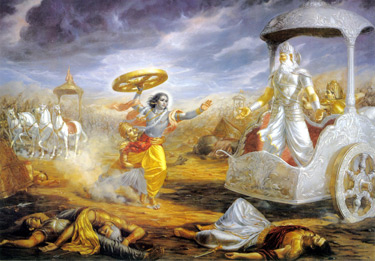
During his conversation with Krishna, Arjuna learns that those who follow the one Lord will become immortal. In the Bhagavad Gita, in the yoga of Wisdom (Chapter 4) these is one of the leading themes and we will start with a quote from an explanation of the Bhagavad Gita:

[...] One who has true union with the Lord is not subject to rebirth. He attains immortality. Such a union can only be achieved when one is free from attachment, fear and anger, being thoroughly purified by right knowledge. The Lord accepts the devotion of all, whatever path they may use to approach  Him. [...]

In this quote the first thing which occurred is "rebirth". As you maybe know in Christianity the idea of rebirth isn't an issue. You can be reborn (as a Christian) during your life, because in Christianity the idea of "rebirth" has to do with choice .... you will be a reborn Christian if you surrender your life to God. That's very different with the idea of the Bhagavad Gita. In Hinduism reincarnation is a strong belief, but (as we can read in the above quote) if the believer has real union with the Lord there is no "rebirth" or "reincarnation" than the believer attains immortality.
"Immortality" is an important issue in the Bhagavad Gita and in several chapters this is be said by Krishna. We those words on immortality he tries to tell Arjuna that he will be immortal as he goes into this all deciding battle to bring peace to the world.

universal experience
walking on the path of wisdom
finding the truth


© Chèvrefeuille

Credits: Bhagavad Gita

The battle in the Bhagavad Gita is a kind of parable of the inner battle to come to enlightenment and that's the goal to reach for Arjuna.

Immortality ... in Christianity that's a theme too, because after dying we enter God's Heavenly Place, the New Jerusalem (as told in the book of Revelations) it's similar to Atman or the Buddhist Nirvana or entering Allah's realm.
As we die ... our soul will be free and immortal, but immortality can only be reached as we have become enlightened (and I think this "enlightenment"-idea can be used for every religious or spiritual path that humankind follows).

Immortality ... is that our goal? Is that what we are striving for?

In the Tarot there is a Great Arcana card titled Death and it's the turning point in the Great Arcana, because the cards before death are all connected to learning the right way to live, the Great Arcana cards after Death are all connected to the right path to grow spiritual ... Death is the gate to immortality.
RWS XIII Death

As we step aside of the Bhagavad Gita and look for a moment to the Tree of Life (Kabbalistic glyph) than we see that Death is in the middle of the glyph, there were Christ Consciousness, the sephiroth Tifareth, has been placed. Also a turning point. Is this what Krishna and Arjuna are having their conversation about? That turning point in life? I think that's what they are discussing ... in the middle of the both armies ... there they have that conversation ... from out of the middle Arjuna has to decide which path he will take ...

I think everyone of us has such points in life in which they had to make a decision which path to take. As I look at myself ... I had such a turning point right at the moment (more than ten (10) years ago) that I became ill because I had made the bad choice to go the path of the occult ... that illness brought me insight ... I had to turn my life in another direction, I let go of the occult and turned to the light to me that was a philosophy based on three things:

+ unconditional love
+ the idea of NaraNaraYana or "in everything and everyone there is God", that's also the reason why I use Namaste often as a greeting.
+ don't do to another one what you don't want to do to yourself


This is what made me who I am now ...

the final frontier
to become newly born -
conquering death


© Chèvrefeuille

This episode wasn't easy to create, but I think I have succeeded ...

This episode is open for your submissions tonight at 7.00 PM (CET) and will remain open until April 12th at noon (CET). I will (try to) publish our new episode, karma, later on. For now ... be inspired and share your haiku with us all.


Wednesday, April 8, 2015

Carpe Diem Special #141, Kala Ramesh's "lotus viewing"


Dear haijin, visitors and travelers,

It's really a honor that I may use the haiku by Kala Ramesh and this month will be exciting because of the journey through the Bhagavad Gita. As asked Kala for permission she emailed me several haiku which I could use and she even had a haiku which fits our Bhagavad Gita theme this month. That haiku is our CD-Special today.

lotus viewing . . .
the flowering
within

© Kala Ramesh

As you maybe know the Lotus stands for inner growth and spiritual growth and that's exactly what the Bhagavad Gita is about. There he stands, Arjuna, in the middle of two great armies. He becomes sad and anxious as he sees those armies and than he and Krishna start a conversation. That conversation will lead Arjuna to that moment that the Lotus, from the depths of the pond grows to the surface of the pond reaching for the sun and than .... the Lotus blooms fully .... Arjuna becomes enlightened and sees the balance between life and dead, between good and evil ... than he sees Atman.

This is what I sense as I read the haiku by Kala, a wonderful and spiritual haiku ... awesome.

Credits: Lotus in full bloom (Dutch website)

As you all know (maybe) the goal of these CD-Specials are to write a haiku in the same sense, tone and spirit as the one given (in this episode the haiku by Kala Ramesh). No need to follow the classical rules, but if you like to do so than ... please feel free.

Here is my attempt to write/compose a new haiku inspired on the one by Kala and in the same sense, tone and spirit as her haiku (I hope).

awakening
at last - Lotuses start blooming
in the old pond

© Chèvrefeuille

A beauty I would say, but that's not up to me of course. Another one which I love to share here also:


lotus flowers
rising from the depths of the pond
everlasting love

everlasting love
like a river flows onwards
uncertain of its goal

uncertain of its goal
rising from the depths of the pond
lotus flowers


© Chèvrefeuille


Well ... enough inspiration I think. Now it's up to you, my dear Haijin, visitors and travelers, to write/compose (an all new) haiku inspired on the haiku by Kala Ramesh trying to catch the sense, tone and spirit ....

PS. The above haiku are from my archives.

This episode is open for your submissions tonight at 7.00 PM (CET) and will remain open until April 11th at noon (CET). I will (try to) publish our new episode, immortality, later on. Than we will go on with our journey and exploration of the Bhagavad Gita.

Carpe Diem Extra #14-2015, call for help


Dear Haijin, visitors and travelers,

As you all (maybe) know I have decided to take every month a weekend off. This month that will be from Friday 17th until Sunday 19th. Last months Jen of Blog it or Lose it filled in those weekends. She is happy to do it again, but maybe there is another Carpe Diem Haiku Family member who loves to be the co-host as I am taking a weekend off.
If you would love to do that than please let me know. I will give you entrance to CDHK and give you the inlinkz code. The only thing you have to do is follow the promptlist, but how you fill in the posts is up to you. You will be the co-host for the regular prompts, so that means you may write three posts.

Would you like to experience what it is to write a daily post ... than this is your chance.

All the best,

Chèvrefeuille, your host.

Tuesday, April 7, 2015

Carpe Diem Ghost Writer #42, 5-7-5 not easy


Dear Haijin, visitors and travelers,

As I was preparing yesterday's post I ran through older posts and I encountered a question by Birgitta of Crazy Art - Photo and Poetry. She asked that question a while ago and I had promised to write a post about it. Until today it had slipt my attention, but today I will try to fulfill my promise. Birgitta her question was about the 5-7-5 syllables rule of haiku. This will not be an easy post, because (as you all know), I am not a fan of the 5-7-5 syllables.

In ancient Japan the common rule was to write haiku in one line (mostly vertical) which was cut in three parts. Every "part" followed the idea of 5-7-5 "onji" or "sound-units". Japanese is a wonderful language which is based on sound as I have explained in our Haiku Writing Techniques chapter 2 "onomatopoeia". a Haiku Writing Technique which is especially for languages based on sounds.

As haiku became more known in the western world we have sought for the right way to translate the Japanese haiku in to our western languages, but the most western languages aren't based on sounds. So western scholars choose to follow the 5-7-5 onji rule by translating it into 5-7-5 syllables, however that made it almost impossible for several languages (including e.g. Dutch). In that time as we westerners started to translate first and later wrote our own haiku the most haiku following the 5-7-5 syllables became artificial, and were called "counted verses".


Every language has its own rules for syllables. In English the rules for syllables are different than e.g. in Dutch or Swedish ... so it's not easy to use the 5-7-5 syllables rule. Several scholars, e.g. Jane Reichhold, introduced the alternative way of composing haiku by bringing up the idea of "a haiku is a poem with three lines following the sequence short-long-short. Others started to bring another way of counting syllables e.g. 3-5-3 syllables, which is more easy to compose.

As you all know I am not a fan of the strict syllables count mostly because of the idea that it is to structured for me and gives to less freedom to compose my haiku ... and becoming artificial. There are several haiku poets of our times who started with that 5-7-5 idea, but during their growth as a haiku poet they more and more got rid of the 5-7-5 rule.
To start with haiku it's ok to use that 5-7-5 rule, but try to loose it after a while, more or less syllables will not harm your haiku ... and it gives you more freedom to compose haiku from your heart. In my opinion using the 5-7-5 rule is really artificial and more with your mind, your brain, and I think poetry has nothing to do with artificiality or your brain. Maybe this is a pure western thought, but I think we, westerners, have re-formed haiku to our western way of thinking, living and so on.

I think we have to let go the 5-7-5 rule and have to try writing haiku as westerners. It's not a "sin" if you don't use the 5-7-5 rule, it's more a blessing to become free of that rule .... it makes haiku (in my opinion) even better and stronger.
Of course that choice is yours. If you love to write your haiku in the 5-7-5 sequence .... than feel free to do so, but it is no obligation. Maybe writing haiku in the 5-7-5 way is a new challenge, to me it is for sure a challenge and not only because of my ideas about, but also because of the fact that I am not familiar enough with the syllables-rules in English.

This was our GW-post for this week and I have a challenge for you all .... Try to write a haiku with the above mentioned 3-5-3 syllables option, a haiku with the 5-7-5 syllables option and a third haiku in the "free-style" as we saw e.g. in the haiku by Santoka Taneda.


Here are my three haiku:

sunflowers
stretch out to the summer sky -
a dog barks

© Chèvrefeuille

As I "count" the syllables of the second line following the Dutch rules, than that line has 7 syllables, but in English the syllables-count is 5 ...

Now I will try to write a haiku following the classical count of 5-7-5 syllables, an oldie:

finally dreams become true
just one peaceful spring night -
blossoms of cherry bloom

© Chèvrefeuille

And finally I will try to write a haiku in the "free-style":

at sunrise
poppies still redder
sacrifice for God

© Chèvrefeuille

Well ... I hope this GW-post has given you all an idea of the 5-7-5 rule and I hope to read wonderful haiku written by you all in response on this GW-post.

This episode is open for your submissions tonight at 7.00 PM (CET) and will remain open until April 10th at noon (CET). I will try to publish our new episode, the second CD Special by Kala Ramesh, later on.

Monday, April 6, 2015

Carpe Diem #701, Ancestors


Dear Haijin, visitors and travelers,

This episode will be not an easy one, because of the idea that there is no afterlife as is told in the Bhagavad Gita. Why afterlife is mentioned here? I will try to explain that.
One of the rules which were given to the world on mount Sinai, the ten commandments, says honor your father and your mother. Is that also meant for worshiping them after they have died? This episode is about ancestors, who we need to cherish, because they were once the seed from which we grew.

It's very common around the globe to worship your ancestors, we have to praise them for all they have done for you ... They have made you who you are now, but what tells the Bhagavad Gita us about this ancestor-worship? Let us take a look at one of the 'verses' in Chapter 9 "The Yoga of The Kingly Science & The Kingly Secret" in 'verse' 25 Lord Krishna says: "The worshipers of the gods go to them; to the manes go the ancestor-worshipers; to the Deities who preside over the elements go their worshipers; My devotees come to Me".

In this we can read that ancestors have to be cherished in your thoughts, but not to be worshiped, because they (the ancestor-worshipers) will go to the manes, the shadow world between life and death, they will never inherited the heavens, or Atman.

This looks very similar with the commandment "to honor your father and mother", when they have left this temporarily life the will inherit Heaven, but we have to honor them always.

What does this tell us? As I stated in our for last episode, hypothetically seen, Christianity has grown, evolved from Hinduism. There are so much similarities .... but that's not for me to say ... scholars will say that and they surely will research it.

Credits: Ancestor Worship

There is a wonderful haiku composed by Issa about worshiping ancestors, the Japanese are very much into ancestor worship they even have a festival for it "O-Bon". The haiku which I love to share here is the following:

tama-dana ni kanarazu kaze no fuku to iu

on the ancestors' altar
without fail
a lucky wind blows 

© Issa

This haiku refers to the O-Bon festival which you can see as similar with our Western "All Souls Night" (Halloween) ... "All Souls Night" is a celebration of the ancestors, of the loved ones with have lost .... in a way .... this western celebration can be seen as ancestor-worship ... and it's based on the Biblical commandment "honor your father and your mother".

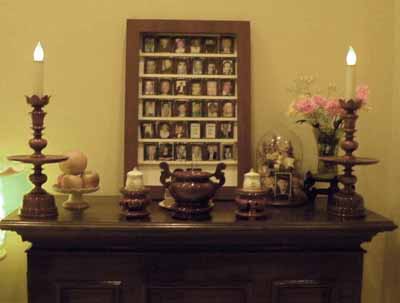
Ancestors we cannot live without them, because without them we didn't exist at all. So ... unlike what Lord Krishna says in the above mentioned verse from the Bhagavad Gita ... ancestor worshipers don't go to the shadows between life and death. To worship your ancestors is part of our life ... I can say that I do honor my ancestors, not in a way of worship, but in the way of cherish their memories who are close to my heart.

on the credenza
the images of ancestors
lighted by a candle

© Chèvrefeuille

This episode is open for your submissions tonight at 7.00 PM (CET) and will remain open until April 9th at noon (CET). I will (try to) publish our next episode, a new Ghost Writer post, later on.

Carpe Diem Extra 2015-#13 Haiku Writing Techniques and Kukai


Dear Haijin, visitors and travelers,

As you maybe remember I love to make an anthology of your responses on the Haiku Writing Techniques. Would you please leave a comment to tell me if you are giving me permission to use your haiku for this Haiku Writing Techniques Anthology?!

Our first Kukai is 'running' and I have had already wonderful entries to the Kukai. Remember that the time for submitting your (new and never published haiku, a maximum of three (3)) haiku will run out on April 15th. So if you would like to submit your haiku for the Kukai than please email your haiku to:

carpediemhaikukai@gmail.com

Please write "kukai2015" in the subject line.

Have a great week,

Chèvrefeuille, your host

Sunday, April 5, 2015

Carpe Diem Time Glass #27, Sunshine


Dear Haijin, visitors and travelers,

Today it's Easter and on this day we celebrate the resurrection of Jesus Christ, but it's also the real start of spring ... Easter brings new hope ... spring brings new life and I hope to see and feel a lot of sunshine this spring.

SUNSHINE is our prompt for this challenging feature in which you have 24 hours to respond and submit your haiku inspired on the prompt and this time a music-video of a song by Matisyahu a reggae singer who uses his Hebrew name on stage. I had never heard of him, but this song is really awesome and fits our prompt as a second skin. Enjoy his music and let it inspire you to write/compose an all new haiku.


This new Time Glass episode is open for your submissions tonight at 7.00 PM (CET) and will remain open until April 6th 7.00 PM (CET). You have just 24 hours to respond .... have fun!