Sunday, November 6, 2016

Carpe Diem Tanka Splendor #7 Teika's third Tanka Writing Technique "Elegant beauty"


Dear Haijin, visitor and travelers,

This month we are exploring the beauty of Tanka, that wonderful 5-lined poem, through the "Ten Tanka Writing Techniques" by Teika. Today I love to share his third Tanka Writing Technique, Elegant Beauty.

Elegant beauty, characterised by harmony, balance, and beauty of cadence
Examples of this style are the poem by Toshyori on Mano Cove, which we saw in our first episode of this month,  and this one from the great poet of the late 7th century - Kakinomoto no Hitomaro from the Kokinshū, #9:409:
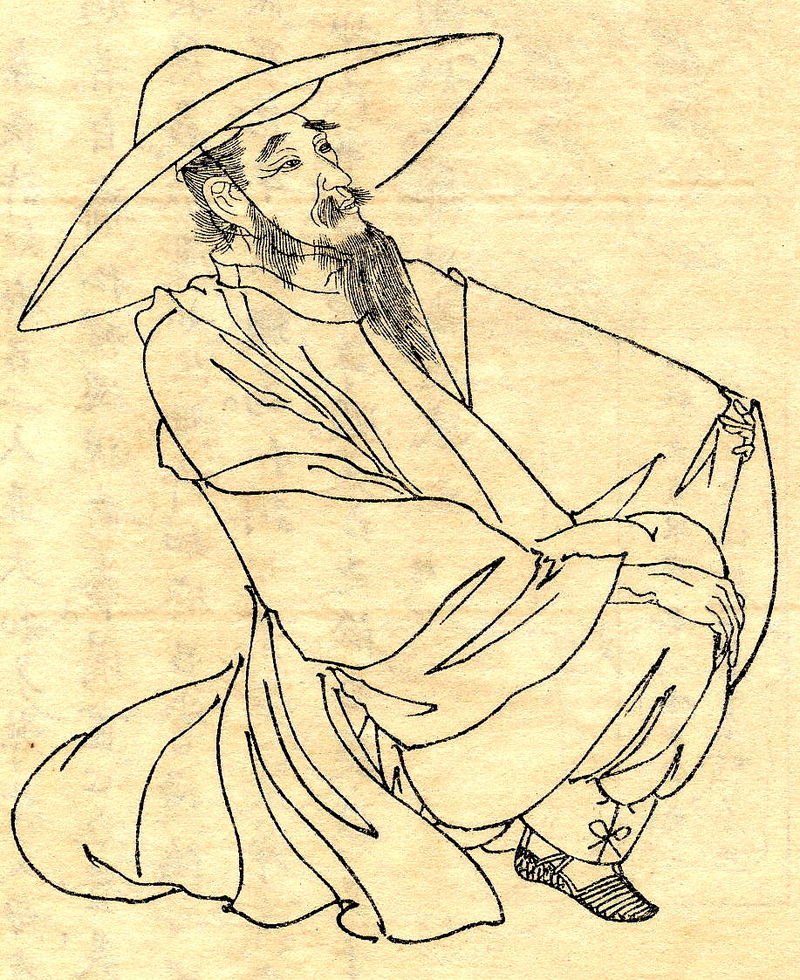
Kakinomoto no Hitomaro
honobono to / akashi no ura no / asagiri ni / shimagakureyuku / fune o shi zo omou

dimly dimly
on the shores of Akashi Bay
morning mist
vanishing by distant islands
longing follows the ship
© Hitomaro
In this tanka you can see the elegant beauty in the smoothness of the scene and the fragile morning mist. And that elegant beauty we can also see / find in the following Japanese Woodblock Print by Hasui Kawase (1883-1957).
Akashi Bay (Japan)
As I prepared this episode of our Tanka Splendor month I thought immediately on a tanka which I wrote a while ago. I think in that tanka this elegant beauty is very well described / used:
Lilies of the valley
their sweet perfume makes me drowsy
hot summer night
between silken sheets her warmth
honeysuckle coolness


© Chèvrefeuille
As I told you in our first Tanka Splendor episode I have chosen a prompt also for every episode about one of Teika's Tanka Writing Techniques ... for today that prompt is "departing geese", but you don't need to use it, you can also choose to use "departing" or "departure" as the theme for your tanka.
Try to create a tanka on "departing" for example and use the Tanka Writing Technique of this episode. As you all know I am not a great Tanka poet, but I love to explore this poetry form further and maybe improve my tanka writing skills.
Willow in autumn
I couldn't come up with a new tanka (yet), so I ran through my archives and found the following tanka in which I think that I caught elegant beauty.
autumn departs
in deep silence willow leaves fall -
tears on this grave
as the willow is green again
another year has gone
© Chèvrefeuille
After a while I thought ... "I cannot conclude this episode without creating a new Tanka". So I have given it a try ...
deep dark forest
seeking for nature’s mysteries –
a new day rises
after a hot and steamy night
she departs … without a kiss
© Chèvrefeuille
Is this elegant beauty? I don't really know, but I think it is. Maybe it's the scene which makes the elegant beauty. I think this one is in balance, but is there also beauty in cadence?

This episode is open for your submissions tonight at 7.00 PM (CET) and will remain open until November 11th at noon (CET). I will try to publish our new episode, dragonfly, later on.
 

Carpe Diem "Make The Haiku Complete" (100) encore, just for fun. "dancing in the moonlight"


Dear Haijin, visitors and travelers,

As you all know I have several special features here at Carpe Diem Haiku Kai and sometimes I just have the urge to share such a feature to "trigger" your imagination and so I thought ... "let's do a surprise episode of Carpe Diem's Make The Haiku Complete.

The goal of this feature is to make the haiku complete which I am giving you. This time I made it a little bit more difficult, because I will give you only the 2nd line of the haiku and than you have to create the first and the third line.

---------------------
dancing in the moonlight
---------------------

On the ---- you have to create the first and the third line.

Dancing
This "encore" is NOW OPEN for your submissions and will remain open until November 11th 10.00 PM (CET). Have fun!

Carpe Diem Tanka Splendor #6 chestnuts


Dear Haijin, visitors and travelers,

First I have to apologize for being a little bit late with this episode. I am on the nightshift so I hadn't time to publish on time.

Tanka was formerly known as waka and to bring some "history" into this episode of our Tanka Splendor month I thought maybe I can tell you a little bit more about waka. In ancient Japanese times it was a custom between two poets (writers) to exchange waka instead of letter in prose. In particular, it was a common use between lovers, mostly in secret affairs. The lovers exchanged waka in the morning when they met each other at the woman's home. These waka were called Kiniginu, because it was thought the man wanted to stay with his lover and when the sun rose he had almost no time to put on his clothes on which he had lain instead of a mattress.
A well known work of this period is the Tale of Genji in which Murasaki Shikibu (the author) uses a lot of waka (795).


Well ... it's always great to tell you a little bit about the background of our wonderful poetry forms. And now back to our prompt for today.
Today our "Tanka Splendor"- prompt is chestnuts. Chestnuts are very common all over the globe and chestnuts have a kind of deeper meaning that fits the idea of tanka being a love poem, because the chestnut's meaning is fertility and desire and it is said that through a kind of ritual with chestnuts you can find the love of your life.
Another meaning tells us that the prickly burrs are the male part of the chestnut, and the fruit inside are the female part. Well ... maybe that's true, the burrs defend the fruits, and that's what man do ... defending women.

The chestnut, as we have seen above, is a great theme for tanka according to its meaning. So I tried it myself to create a tanka, but before that I love to share a haiku by Matsuo Basho with the above mentioned deeper meaning hidden in it:

yoru hisokani   mushi wa gekka no   kuri wo ugatsu

a night secret
a worm under the moon
bores in a chestnut
© Matsuo Basho
I leave it up to you to "discover" the deeper, hidden, love layer in this haiku.

in the twilight
on an open place in the forest
witches dance
the sweet perfume of roasted chestnuts
and entangled bodies


© Chèvrefeuille

This episode is NOW OPEN for your submissions and will remain open until November 11th at noon (CET). I will (try to) publish our new episode, elegant beauty, the third tanka writing technique by Teika, later on.

Carpe Diem Kukai "autumn", last call for submissions


Dear Haijin, visitors and travelers,

The "autumn" kukai is running towards its end, you can submit your three new and never published earlier haiku themed "autumn", until November 10th at 10.00 PM (CET). Send your submissions to our email-address: carpediemhaikukai@gmail.com please write "kukai autumn" in the subject-line.

tears fall
this autumn day
has gone by


© Chèvrefeuille, your host


Saturday, November 5, 2016

Wandering Spirit - mai ejakkeishan iyaazu (education years)


Mai ejakkeishan iyaazu (education years)

After my dad showed me the beautiful garden he created for my mom he took me by the hand. "Come my son", he said. "We have work to do". I looked at him. He for sure saw the questions in my eyes. "I have been to Tokugawa Iemitsu, the shogun, and he has given you permission to go live with him to be educated", my dad answered. I looked up at him. "Are you sure dad?!" He nodded. "Yes, you may start today if you want?" As he saw the big bright smile on my face he knew immediately that he had given me the greatest gift of all.
I was honored that the shogun invited me to live with him, because you had to be at least seven years old, but I was only four years old. My first year at the home of the shogun was awesome. I learned about the wisdom of the Chinese philosopher Confucius. Through the wisdom of this wise man I also learned to write and read and I discovered the beauty of Chinese poetry.
I remember that the first poem I read was "Li Sao" by Qu Yuan, a Chinese poet. It was a kind of allegory, but wonderful to read or actually recited aloud or chanted, because it was written in the "Fu"-style with a strict onji rule. I really was excited to become educated in all that beauty.
As I became five the shogun made me Wakashu*. He shaved my head partially. Now I had a small shaved portion at the crown of my head and long forelocks at front and sides, but the most exited I became as the shogun bought me a new and beautiful kimono with open sleeves. I really was glad to wear this kimono.

One day my father visited me and as he saw that I wore a beautiful kimono he smiled. "You are such a good looking boy Yozakura. I am glad to see that the shogun has made you Wakashu", he said. He hugged me. "The shogun has given me permission to take you with me to visit your mother's grave. She would be so proud to see you! My son ... now a Wakashu." I saw tears on my father's face and that made me even more proud. "Dad ... don't cry", I said. "I know that you are proud. Mother would have been proud too". My father knelt before me. "I am proud my son. You are now accepted in the samourai world. Your lessons will change now. You will learn how to write and paint, but you also will learn the way of battle. And ..." I saw that my dad swallowed in a reflex. "And you will learn ... you will learn directly from the brother of the shogun, Hoshina Masayuki, who is great in martial arts, but also great in philosophy and poetry ... and ... " My father hesitated to go on with his sentence. Again I saw him swallow. "And he will love you dearly".

Hoshina Masayuki
A few years later I finally understood why my dad hesitated to tell me everything as I started my apprentice-ship in the house of Hoshina Masayuki and why he said "he will love you dearly". As I was almost three months an apprentice of Hoshina he asked me if I would be his lover ...

I have learned a lot of Hoshina, not only about battle, but also about poetry, painting, philosophy and politics. And I am still grateful for his teachings. After eight years, short after I turned 13 years, I went back to my father to help him in the grocery he started a few years earlier.

スペアルフローアー・ベリーズ ・テムプティング・ザ・スパローズ・ウィズ・ゼア・カラー・- ・グレイヴャッド・イン・ザ・ミスト
supearufurooaa beriizu temuputingu za suparoozu wizu zea karaa - gureivyaddo in za misuto


spearflower berries
tempting the sparrows with their color -
graveyard in the mist
© Yozakura

to be continued ...

Note:* In the above episode of Wandering Spirit I mentioned Wakashu, this was a common way of same-sex culture in the ancient Samourai class. It was a common use for adult man to have a relationship with minors. Of course in nowadays Japan this isn't an accepted habit as far as I know.

Friday, November 4, 2016

Carpe Diem Tanka Splendor #5 low sunlight


Dear Haijin, visitors and travelers,

What a joy to present a new episode in our Tanka Splendor month. I have alrady read beautiful tanka, but I am still a bit behind with commenting on all of your beautiful poems.
Yesterday I presented our second Tanka Writing Technique by Teika. So let us take a look at the two tanka writing techniques we have already seen here:

Mystery and Depth 
Appropriate Statement

By clicking on the above links you can read the episode again, because in this 5th episode I love to challenge you to create a tanka with the prompt low sunlight in this time of year (autumn) the low sunlight can be very dangerous in traffic for example, but low sunlight can also be interpreted as last sunlight of the day as the sun down is almost over. Low sunlight can give nice and beautiful mysterious scenes, and low sunlight can also be interpreted (with a little twist) as a moment of pleasure or romance.

© photo

Remember tanka was meant for love poems once, of course tanka without that are also tanka in my opinion, but maybe we have to try to stay close to the purpose of tanka ... being a love poem for a secret lover.

Here is my attempt to create a tanka:

the last sunbeams
illuminate the forest path
were I once walked
with the love of my life
loneliness hurts like hell


© Chèvrefeuille

In this tanka I have tried to use both techniques we have learned already and I think I am on the right path to make my tanka stronger and more beautiful.

This episode is NOW OPEN for your submissions and will remain open until November 9th at noon (CET). I will try to publish our new episode, chestnuts, later on. For now ... have fun!


Thursday, November 3, 2016

Carpe Diem Tanka Splendor #4 Teika's 2nd Tanka Writing Technique "Appropriate statement" - prompt: bare branches


Dear Haijin, visitors and travelers,

Welcome at a new episode of our Tanka Splendor month in which we will explore the "Ten Tanka Writing Techniques" by Teika. Today our prompt is the second Tanka Writing Technique by Teika "Appropriate Statement" to which I have "glued" the prompt "bare branches".

Fujiwara no Teika lived in the 13th century and was one of the first tanka poets who shared his thoughts about tanka with the world. He created ten writing techniques to improve his skills (and the skills of others) to write / create tanka.


Appropriate statement

From the former emperor Go-Toba's Secret Teachings, is his statement that the Priest Shun'e said of this style "that a poem should be composed so that seems to glide as smoothly as a drop of water rolling down the length of a five-foot iris leaf". The priest was known to have composed in a smooth quiet manner.

As example is this poem by Shunzei, #16:988 Senzaishū:

sumiwabite / mi o kakusubeki / yamazoto ni /amari kuma naki /yowa no tsuki kana

weary of the world
I thought to hide myself away
in this mountain village
but it reaches every corner of the night
bright radiance of the moon


In this Tanka Writing Technique we can see (and read) immediately that tanka and haiku are in a way the same. The only difference, according to this technique, is the form. Tanka has five lines (5-7-5-7-7) and haiku has three lines (5-7-5), but they both have nature as their most important theme. However ... in tanka we can find mostly a more secret layer on love, sensuality and sexuality, because tanka as we already know was derived from waka, which was a kind of love-poem to share secret love-affairs with.


bare branches colorful leaves fallen a natural quilt thoughts arise ... arouse the senses sharing warmth with the one I love

© Chèvrefeuille

This episode is NOW OPEN for your submissions and will remain open until November 8th at noon (CET). I will try to publish our next episode, low sunlight, later on. For now ... have fun!