Tuesday, March 6, 2018

Carpe Diem #1383 Moses (Musa)


Dear Haijin, visitors and travelers,

Welcome at a new episode of our wonderful Kai in which we are exploring the holy scripture of Islam, the Quran. I have said it several times this month ... there are a lot of similarities between the Quran and other holy scriptures, especially the Bible.
Today I love to look at a very important prophet in the Quran and in the Bible, Moses. You all will (maybe) know the story of Moses, the jewish boy who was placed in the river and became a prince of Egypt. He became the "voice of God" as God decided to free his people from the slavery in Egypt. This same story we find in the Quran, another clue that the Quran is written through the wisdom and knowledge of Muhammed as I stated yesterday in our post, but as I also have said often this month of course I respect the idea that the Quran was given by God to Muhammed, but I also think that everyone has the right to have his / her ideas and thoughts.

Moses (Musa) Persian miniature 15th century

Let me give you the verses for today's inspiration:

[...] "When Moses said to his people: “O my people! Remember the favor of God on you when He made prophets among you and made you kings and gave you what He has not given to any of the other peoples. O my people! Enter the holy land which God has decreed for you and do not turn back, otherwise you would turn about losers”. They said: “O Moses! There is a mighty people in it; we will not enter it until they go out of it. If they go out, we will enter it”. Then two men who fear [God] whom God has given favor to said: “Enter on them by the gate. Once you have entered you will be victorious. Put your trust in God if you are believers”. They said: “O Moses! We will never enter it as long as they are in it. Go you and your Lord and fight. We will sit here”. He said: “My Lord! I do not control other than myself and my brother, so separate between us and the rebellious people”. He said: “It shall then be forbidden for them for forty years in which they shall wander in the earth, so do not grieve for the rebellious people”. [...] (The Chapter of al-Ma’ida (The Table) (5.20-26)

The above verses could have been taken directly from the Bible, because in almost the same words, you find this story in the Bible.

clouds fighting
a spring wind is raging
through nature

© Chèvrefeuille

With this verse I conclude this episode, a short one, just because of lack of time. 

This episode is NOW OPEN for your submissions and will remain open until March 13th at noon (CET). I will try to publish our new episode later on.


Monday, March 5, 2018

Carpe Diem #1382 Adam and Eve


Dear Haijin, visitors and travelers,

Peace be with you. What does it mean to say that? Well ... I think it's a wonderful greeting, because I wish you all peace of heart, mind and soul. This was what made me doubt if I should do a whole CDHK month about the Quran, the Holy Book of Islam. I love everyone unconditional and therefore I also love muslim, but as you all know the last years Islam became a feared religion through IS and that made me sad and doubtful. After thinking it over and over again I decided to create this month full of the wisdom from the Quran. Of course it's not my goal to convert you to Islam, but the Quran is a wonderful Book full of wisdom. Given to the world, especially for muslim, but there are also wonderful words in the Quran that can give peace of mind to everyone, not only muslim.

This month I love to share with you the wonders and beauties of the wisdom in the Quran and of course I will, without losing respect for the Quran, try to find similarities between the religious books we all know. (By the way as you have noticed maybe, I don't use Allah, but God, in our episodes. Not to be disrespectful, but because my philosophy is stated on the idea "All Gods Are One God".


Today I have chosen a verse from Surah 4: Ayah 1 (an-Nisa' or "women"). In this verse we can easily see the story of Adam and Eve as we know it from the Bible. Let me give you first the mentioned verse:

[...] "O people! Fear your Lord, who created you from a single soul, and created from it its mate, and propagated from them many men and women. And revere God whom you ask about, and the parents. Surely, God is Watchful over you." [...] (Surah 4: Ayah 1)

And this is what the Bible says about this:

[...] "So the Lord God caused the man to fall into a deep sleep; and while he was sleeping, he took one of the man’s ribs and then closed up the place with flesh. Then the Lord God made a woman from the rib he had taken out of the man, and he brought her to the man.

The man said,

“This is now bone of my bones
    and flesh of my flesh;
she shall be called ‘woman,’
    for she was taken out of man.”

That is why a man leaves his father and mother and is united to his wife, and they become one flesh." [...] (Genesis 2: 21-24 NIV)

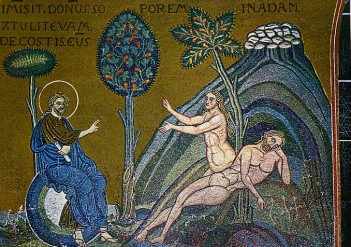
ADAM AND EVE . This mosaic from the Cathedral of Monreale, Sicily, depicts the creation of woman in the Bible. Eve is shown emerging from Adam’s side. Most translations of the Adam and Eve story say that Eve was created from Adam’s rib, but Ziony Zevit contends that she was created from a very different part of Adam’s body.

The creation of mankind is in both scriptures the same, the only thing is the use of the words, but in it's origin the stories are alike.

As I said in earlier posts, Islam is a young religion and there are a lot of similarities with other religions. I however respect the idea that the Quran was given to Muhammed. Is it possible without being disrespectfull to look at this somewhat closer?

In my opinion, without being disrespectfull, I think that Muhammed was a very wise man seeking for inner peace and was wandering around the world to find peace of mind. Than he ran into all the different beautiful religions and philosophies and wrote it down? But isn't that the same statement I have made about the Bible? Because if we look at e.g. Jesus Christ, it sounds like Krishna. Hinduism is in my opinion the oldest religion on earth, except of course the religion of nature.

Isn't that wonderful in this short episode I said "All Gods Are One God" and if we look closer to all the different kinds of religions and analyze them we always arrive at the idea of only one God.

new life rises
after the cold winter
daffodils bloom
taken from her man's body
she was created by God's hand

© Chèvrefeuille

What a story this is ... and what a joy to read this in both the Quran and the Bible. God works in mysterious ways.

Hinduism

I also love to share how man and woman were created according to Hinduism, just to give you an idea, that there are similarities between all the religions:

[...] "He (Yājñavalkya) was not at all happy. Therefore people (still) are not happy when alone. He desired a mate. He became as big as man and wife embracing each other. He parted this very body into two. From that came husband and wife. Therefore, said Yājñavalkya, this (body) is one-half of oneself, like one of the two hálves of a split pea. Therefore this space is indeed filled by the wife. He was united with her. From that men were born." [...] (Brihadaranyaka Upanishad 1.4)

This episode is open for your submissions tonight at 7:00 PM (CET) and will remain open until March 12th at noon (CET). I will try to publish our new episode later on. For now ... have fun, be inspired and share your Japanese poetry with us all.


Sunday, March 4, 2018

Carpe Diem Extra March 4th 2018 a few things I love to share


Dear Haijin, visitors and travelers,

I have a few things that I love to share here with you. First I hope to publish the results of the Troiku kukai later on this week. I am very busy at work, so I cannot guarantee if I will succeed in this ... but we will see.

As I told you earlier this week my mom is hospitalized because cardiac failure. She has had medicines and slowly she is recovering. Thank you all for your warmth thoughts and prayers.

Than I love to invite you to be part in a new Renga session here at Carpe Diem Haiku Kai. Maybe you can remember that we have done this earlier. One of the Renga was titled "In The Twilight". You can find that renga above in the menu or by following this link.


For this new CDHK Renga party I have chosen a haiku written by one of the classic haiku poets, renown haiku poet Matsuo Basho. The haiku, which I love to use, was written in Autumn 1689. The title for this renga is: "best for seeing the moon". As the title of this renga tells us the haiku is a real autumn verse. As you (maybe) know the moon is a seasonword for autumn. In Japan they find the moon of autumn the most beautiful and there are lot of haiku written with the autumn moon. The moon was (and is still) a seasonword for autumn. In my country, The Netherlands, poets find the moon of winter the most beautiful. Maybe that's true, but as a haiku poet I find the moon of autumn the most beautiful and spectacular. Why? I can't say why it's a feeling. Maybe it's because of my interest in the classical haiku, maybe it's because the Japanese haiku poets have written such beautiful haiku about the autumn moon.

Here is the haiku, the hokku of this renga party, by Basho:

let's visit the places
best for seeing the moon
sleeping on a journey


©Matsuo Basho

This haiku was part of a 15 link renga written at the house of Tosai, who lived in Fukui. The renga was recorded by Miyazaki, a disciple of Basho in Ogaki. By the way Miyazaki recorded it in Basho O Tsuki Ichiya Jogo Ku. 


Which places are the best for moon viewing? The shore, the mountains, a Temple or what ever?I look at the moon from my backyard, because I love the sight of the moon rising up above the surrounding houses. It's leaving me in awe as the moon rises just around a chimney. Or as a mysterious circle behind thin clouds. I love the moon of every season, but ... it's true in autumn the moon is the most beautiful.
 
Are you with me? You can subscribe to this CDHK Renga Party "best for seeing the moon" through the comment field. We will create a so called "kasen-renga" (a renga of 36 verses). The subscription for this Renga Party is NOW OPEN and will run to March 18th 10:00 PM (CET). Than I will make the line-up.

Have a nice week and I hope you will participate in this new CDHK Renga Party.

Namasté,

Chèvrefeuille, your host

Carpe Diem #1381 Thunder and Lightning


Dear Haijin, visitors and travelers,

I have said it in earlier posts this month, but there are several similarities between the Quran and The Bible. One of those similarities is the story about the Creation. In the Quran and The Bible the creation stories are completly the same. What does that mean?
We all know that Islam is a young religion (7th century CE) and the story is the same as in the Bible. Of course we know that the Quran was reveealed to Muhammed the Prophet, but can Muhammed be the Prophet of the Christian God? Or is he really a prophet of Allah, I think we have to respect that idea, but I also think we can ask us these questions too.

Did Muhammed knew about the Bible? And was he just another interpreter of the Holy Bible? This could be an explanation of the similarities between the Quran and the Bible. Both holy books tell the story of the Creation.

The Beauty of Nature
 The following verses are from the Surah ar-Ra'd or thunder. Thunder and Lightning is the title of this episode and I have chosen that title, because thunder and lightning are energies "used" by God. Maybe He used it as He was creating the flood that re-created Earth (the story of Noah). The Quran mentions thunder and lightning as a kind of punishment for Earth and its inhabitants.

[...] "It is He who shows you the lightning, causing fear and hope. And He produces the heavy clouds. The thunder praises His glory, and so do the angels, in awe of Him. And He sends the thunderbolts, striking with them whomever He wills. Yet they argue about God, while He is Tremendous in might." [...] (Surah 13: 12-13)

A similar verse we find in the book of Exodus:

[...] "And all the people were watching the thunderings and the flames and the sound of the horn and the mountain smoking; and when they saw it, they kept far off, shaking with fear. And they said to Moses, To your words we will give ear, but let not the voice of God come to our ears, for fear death may come on us." [...](Exodus 20: 18-19)

In both examples we see that the voice of God is heard as thunder and lightning, and that's very similar to the Scandinavian idea of Thor, God of Thunder. Or in that wonderful Hindu book Mahabharata you can find several verses in the same tone with the same idea and emotion.

[...] "Even as he said this, the clouds above thundered and everyone knew that the god of the thunderbolt was coming, and trembled in fear.' [...] (Source: Mahabharata)

Raijin Shinto god of thunder (wooden sculpture)

The same idea is also mentioned in several Shinto scriptures. Often the Shinto god of thunder and lightning is named Raijin (His name is derived from the Japanese words rai ("thunder") and "god" or "kami" (shin). He is typically depicted as a demon-looking spirit beating drums to create thunder, usually with the symbol tomoe drawn on the drums. During a thunderstorm parents say to their children to hide their belly bottoms (navel), because the god of thunder will eat their belly bottom.

All wonderful ideas and thoughts I think, all can be a source for the Quran, but we have to respect the idea that the Quran was given to Muhammed by God.

frogs jump in -
the sound of rain far away
thunder and lightning

© Chèvrefeuille

The Beauty of Nature

Another one also from my archives:

rolling thunder
between green banks
clear waterfall

© Chèvrefeuille

And here is a new one, a tanka this time:

rolling thunder
my heart jumps of love
embracing her
she the one I love so dearly
cries in fear of lightning

© Chèvrefeuille

Well ... I hope you did like this episode and that it will inspire you to create haiku, tanka or other Japanese poetry form.

This episode is open for your submissions tonight at 7:00 PM (CET) and will remain open until March 11th at noon (CET). I will try to publish our new episode later on.


Saturday, March 3, 2018

Carpe Diem Weekend-Meditation #22 Revise That Haiku ... Improve Your Haiku Writing Skills


!!! Open for your submissions next Sunday March 4th at 7:00 PM (CET) !!!

Dear Haijin, visitors and travelers,

Welcome at this belated weekend-meditation. This weekend I love to challenge you to revise two renown haiku by Matsuo Basho. Every one of us will have this experience I think. Sometimes you write a haiku, but a while later you are revising your first version. Nothing wrong with ... even the most renown haiku poets did this, Basho also was known for his revisions. During a period in his life say 1681-1683 he wrote his haiku in the way of the Chinese verse. He left the strict rules of haiku and tried to write his haiku in the Chinese way. After this short period we know that Basho revised his haiku that he had written in the way of the Chinese verse back to the classical way.


This weekend I love to challenge you to revise two of his renown haiku, "frogpond" and "crow". I know that this is quit something to revise these haiku, but remember it's a way of improving your own haiku skills.

old pond
a frog jumps in
sound of water

© Basho (Tr. Chèvrefeuille)

autumn evening;
a crow perched
on a withered bough

© Basho (Tr. R. H. Blyth)

Two really beautiful haiku by the master and now you may revise them. Have a great weekend full of inspiration.


This weekend-meditation is open for your submissions next Sunday March 4th at 7:00 PM (CET) and will remain open until March 11th at noon (CET). I will try to publish our new episode later on.

Background on "a crow perched".


Thursday, March 1, 2018

Carpe Diem #1380 present life


Dear Haijin, visitors and travelers,
Welcome at a new episode of Carpe Diem Haiku Kai. this month we are exploring the Quran as a book of wisdom and as a source for inspiration. Today I have a nice quote from the Quran for your inspiration.
[...] "And cite for them the parable of the present life: it is like water that We send down from the sky; the plants of the earth absorb it; but then it becomes debris, scattered by the wind. God has absolute power over everything.  Wealth and children are the adornments of the present life. But the things that last, the virtuous deeds, are better with your Lord for reward, and better for hope." [...] (Surah 18: Ayah 45 & 46)
autumn leaves in early sunlight

What does this mean? What kind of similarities we can see with other spiritual literature?

Let us take a look at the first Ayah in this quote: It sounds like what Jesus said "I am the water of life" and I think that's what this part of the quote means. God sends us rain to water our crops, without rain it will not grow. And of course we know that the crops will absorb it, but during the seasons it will grow, it will give fruits and finally it will die. In this Ayah we can see the whole circle of life in a few words.
In the second Ayah we can read about how we have to look at life ... like we were children. Isn't that also what is said "Let the children come to me, because Paradise is for those who are like children". Wealth is nice, but it cannot be the ultimate goal. The ultimate goal is what we have done in our life, did we reach the goals imprinted in our soul by the Creator. In this we can also see the idea of reincarnation as is part of Buddhism and Hinduism.
Isn't it a wonder to look at the Quran and try to understand the words, but also the depth in the words? The Quran is a wonderful book full of ancient knowledge ... knowledge we see in other religions and philosophies too, maybe not in the same words, but for sure in the same idea, the same spirit.

departure
following the winding road
circle of life
© Chèvrefeuille
This episode is open for your submissions tonight at 7:00 PM (CET) and will remain open until March 8th at noon (CET). I will try to publish our new episode later on. For now ... have fun!


Carpe Diem Extra - March 1st 2018 Looking forward to the 2nd quarter.


Dear Haijin, visitors and travelers,

We just started with our third month of 2018, but I love to give you all already a sneak preview for the 2nd quarter of 2018. Of course this is a real preview and it's possible that I change a theme, but I don't think I  will change my ideas.

April 2018:

April will be a month in which I will challenge you to create haibun in several forms. Of course I will challenge you to create a classical haibun as e.g. Basho's "Narrow Road", but I will also try a few new forms in this wonderful poetry form e.g kikobun or one-bun. But I also will try to introduce a new haibun form to you all.

One of the Logo's I used for our haibun features
May 2018:

In May I love to go on another journey. This time we will visit South America and we will travel by train through the Andean Mountains. It will be an adventure and we will visit the highest station on this railway ... Galera, on the Ferrocarril Centro Andino at 4781m above sea level. During this journey we will dive into the ancient history of this wonderful continent.

Galera Station, the highest train station in the world
June 2018:

In June we will have a laid-back month in which I love to introduce classical kigo (seasonwords) for summer and maybe a few modern kigo. A wonderful rule of haiku (in my opinion) is the use of seasonwords, but we all know that in modern haiku these kigo aren't really important, but I love to challenge you this month to "re-use" kigo ... maybe I will ask you this month to create classical haiku following the rules. I haven't decided that yet.

I think this 2nd quarter will be an awesome quarter. Of course there will be another Carpe Diem Retreat too which will start on April 15th and will run to May 15th, 30 days of creating haiku (or tanka) on a specific theme. At this moment I haven't chosen a theme, but I will keep you posted.

Well enough to look forward at ...

Namasté,

Chèvrefeuille, your host