Showing posts with label Bhagavad Gita. Show all posts

Monday, October 16, 2017

Carpe Diem #1280 Wheel of Creation


Dear Haijin, visitors and travelers,

Let us go further on our trip along memory lane. We enter a new year in this trip and have arrived at 2015. 2015 Was a wonderful year in which we started to read more and more to seek for the Peace Within. The Peace Within was the reason why we started to read the Bhagavad Gita that wonderful chapter of the Hindu "bible", the Mahabaratha. We started reading in April 2015 and it was a real journey through Hinduism. We disputed Hinduism as the Mother of all Religions, of course just hypothetical.

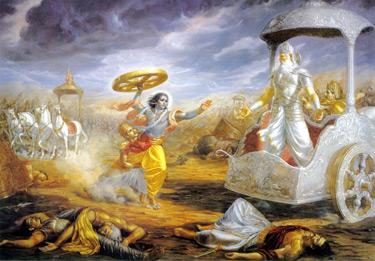
The Bhagavad Gita is a really wonderful story to read. It's the heart of Hinduism. It gives a report from a conversation that Arjuna had with Krishna at the start of a great war between good and evil. Arjuna dares not to start the war, because he sees friend, relatives and family between the army of the enemy. He doesn't want to kill his beloved ones. Than Krishna teaches him the path of life.

During that month we explored nt only Hinduism, but we also tried to find connections between religions and philosophies from all around the world. We even could find connections with the Tarot and the Kabbalah.

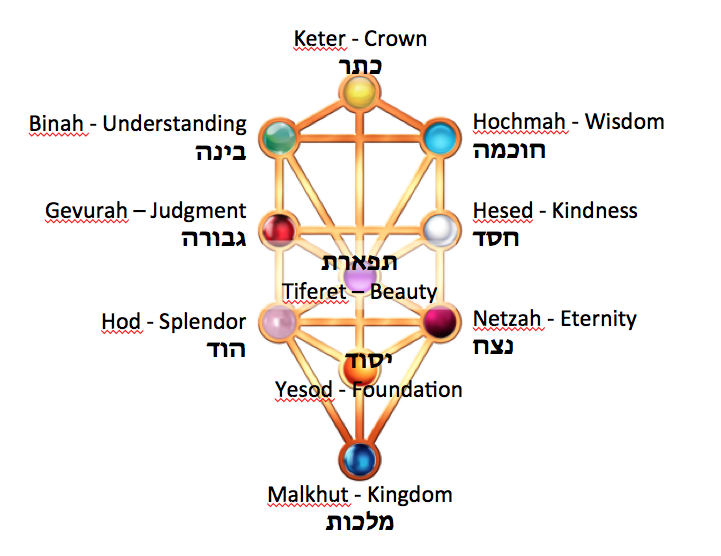
Tree of Life (Kabbalah)
We are on our way to find Peace of Mind and Heart ... and I hope you have found that while we were reading the Bhagavad Gita.

Haiku is not only the poetry of nature, but it is also a way to find that peace. While strolling through nature we become one with nature, become part of nature (as it was once meant to be) and than we experience the beauty of our Earth. We have to cherish her beauty, Earth is the only source to find peace of mind and heart. Isn't that what we all see as our goal?

cherry blossom
long cold night
reborn

© Chèvrefeuille (experimental haiku)

Well ... I hope I didn't sound like a preacher, this was not a sermon, only a flow of thoughts ...

This episode is open for your submissions tonight at 7:00 PM (CET) and will remain open until October 23rd at noon (CET). I will try to publish our new episode, Suzuran, later on. Have fun!


Wednesday, April 29, 2015

Carpe Diem #716, Joy


Dear Haijin, visitors and travelers,

Today we are at the end of our journey through the Bhagavad Gita. We have explored this wonderful "Veda" and maybe you have found the "peace of mind" which was our central theme this month. It's with a little bit of pain in my heart that I write this last episode for April, but at the other hand it's a joy, as is our prompt for today, that this month is over, because this month wasn't easy to make.

We have tried to come in contact with Arjuna, the Archer, and Krishna, the Charioteer, who had a conversation about the goal of life ... Enlightenment. We even dared to step into the hypothetical question "Do all religions and life-philosophies derive from Hinduism, the oldest known religion?" This question stays unanswered, but it was worth to think it over.

Today our prompt is joy and as I started this episode I first thought of an abbreviation which which I once heard, but than I realized that that abbreviation was more based on the Christian believe and I don't think that I can refer to Christianity in our last episode of this "peace of mind" month in which we have read the Bhagavad Gita.
So I decided to reproduce the last 20 verses of the Bhagavad Gita here ... those last verses are full of joy and are giving us a kind of summary of the whole Bhagavad Gita.

50. Learn from Me in brief, O Arjuna, how he who has attained perfection reaches Brahman, that supreme state of knowledge.
51. Endowed with a pure intellect, controlling the self by firmness, relinquishing sound and other objects and abandoning both hatred and attraction,
52. Dwelling in solitude, eating but little, with speech, body and mind subdued, always engaged in concentration and meditation, taking refuge in dispassion,
53. Having abandoned egoism, strength, arrogance, anger, desire, and covetousness, free from the notion of “mine” and peaceful,—he is fit for becoming Brahman.
54. Becoming Brahman, serene in the Self, he neither grieves nor desires; the same to all beings, he attains supreme devotion unto Me.
55. By devotion he knows Me in truth, what and who I am; and knowing Me in truth, he forthwith enters into the Supreme.
56. Doing all actions always, taking refuge in Me, by My Grace he obtains the eternal, indestructible state or abode.
57. Mentally renouncing all actions in Me, having Me as the highest goal, resorting to the Yoga of discrimination do thou ever fix thy mind on Me.
58. Fixing thy mind on Me, thou shalt by My Grace overcome all obstacles; but if from egoism thou wilt not hear Me, thou shalt perish.
59. If, filled with egoism, thou thinks: “I will not fight”, vain is this, thy resolve; Nature will compel thee.
60. O Arjuna, bound by thy own Karma (action) born of thy own nature, that which from delusion thou wishes not to do, even that thou shalt do helplessly!
61. The Lord dwells in the hearts of all beings, O Arjuna, causing all beings, by His illusive power, to revolve as if mounted on a machine!
62. Fly unto Him for refuge with all thy being, O Arjuna! By His Grace thou shalt obtain supreme peace and the eternal abode.
63. Thus has wisdom more secret than secrecy itself been declared unto thee by Me; having reflected over it fully, then act thou as thou wishes.
64. Hear thou again My supreme word, most secret of all; because thou art dearly beloved of Me, I will tell thee what is good. 65. Fix thy mind on Me, be devoted to Me, sacrifice to Me, bow down to Me. Thou shalt come even to Me; truly do I promise unto thee, (for) thou art dear to Me.
66. Abandoning all duties, take refuge in Me alone; I will liberate thee from all sins; grieve not.
67. This is never to be spoken by thee to one who is devoid of austerities, to one who is not devoted, nor to one who does not render service, nor who does not desire to listen, nor to one who cavils at Me.
68. He who with supreme devotion to Me will teach this supreme secret to My devotees, shall doubtless come to Me.
69. Nor is there any among men who does dearer service to Me, nor shall there be another on earth dearer to Me than he.
!! NB. For this month's quotes from the Bhagavad Gita I used the version as given by Sri Swami Sivananda, the founder of the Divine Life Society !!

high above Mother Earth
I feel like an Eagle watching
searching for new life
inside with my Inner Eye
flight of an Eagle


© Chèvrefeuille (published earlier at my personal weblog)


Well ... it wasn't an easy month, but I hope you all did like this month and I am glad that this story could be told here at Carpe Diem Haiku Kai ... And now we are going "on the trail with Basho" next month .... I am looking forward to this new month of CDHK and I hope it will be a great success and a joy.

This episode is open for your submissions tonight at 7.00 PM (CET) and it will remain open until May 2nd at noon (CET). I will try to publish our first episode of our new month, Weather Beaten, later on.

Tuesday, April 28, 2015

Carpe Diem #715, Purity


Dear Haijin, visitors and travelers,

We are counting down, we have just two episodes to go this month in which we were searching for "peace of mind" through reading the Bhagavad Gita and following the conversation between Arjuna and Krishna while they are standing between two armies ready for battle.
The Bhagavad Gita is the most important "veda" for Hinduism, because in the Bhagavad Gita they learn how to become in peace with their own heart, mind and soul. I can only hope that the Bhagavad Gita has given you all a little bit of the "peace of mind", our central theme this month.

Purity is our prompt for today, but what is purity? Is it like a newborn child? Is the purity described here that what we call pure ... as in dark chocolate? Is the purity of white or unconditional love? Purity can be explained in a lot of ways. To me purity is honesty, righteousness, unconditional love, to me purity is the beauty of nature in all her different shapes. To me purity is the most important thought to be your host here at Carpe Diem.
Purity of haiku, that impression of a moment as short as the sound of a pebble thrown into water caught in just three lines. In my response on a comment in our yesterday's post I said: "Without my readers I am nothing. I need my readers to be what I am ... a haiku poet ... that's purity to me.


What is said about purity in the Bhagavad Gita? Let us take a look.

There are a lot of verses about purity. They mostly exist in the last chapter (18) and I ran into a verse which says it all:

"Serenity, self-restraint, austerity, purity, forgiveness and also uprightness, knowledge, realization and belief in God are the duties of the Brahmanas, born of (their own) nature".

In my opinion, without propagandizing my ideas or those in the Bhagavad Gita or in Hinduism, the above verse says it all. Purity could be our savior to bring the world finally ultimate peace, not only peace in mind, but also peace between countries and religions. Purity is the energy which we can use to become better people.

Purity ... in this episode from the ideas and thoughts in the Bhagavad Gita, is also the purity which all religions and life philosophies are seeking for. It is all based on becoming good people. This is what is called "the first triad" in the glyph of the mystical wisdom of the Kabbalah in which the three most important Sephira are gathered "Kether, Binah and Chochma" in those three Sephira purity is all what there is ....

pure of heart
white roses start to bloom
one with the Cosmos


© Chèvrefeuille

Purity ... is a great idea, a great thought, a great feeling ... it is part of us ... we may be pure in everything we do ...

This episode is NOW OPEN for your submissions and will remain open until May 1st at noon (CET). I will try to publish our next episode, joy, later on. For now ... be inspired and share ....

Saturday, April 25, 2015

Carpe Diem #714, Universal Self


Dear Haijin, visitors and travelers,

The final goal of our journey, peace of mind, is almost there and today we do one of our final steps. The Bhagavad Gita is a wonderful and spiritual story and the final goal is that Arjuna finds the meaning of life and death ... his (Arjuna) goal is to become One with all and everything ... he will find it and reach his goal .... Universal Self. One with the Universe, becoming only One with all ... this is what the Bhagavad Gita has to tell us.

We are part of all and everything. We are all one with God (or Spirit, Light ...) and God is one with us. Finally we will be only spirit .... oneness .... In this journey we have seen that through the veils of the Bhagavad Gita and we have seen it ... we are all one. We are all one with nature, not only we are in nature, we are nature ... isn't that wonderful? We are all nature .... as every haiku poet/ess is.
Maybe you can read the Little Creatures episode of today once again ... because Chiyo-ni was also nature ...

What a joy that we are nature, we are ONE with nature and ONE with God .... isn't that what all the religions and life-philosophies are saying? Is this Universal Self the answer on our hypothetical question "Are all religions born from Hinduism, the oldest known religion?
Christians, Buddhists, Muslim, Pentecostals and more are all searching for becoming one with God ... it just can't be different .... Hinduism is the source of all religions. Of course this idea is hypothetical, because I am not a professor in religion and spirituality ... maybe there are scientists who are busy with this idea ... I don't know ...

Credits: Universal Self

no boundaries left
all one with nature, the universe
a new day rises


© Chèvrefeuille

Not a strong verse this time, but as I say it aloud it feels strong and like a mantra ... am I one with the Universe? Have I found (finally) my Universal Self?

This episode is open for your submissions tonight at 7.00 PM (CET) and will remain open until April 28th at noon (CET).. I will (try to) post our new episode, our last haiku by Kala, our featured haiku poetess, later on


Friday, April 24, 2015

Carpe Diem #713, devotion


Dear Haijin, visitors and travelers,

As I was starting to create this episode I realized that I have done an earlier post on devotion. So in a way this will be a kind of reprise prompt, but I think that's ok.
We are busy with reading and exploring the Bhagavad Gita, the story in which Arjuna and Krishna have a conversation about the goals of life, life and death and so on. There they are in the middle of two big armies. Families, friends and teachers who are willing to start a battle against eachother. As Arjuna sees the both armies he isn't sure to start the battle.

The Bhagavad Gita is about devotion. Devoted to Krishna to become a better man. Discovering Self and selflessness. Arjuna learns this right from Krishna himself and that makes him a kind of prophet or even similar to the human idea of Jesus.

In several of our episodes we asked our self the question, hypothetically seen, if all religions have derived from Hinduism, because of the fact that Hinduism is the oldest religion we know of. There are a lot of similarities as we have seen already, but still the questions stays on "Did all religions derive from Hinduism?" That's a great question, but it will not be easy to find the answer, because historians have "made" history to point the Western world to the Romans and Greek as being the base of our history. The Eastern world isn't seen as the base of our history .... In this time the 21st century there are historians who finally are giving the world the insight that there was an Eastern world, that maybe there is a connection with the Eastern world and their religions. That's a very big change of ideas and it will take time to accept that idea.


Back to our prompt for today, devotion. Every one is devoted to something (or someone). For example I am devoted to my patients, but also to haiku. I am not a devotee of some religion, but I belief that there has to be something, a strong spiritual power, that leads me on the path I am going. Devotion to God, Allah, Krishna or what name the gods have, isn't really what I am doing, but of course I respect others who are devoted to something or someone ... and they will respect me (at least that's what I think is the best way to find peace of mind, and maybe peace all over the globe).

That's also the main theme in the Bhagavad Gita, devotion, peace of mind and peace all around the globe. And that's what (again) gives me the idea that our hypothetical question is close to the truth.

chanting their mantra
broomstick and rake in hand
true meditation


(c) Chèvrefeuille

We are almost at the end of our journey through the Bhagavad Gita and we have read and found wonderful insights in this gorgeous story .... just a few days and than we will go "on the trail with Basho" .... I am excited ....

This episode is open for your submissions tonight at 7.00 PM (CET) and will remain open until April 27th at noon (CET). I will (try to) publish our next episode, Universal Self, later on.

Thursday, April 23, 2015

Carpe Diem #712, Lotus


Dear Haijin, visitors and travelers,

What a joy this month gives me, of course it's a tough month to create the episodes, but I love doing it. It's a wonderful story this Bhagavad Gita and I think you all like this themed month too. For today I love to do it a little bit different.

Maybe you can recall our special feature "Carpe Diem Imagination" in which the goal was to create a haiku inspired on a given image (as I do e.g. in the Time Glass feature). As you can read in the title of this episode, Lotus, is our prompt for today and therefore I love to challenge you to create a haiku inspired on an image of the Lotus.

Credits: Lotus
A wonderful image I think and I hope it will inspire you to create an all new haiku. Feel free to use another image of a Lotus or to create a tanka or haiga instead of a haiku.

I have chosen to use a haiku from my archives, so no newly created haiku this time.

spirit grows -
from the bottom of the pond
into the light

into the light
the Lotus reaches from the deep -
spirit grows

© Chèvrefeuille

The stage of growth the lotus flower is in represents a different stage of enlightenment. A closed lotus flower represents the time before enlightenment. A lotus flower fully bloomed and open represents full enlightenment and self-awareness. And that's were it is all about in the Bhagavad Gita. This idea of the Lotus representing spiritual growth we also see in Buddhism.

This episode is open for your submissions tonight at 7.00 PM (CET) and will remain open until April 26th at noon (CET). I will (try to) publish our new episode, devotion, later on. For now .... have fun, be inspired and share your haiku with us all.


Wednesday, April 22, 2015

Carpe Diem #711, Harmony


Dear Haijin, visitors and travelers,

Today our prompt is harmony and it is based on the following verse from the 6th chapter of the Bhagavad Gita:
18. When the perfectly controlled mind rests in the Self only, free from longing for the objects of desire, then it is said: “He is united”.

Without union with the Self neither harmony nor balance nor Samadhi is possible. This is quit the same as the Emptiness idea in Buddhism, but also in the idea of living as a hermit in a lot of other religions or life philosophies. Let us step outside the Bhagavad Gita for a moment and look at the Hermit (IX), one of the cards of the Major Arcana of Tarot. What do we see?


We see an old man, cloaked and hooded, who holds a lantern in his right hand in which a light shines in the shape of The Star of David, two superimposed triangles. In his left hand he has a staff. He stands in the snow somewhere in the mountains as we can see in the background.


He looks like The Fool (0), but is older than The Fool. He is similar with The Fool, but there is a big difference. The Fool gathered his knowledge and wisdom by walking / travelling through the world and to look around him. He saw the beauty of nature, the beauty of God's Creation. The Fool's knowledge is of a low, but lived, level, which I call external knowledge.. The Hermit (IX) gathered his knowledge and wisdom through meditation and contemplation on his own, maybe he used secret scriptures when he sat down to meditate and contemplate or he had spiritual revelations, because he was just alone with God's Spirit. His knowledge and wisdom I use to call internal knowledge on a high level.

Anchorite
contemplates on love
seeking knowledge

s
eeking knowledge
insight the Inner Self
the hermit's choice

© Chèvrefeuille

The Hermit (IX) closes the third trinity of the Major Arcanum and stands for the Holy Spirit. As The Hierophant represents God the Son, the Redeemer who walked among us, The Hermit represents God the Holy Spirit. It's through the Power of the Holy Spirit that we are in touch with our emotions to grow spiritually and physically.
The Light of the World, depicted in this card by the lantern in the right hand, is one of the names of Jesus Christ (Krishna?). His Light shines upon us and He said of that Light: [...] "No one lights a lamp and puts it in a place where it will be hidden, or under a bowl. Instead they put it on its stand, so taht those who come in may see the light"[...] (Luke 11: 33)

There is a similar verse in the Bhagavad Gita 6th chapter verse 19:

“As a lamp placed in a windless spot does not flicker—to such is compared the Yogi of controlled mind, practicing Yoga in the Self (or absorbed in the Yoga of the Self)"
let shine the light
don't hide it under a bowl -
share the Light of the World


© Chèvrefeuille

So The Hermit fulfills this task. He lets the light shine and through that light we can see the ancient knowledge and wisdom in the Tarot, the divine Tarot.
A Hermit lives alone in his cave, home, hut or something else. He lives in absolute isolation of mankind. All his days and nights are for becoming wiser through meditation and contemplation. Through his perseverance he comes in contact with his Inner Self, with the Holy Trinity of Father, Son and Spirit.
As we place The Hermit on the Tree of Life we will find him in Chochmah, the second sephira, right after Kether and before Binah. So he is placed in the same spot as Adam. Chochmah is the sephira of wisdom and it's also similar with the 'Third-Eye'. The Hermit is internal knowledge and wisdom and he knows all the ancient mystical secrets and as we all know so did Jesus.
I told earlier that The Hermit lives in complete isolation of the worldly things and manners. As I was preparing this episode through research, the first thought which came in mind was the Temptation of Christ (Matthew 4: 1-11). In which the devil tempted Him, but He succeeded and withstood the temptation.
Also The Hermit (IX) is tempted to leave his cave, but he didn't because he would learn all and everything about knowledge and wisdom.


Credits: Harmony (one with nature)

Another thing which came in mind as I was reading these verses in the Bhagavad Gita is the Prayer of Christ on the Mount of Olives (Luke 22: 39-46). He beseeches His Father to take the cup away. On that moment He was more human than ever, but He knew that He had to drink the cup.

This can point to open the Inner Self as is meant in the above verses of the Gita. Only when the heart, mind and soul are united than you become in harmony. Is this again part of our hypothetical idea that all religions are deriving from Hinduism?

Harmony in my opinion can reach through all boundaries and maybe we will once say “finally the World is united and in Peace”.
finding peace of mind
the soothing sound of rippling water
the rustling of leaves
strengthens my tired mind
that's fortitude


that's fortitude
deep inner peace, the beating of my heart,
the music of life


the music of life
caught in the rippling stream -
finding peace of mind


© Chèvrefeuille

It wasn't really easy to create this episode on harmony, because it has so much different meanings and ideas ...

This episode is open for your submissions tonight at 7.00 PM (CET) and will remain open until April 25th at noon (CET). I will (try to) publish our new episode, Lotus, later on. For now .... have fun, be inspired and share your haiku with us all.


Sunday, April 19, 2015

Carpe Diem #710, Renunciation


Dear Haijin, visitors and travelers,

After a wonderful weekend off in which Hamish Managua Gunn was your co-host at CDHK I am full of new energy. Thank you Hamish for being our co-host last weekend, you did a great job and I have enjoyed your posts. Maybe another time again? Next month (May 2015) Georgia will be your co-host as I take my weekend off, but that's in the near future. Now we are in the present and we are reading the Bhagavad Gita to (maybe) find peace of mind, as is the theme for this month.

Today it's all about renunciation ... a not so easy to use prompt I think, but maybe the definition for renunciation can help a little bit. This is the definition: an act or instance of relinquishing, abandoning, repudiating, or sacrificing something.

As I re-read this definition than it's obviously that renunciation is an act. An act to give up Self for the greater task in life. That's what Krishna tells Arjuna as they are standing in the middle of the two armies. Let us take a look at the Bhagavad Gita and what it tells us about renunciation.

without sadness
the birds in the sky
rejoice

© Chèvrefeuille


song of a Nightingale


[...] Arjuna asking what is true Sannyasa and true Tyaga (renunciation). In reply to this important and crucial query, the blessed Lord makes it clear to us that real Sannyasa or renunciation lies in renunciation of selfish actions, and even more in the renunciation of the desire or greed for the fruits of any action. Very clearly we are told that selfless and virtuous actions, and actions conducive to the welfare of others should not be abandoned. You must engage yourself in performing such action but renouncing attachment and greed. The true and proper renunciation is giving up of selfishness and attachment while performing one’s legitimate duties. This is called Sattwic Tyaga. We neither hate unpleasant action nor are we attached to pleasurable action. As it is not possible for you to renounce all action, the renunciation of egoism, selfishness and attachment in your activity is declared as true renunciation. Karma does not accumulate and bind one who is thus established in such inner renunciation.

The divine injunction is that God must be made the sole object of one’s life. This is the heart of the Bhagavad Gita. This is the central message in its teaching. This is the one way to your welfare here. Now Sanjaya concludes his narrative by declaring that where there is such obedience as that of Arjuna, and such willing readiness to carry out the divine teachings, there surely prosperity, victory, glory and all blessedness will prevail. [...]

As follows a conversation between Arjuna and Krishna about "Selflessness" and part of this conversation I will reproduce here. (The following verses are from the 18th chapter)

10. The man of renunciation, pervaded by purity, intelligent and with his doubts cut asunder, does not hate a disagreeable work nor is he attached to an agreeable one.
11. Verily, it is not possible for an embodied being to abandon actions entirely; but he who relinquishes the rewards of actions is verily called a man of renunciation.

50. Learn from Me in brief, O Arjuna, how he who has attained perfection reaches Brahman, that supreme state of knowledge.
51. Endowed with a pure intellect, controlling the self by firmness, relinquishing sound and other objects and abandoning both hatred and attraction,
52. Dwelling in solitude, eating but little, with speech, body and mind subdued, always engaged in concentration and meditation, taking refuge in dispassion,
53. Having abandoned egoism, strength, arrogance, anger, desire, and covetousness, free from the notion of “mine” and peaceful,—he is fit for becoming Brahman.
54. Becoming Brahman, serene in the Self, he neither grieves nor desires; the same to all beings, he attains supreme devotion unto Me.
55. By devotion he knows Me in truth, what and who I am; and knowing Me in truth, he forthwith enters into the Supreme.


Arjuna has to let go Self and has to become selfless completely devoted to Krishna if he wants to go to "heaven". He has to become one with Brahman to enter Atman.


Credits: All Gods Are One God

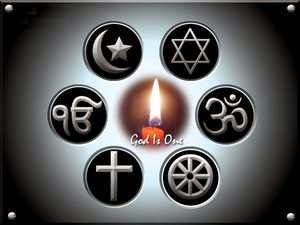
Isn't that also what is said in so many other religions? Is this again a based on the idea that all religions derived from Hinduism? I think so hypothetically ... because there are so much connections to the sacred texts which we (maybe) all know. Is this not what is said in the proverb "All Gods Are One God" .... again a lot to think about, but how to catch this in a haiku?
As you read in the above haiku ... I think we can catch renunciation through nature and all that's living in it, including humans. Although ... humans can choose for renunciation, but nature it self, animals, birds and so on, don't have that choice, because they are all part of the greater .... part of the Creator (as we are too, as we could read in several episodes on the Tarot in 2013). We are all made from "god stuff" ... and that makes us, nature and humans, one.

lost in the forest
wind, sun, trees and birds
one with it all


© Chèvrefeuille

A though episode to write, but I think I have succeeded to make it ... I hope this episode will inspire you to look at nature without Self ... completely in tune with nature ... 


This episode is open for your submissions tonight at 7.00 PM (CET) and will remain open until April 23th at noon (CET). I will try to publish our new episode, another wonderful haiku by Kala Ramesh, later on. For now, have fun!


Wednesday, April 15, 2015

Carpe Diem #707, Pranayana (breath control)


Dear Haijin, visitors and travelers,

We are busy with exploring the Bhagavad Gita to find (maybe) "peace of mind", which is the leading theme this CDHK month. And today we have another nice prompt I think and I think this prompt is essential for coming to peace with yourself and finding the peace of mind which we are looking for through reading the Bhagavad Gita.

Today our prompt is Pranayana (breath control). I don't know if you are familiar with yoga or meditation or something else to focus your heart and mind, but I think breathing is an important way to find peace of mind.
As I look at myself than there are sometimes nights in which I sleep bad, but as I try to focus my mind and heart on my breathing than I mostly fall a sleep finally. Is that what Pranayana means? Let us look at the Bhagavad Gita and see what is said about this ...

[...] Thus, always keeping the mind balanced, the Yogi, with the mind controlled, attains to the peace abiding in Me, which culminates in liberation.
When the perfectly controlled mind rests in the Self only, free from longing for the objects of desire, then it is said: “He is united.”
As a lamp placed in a windless spot does not flicker—to such is compared the Yogi of controlled mind, practicing Yoga in the Self (or absorbed in the Yoga of the Self).
Little by little let him attain to quietude by the intellect held firmly; having made the mind establish itself in the Self, let him not think of anything.
From whatever cause the restless, unsteady mind wanders away, from that let him restrain it and bring it under the control of the Self alone.
Supreme bliss verily comes to this Yogi whose mind is quite peaceful, whose passion is quieted, who has become Brahman, and who is free from sin.
With the mind harmonized by Yoga he sees the Self abiding in all beings and all beings in the Self; he sees the same everywhere.
He who, full of faith and with his inner self merged in Me, worships Me, he is deemed by Me to be the most devout. [...]
(Taken from the 6th chapter from the Bhagavad Gita)


In this quote we can read how one can find peace of mind by concentrating, meditating and contemplating by breath control. In this quote we also can read an idea which we can find in several other religions and philosophies "only the just, free from sin, will enter Atnan", is what it saids. This is very similar to the Christian and Muslim ideas. Again we see a connection with the idea, hypothetically seen, that Christianity and Islam have derived from Hinduism, the oldest know religion. Can it be real? I don't know, but what I know is that I have taken this Pranayana with me as I started meditating a long time ago. And it has brought me joy and peace and happiness ...

with faithfulness
monks resonating their mantra
for the Boddhisatva

dedicated
to the doctrine of emptiness
the monks keep silent

© Chèvrefeuille

These haiku are more related to Buddhism than to Hinduism, but these religions have a lot in common, so I thought I could use these haiku for this episode.

This episode is open for your submissions tonight at 7.00 PM (CET) and will remain open until April 18th at noon (CET). I will try to post our next episode, wisdom, later on.
PS. I can't give my word that I will be on time tomorrow, because than I will be busy with our first Kukai contest.


Monday, April 13, 2015

Carpe Diem #706, Delusion


Dear Haijin, visitors and travelers,

Before I start with our new episode, delusion, I first will explain why I have removed 5-7-5 from the Header and replaced it with "short-long-short". As you all know recently I published a few posts about the 5-7-5 rule of haiku. This 5-7-5 rule IS part of haiku, but I have other ideas about that rule, but that idea brought disunity to our Carpe Diem Haiku Kai family and that's for sure not how I see our Carpe Diem Haiku Kai. We are a community of very different individuals and that is what makes our Haiku Kai. Diversity and wonderful people are our base and I love to make this community of haiku poets a steady community in which everyone, every individual can write/compose his/her haiku as they love to do it and that's why I removed 5-7-5 from the Header. With this explanation I shut the discussion on the 5-7-5 rule. A few last words ... enjoy haiku, it's a wonderful poetry form which is binding us together ... we all love to write and share haiku.

We are on our way to find peace of mind and therefore we are exploring the Bhagavad Gita and today it's all about delusion. Arjuna standing in the middle of the two armies has a conversation with Krishna. Arjuna is disillusioned as he sees the armies in which he has friends, relatives and family standing against each other for battle. Krishna tries to take away the delusion of Arjuna.


Krishna says that whatever exists is nothing but Himself. He is the cause of the appearance of the universe and all things in it. Everything is strung on Him like clusters of gems on a string. He is the essence, substance and substratum of everything, whether visible or invisible. Although everything is in Him, yet He transcends everything as the actionless Self. Prakriti or Nature is made up of the three Gunas or qualities—Sattwa, Rajas and Tamas. These three qualities delude the soul and make it forget its true nature, which is one with God. This delusion, termed Maya, can only be removed by the Grace of the Lord Himself.

As I re-read this than another idea/concept of Maya comes in mind and than I am confused, because in the above quote we read that Maya is delusion, but in the Upanishads I read a completely different concept:

Māyā pre-exists and co-exists with Brahman – the Ultimate Principle, Consciousness. Maya is perceived reality, one that does not reveal the hidden principles, the true reality. Maya is unconscious, Atman is conscious. Maya is the literal, Brahman is the figurative Upādāna – the principle, the cause. Maya is born, changes, evolves, dies with time, from circumstances, due to invisible principles of nature, state the Upanishads. Atman-Brahman is eternal, unchanging, invisible principle, unaffected absolute and resplendent consciousness. Maya is "the indifferent aggregate of all the possibilities of emanatory or derived existences, pre-existing with Brahman", just like the possibility of a future tree pre-exists in the seed of the tree.
I wonder ... can it be that Hinduism is a religion with contradictions? That makes Hinduism as complex as it is. And it becomes very clear that "peace of mind" is not an easy task as Arjuna is experiencing in the Bhagavad Gita.


Can I say that there is a connection with Christianity in this idea of delusion? I don't know but the last words of the first quote "This delusion can only be removed by the Grace of the Lord Himself". Is this delusion of the same level as forgiveness?

peace of mind
lotuses reach for the sun
growing from the dark


© Chèvrefeuille

Not a strong haiku I think, but ... it's a difficult matter to catch delusion in a haiku ....

This episode is open for your submissions tonight at 7.00 PM (CET) and will remain open until April 16th at noon (CET). I will (try to) publish our next episode, a new GW-post based on a haiku by our featured haiku poetess Kala Ramesh (a 'double' episode), later on. For now .... have fun!


Sunday, April 12, 2015

Carpe Diem #705, Debonding (or detaching)


Dear Haijin, visitors and travelers,

I have had a very busy day today, because I have already created two new posts for our Carpe Diem Haiku Kai and this will be the third post. No problemo by the way I love to be your host and I hope you all do like what I am doing and that makes me humble and happy.

We are on a journey through the Bhagavad Gita to explore Peace of Mind, our theme for this month. Today I love to go further with the spiritual growth of Arjuna who is in a conversation with Krishna in the middle of two armies.
I understand that the prompt for today as in the prompt-list given, debonding, is not a common word in English, so I have given the other word for the same thing, detaching, this episode is about "letting go".

Arjuna is anxious and sad as he sees the two armies in which his dearest friends and family-members are gathered standing against each other. Krishna tells him about life and death, good and evil and so on. And he asks Arjuna to "let go", "you are bound to the Earth Arjuna, bound to your friends and family, but you have to let them go to inherit Atman ... you have to detach from your mind and your ideas, follow your heart ... and you will find the Light".

detached
a last leaf falls
the first snow


© Chèvrefeuille

To become who you want to be means making choices and maybe you have to detach from your ideas, feelings and thoughts. Try to look inside you and try to find what is bordering you for example. To go on your path ... it some times will be a time to detach, take another path. Every path you take is good or great ... it will always bring you were you finally want to come.

This episode is open for your submissions tonight at 7.00 PM (CET) and will remain open until April 15th at noon (CET). Have fun!
!! At 7.00 PM (CET) there will be also a new Time Glass on line !!


Saturday, April 11, 2015

Carpe Diem #704, Wheel of Creation


Dear Haijin, visitors and travelers,

Let us go on with our journey and exploration of the Bhagavad Gita to find (maybe) Peace of Mind, as is the theme for this month. Today our prompt is Wheel of Creation and it's very clear that this prompt is about Creation as it is thought in Hinduism.
In the middle between the two armies Arjuna and Krishna are having a conversation and Krishna explains to Arjuna how the world was created and how it will be created again like an everlasting movement.

The Hindu tradition perceives the existence of cyclical nature of the universe and everything within it. The cosmos follows one cycle within a framework of cycles. It may have been created and reach an end, but it represents only one turn in the perpetual "wheel of time", which revolves infinitely through successive cycles of creation and destruction. Within this cycle of creation and destruction of the universe, the soul (atman) also undergoes its own version of cycle called samsara, the cycle of rebirth in which individual souls are repeatedly reincarnated.

In the beginning there was neither existence nor non- existence; there was no atmosphere, no sky, and no realm beyond the sky. What power was there? Where was that power? Who was that power? Was it finite or infinite?

There was neither death nor immortality. There was nothing to distinguish night from day. There was no wind or breath. God alone breathed by his own energy. Other than God there was nothing.

In the beginning darkness was swathed in darkness. All was liquid and formless. God was clothed in emptiness.

Then fire arose within God; and in the fire arose love. This was the seed of the soul. Sages have found this seed within their hearts; they have discovered that it is the bond between existence and non-existence.

Who really knows what happened? Who can describe it? How were things produced? Where was creation born? When the universe was created, the one became many. Who knows how this occurred?

Did creation happen at God's command, or did it happen without his command? He looks down upon creation from the highest heaven. Only he knows the answer -or perhaps he does not know.


(Rig Veda 10:129.1-7)

Credits: Wheel of Creation (Samsara)

As I read these verses from the Rig Veda I immediately saw the Christian idea of Creation in front of me. It's almost the same. Could it be, as we stated earlier, that Christianity has derived from Hinduism, the oldest known religion? That would be a stunning revelation ... because I have learned that Christianity derived from Judaism? If Christianity really derived from Hinduism, than Hinduism is the Mother of all religions ... is that real?

I don't know that of course, it's hypothetical ... but it can ....

departing
cherry blossom petals fall
without sound

without sound
cherry blossom petals ride
on gusts of wind

on gusts of wind
cherry blossom petals, full circle,
the taste of cherries

the taste of cherries
helping me through the cold winter
Sakura blooms again


© Chèvrefeuille

Well ... I hope you did like this episode and I hope it will inspire you all to write/compose an all new haiku.

This episode is open for your submissions tonight at 7.00 PM (CET) and will remain open until April 14th at noon (CET). I will try to publish our next episode, debonding (or detaching), later on.

Friday, April 10, 2015

Carpe Diem #703, Karma


Dear Haijin, visitors and travelers,

I am a bit late today with publishing our new episode, and I am at work, so this will not become a big post. Today's prompt is karma.The concept of karma first appears strongly in the Bhagavad Gita it is a concept in Hinduism which explains causality through a system where beneficial effects are derived from past beneficial actions and harmful effects from past harmful actions, creating a system of actions and reactions throughout a soul's reincarnated lives forming a cycle of rebirth. The causality is said to be applicable not only to the material world but also to our thoughts, words, actions and actions that others do under our instructions.

Credits: Karma (Dutch website)
cherry blossom blooms
after the long cold night
the circle of life


© Chèvrefeuille

Not as strong as I had hoped, but I do like this haiku ... it feels like 'karma', another year has past and the cherry tree has become older and wiser, but blooms again ... open to a new year of growth.

This episode is NOW OPEN for your submissions and will remain open until April 13th at noon (CET). I will try to publish our next episode, Wheel of Creation, later on.

Thursday, April 9, 2015

Carpe Diem #702, Immortality


Dear Haijin, visitors and travelers,

I hope you did like our CD-Special in which I shared a haiku by Kala Ramesh that fits our theme for this month "Peace of Mind". Today we will go on further with our journey, our exploration of the Bhagavad Gita. Today's prompt is not exclusively for Hinduism, today's theme we see in almost every religion or life-philosophy around the globe. Today is about immortality.

During his conversation with Krishna, Arjuna learns that those who follow the one Lord will become immortal. In the Bhagavad Gita, in the yoga of Wisdom (Chapter 4) these is one of the leading themes and we will start with a quote from an explanation of the Bhagavad Gita:

[...] One who has true union with the Lord is not subject to rebirth. He attains immortality. Such a union can only be achieved when one is free from attachment, fear and anger, being thoroughly purified by right knowledge. The Lord accepts the devotion of all, whatever path they may use to approach  Him. [...]

In this quote the first thing which occurred is "rebirth". As you maybe know in Christianity the idea of rebirth isn't an issue. You can be reborn (as a Christian) during your life, because in Christianity the idea of "rebirth" has to do with choice .... you will be a reborn Christian if you surrender your life to God. That's very different with the idea of the Bhagavad Gita. In Hinduism reincarnation is a strong belief, but (as we can read in the above quote) if the believer has real union with the Lord there is no "rebirth" or "reincarnation" than the believer attains immortality.
"Immortality" is an important issue in the Bhagavad Gita and in several chapters this is be said by Krishna. We those words on immortality he tries to tell Arjuna that he will be immortal as he goes into this all deciding battle to bring peace to the world.

universal experience
walking on the path of wisdom
finding the truth


© Chèvrefeuille

Credits: Bhagavad Gita

The battle in the Bhagavad Gita is a kind of parable of the inner battle to come to enlightenment and that's the goal to reach for Arjuna.

Immortality ... in Christianity that's a theme too, because after dying we enter God's Heavenly Place, the New Jerusalem (as told in the book of Revelations) it's similar to Atman or the Buddhist Nirvana or entering Allah's realm.
As we die ... our soul will be free and immortal, but immortality can only be reached as we have become enlightened (and I think this "enlightenment"-idea can be used for every religious or spiritual path that humankind follows).

Immortality ... is that our goal? Is that what we are striving for?

In the Tarot there is a Great Arcana card titled Death and it's the turning point in the Great Arcana, because the cards before death are all connected to learning the right way to live, the Great Arcana cards after Death are all connected to the right path to grow spiritual ... Death is the gate to immortality.
RWS XIII Death

As we step aside of the Bhagavad Gita and look for a moment to the Tree of Life (Kabbalistic glyph) than we see that Death is in the middle of the glyph, there were Christ Consciousness, the sephiroth Tifareth, has been placed. Also a turning point. Is this what Krishna and Arjuna are having their conversation about? That turning point in life? I think that's what they are discussing ... in the middle of the both armies ... there they have that conversation ... from out of the middle Arjuna has to decide which path he will take ...

I think everyone of us has such points in life in which they had to make a decision which path to take. As I look at myself ... I had such a turning point right at the moment (more than ten (10) years ago) that I became ill because I had made the bad choice to go the path of the occult ... that illness brought me insight ... I had to turn my life in another direction, I let go of the occult and turned to the light to me that was a philosophy based on three things:

+ unconditional love
+ the idea of NaraNaraYana or "in everything and everyone there is God", that's also the reason why I use Namaste often as a greeting.
+ don't do to another one what you don't want to do to yourself


This is what made me who I am now ...

the final frontier
to become newly born -
conquering death


© Chèvrefeuille

This episode wasn't easy to create, but I think I have succeeded ...

This episode is open for your submissions tonight at 7.00 PM (CET) and will remain open until April 12th at noon (CET). I will (try to) publish our new episode, karma, later on. For now ... be inspired and share your haiku with us all.


Wednesday, April 8, 2015

Carpe Diem Special #141, Kala Ramesh's "lotus viewing"


Dear haijin, visitors and travelers,

It's really a honor that I may use the haiku by Kala Ramesh and this month will be exciting because of the journey through the Bhagavad Gita. As asked Kala for permission she emailed me several haiku which I could use and she even had a haiku which fits our Bhagavad Gita theme this month. That haiku is our CD-Special today.

lotus viewing . . .
the flowering
within

© Kala Ramesh

As you maybe know the Lotus stands for inner growth and spiritual growth and that's exactly what the Bhagavad Gita is about. There he stands, Arjuna, in the middle of two great armies. He becomes sad and anxious as he sees those armies and than he and Krishna start a conversation. That conversation will lead Arjuna to that moment that the Lotus, from the depths of the pond grows to the surface of the pond reaching for the sun and than .... the Lotus blooms fully .... Arjuna becomes enlightened and sees the balance between life and dead, between good and evil ... than he sees Atman.

This is what I sense as I read the haiku by Kala, a wonderful and spiritual haiku ... awesome.

Credits: Lotus in full bloom (Dutch website)

As you all know (maybe) the goal of these CD-Specials are to write a haiku in the same sense, tone and spirit as the one given (in this episode the haiku by Kala Ramesh). No need to follow the classical rules, but if you like to do so than ... please feel free.

Here is my attempt to write/compose a new haiku inspired on the one by Kala and in the same sense, tone and spirit as her haiku (I hope).

awakening
at last - Lotuses start blooming
in the old pond

© Chèvrefeuille

A beauty I would say, but that's not up to me of course. Another one which I love to share here also:


lotus flowers
rising from the depths of the pond
everlasting love

everlasting love
like a river flows onwards
uncertain of its goal

uncertain of its goal
rising from the depths of the pond
lotus flowers


© Chèvrefeuille


Well ... enough inspiration I think. Now it's up to you, my dear Haijin, visitors and travelers, to write/compose (an all new) haiku inspired on the haiku by Kala Ramesh trying to catch the sense, tone and spirit ....

PS. The above haiku are from my archives.

This episode is open for your submissions tonight at 7.00 PM (CET) and will remain open until April 11th at noon (CET). I will (try to) publish our new episode, immortality, later on. Than we will go on with our journey and exploration of the Bhagavad Gita.

Monday, April 6, 2015

Carpe Diem #701, Ancestors


Dear Haijin, visitors and travelers,

This episode will be not an easy one, because of the idea that there is no afterlife as is told in the Bhagavad Gita. Why afterlife is mentioned here? I will try to explain that.
One of the rules which were given to the world on mount Sinai, the ten commandments, says honor your father and your mother. Is that also meant for worshiping them after they have died? This episode is about ancestors, who we need to cherish, because they were once the seed from which we grew.

It's very common around the globe to worship your ancestors, we have to praise them for all they have done for you ... They have made you who you are now, but what tells the Bhagavad Gita us about this ancestor-worship? Let us take a look at one of the 'verses' in Chapter 9 "The Yoga of The Kingly Science & The Kingly Secret" in 'verse' 25 Lord Krishna says: "The worshipers of the gods go to them; to the manes go the ancestor-worshipers; to the Deities who preside over the elements go their worshipers; My devotees come to Me".

In this we can read that ancestors have to be cherished in your thoughts, but not to be worshiped, because they (the ancestor-worshipers) will go to the manes, the shadow world between life and death, they will never inherited the heavens, or Atman.

This looks very similar with the commandment "to honor your father and mother", when they have left this temporarily life the will inherit Heaven, but we have to honor them always.

What does this tell us? As I stated in our for last episode, hypothetically seen, Christianity has grown, evolved from Hinduism. There are so much similarities .... but that's not for me to say ... scholars will say that and they surely will research it.

Credits: Ancestor Worship

There is a wonderful haiku composed by Issa about worshiping ancestors, the Japanese are very much into ancestor worship they even have a festival for it "O-Bon". The haiku which I love to share here is the following:

tama-dana ni kanarazu kaze no fuku to iu

on the ancestors' altar
without fail
a lucky wind blows 

© Issa

This haiku refers to the O-Bon festival which you can see as similar with our Western "All Souls Night" (Halloween) ... "All Souls Night" is a celebration of the ancestors, of the loved ones with have lost .... in a way .... this western celebration can be seen as ancestor-worship ... and it's based on the Biblical commandment "honor your father and your mother".

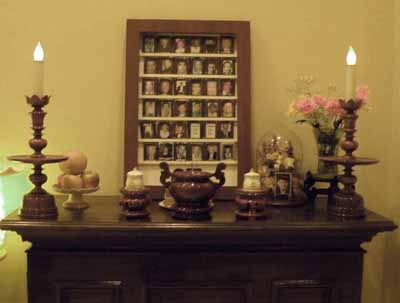
Ancestors we cannot live without them, because without them we didn't exist at all. So ... unlike what Lord Krishna says in the above mentioned verse from the Bhagavad Gita ... ancestor worshipers don't go to the shadows between life and death. To worship your ancestors is part of our life ... I can say that I do honor my ancestors, not in a way of worship, but in the way of cherish their memories who are close to my heart.

on the credenza
the images of ancestors
lighted by a candle

© Chèvrefeuille

This episode is open for your submissions tonight at 7.00 PM (CET) and will remain open until April 9th at noon (CET). I will (try to) publish our next episode, a new Ghost Writer post, later on.